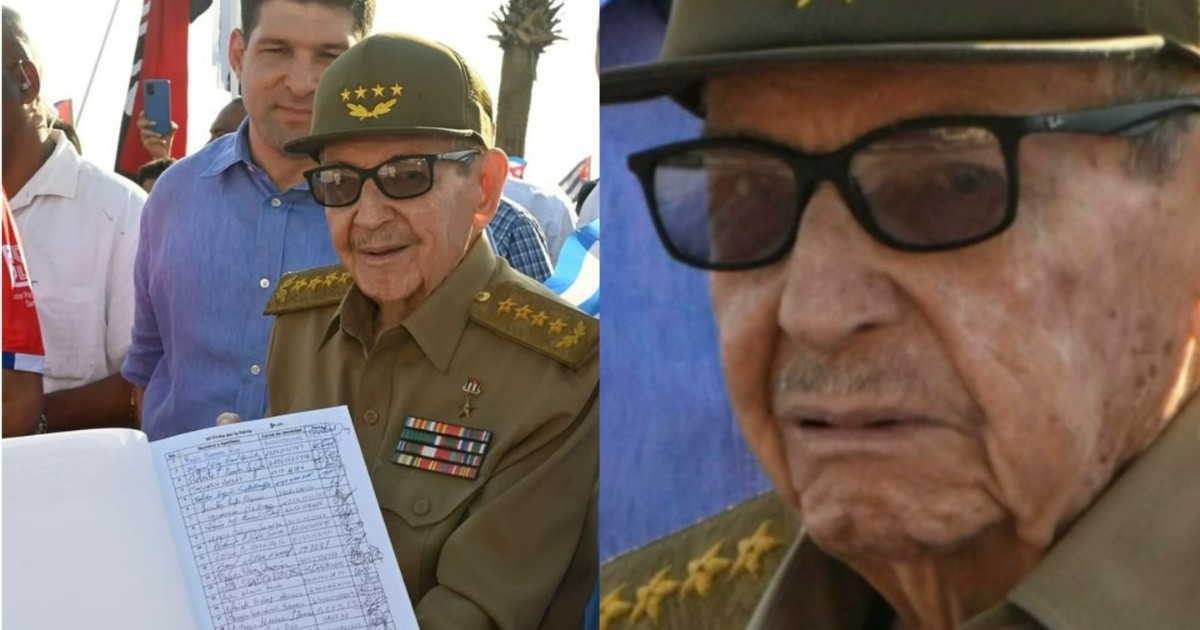
Leticia Martínez Hernández, head of press at the Palace and digital communication advisor to President Miguel Díaz-Canel, shared a series of seemingly edited photos of Raúl Castro on her public Facebook profile. These images, titled "Raúl with our signatures," were released in conjunction with the central event of International Workers' Day at the José Martí Anti-Imperialist Tribune in Havana.
Mario J. Pentón, a Cuban journalist in exile, criticized the photo editing by posting both the original and the altered images, along with the comment: "Someone needs to tell Leticia to ease up on Photoshop; she's overdoing it. The bottom image is the real one," using the hashtag #ridiculous.
The alleged photo touch-up draws attention as Raúl Castro's May Day appearance was his first public outing in five months, since December 2, 2025. At that time, he was described as frail and having difficulty walking during the final session of the National Assembly.
The State of Raúl Castro's Health
Various sources described the 94-year-old former leader as "visibly deteriorated" during the event, which he attended alongside Díaz-Canel near the U.S. Embassy on Havana's Malecón. Díaz-Canel himself admitted in an April interview with Telesur that Raúl is "alive but retired for health reasons" and "fragile due to his advanced age."
Amid this backdrop, the supposed photo edits by his press advisor seem aimed at downplaying the apparent physical decline of the historic leader, as the regime attempts to project an image of vitality and resilience.
Event Highlights and Public Response
The event centered around presenting Raúl Castro with two books containing over 6.2 million signatures from the "My Signature for the Homeland" campaign, launched on April 19 to mark the 65th anniversary of the Bay of Pigs Invasion.
Opposition sources reported low turnout at the march, with allegations of pressure on state workers and students to attend. Testimonies indicated that "the signature is mandatory at workplaces; if you don't sign, you know, you're out."
The event was moved from Revolution Square to the smaller Anti-Imperialist Tribune due to austerity measures and an energy crisis. However, Cuban state media insisted on portraying it as a massive show of public support.
Controversies and Internal Tensions
Leticia Martínez Hernández is no stranger to controversy. In December 2024, she was involved in a dispute with Michel Torres Corona, host of the Cuban Television program "Con Filo," highlighting internal tensions within the regime's communication apparatus.
Raúl Castro did not attend the 9th Congress of the Communist Party of Cuba in March 2026, where Díaz-Canel was reaffirmed as first secretary, fueling further speculation about his health.
This image manipulation adds to a documented pattern of information control by the Cuban state media, in a country ranked 165th out of 180 on the 2025 World Press Freedom Index.
Understanding the Impact of Photo Edits on Cuban Politics
Why was Raúl Castro's appearance significant on May Day?
Raúl Castro's appearance was significant because it marked his first public outing in five months, highlighting his health status amid ongoing political transitions in Cuba.
What was the purpose of the "My Signature for the Homeland" campaign?
The "My Signature for the Homeland" campaign aimed to garner public support and commemorate the 65th anniversary of the Bay of Pigs Invasion, a significant event in Cuban history.
How did the Cuban state media portray the May Day event?
Cuban state media portrayed the May Day event as a large-scale demonstration of popular support, despite reports of low turnout and coercion among attendees.