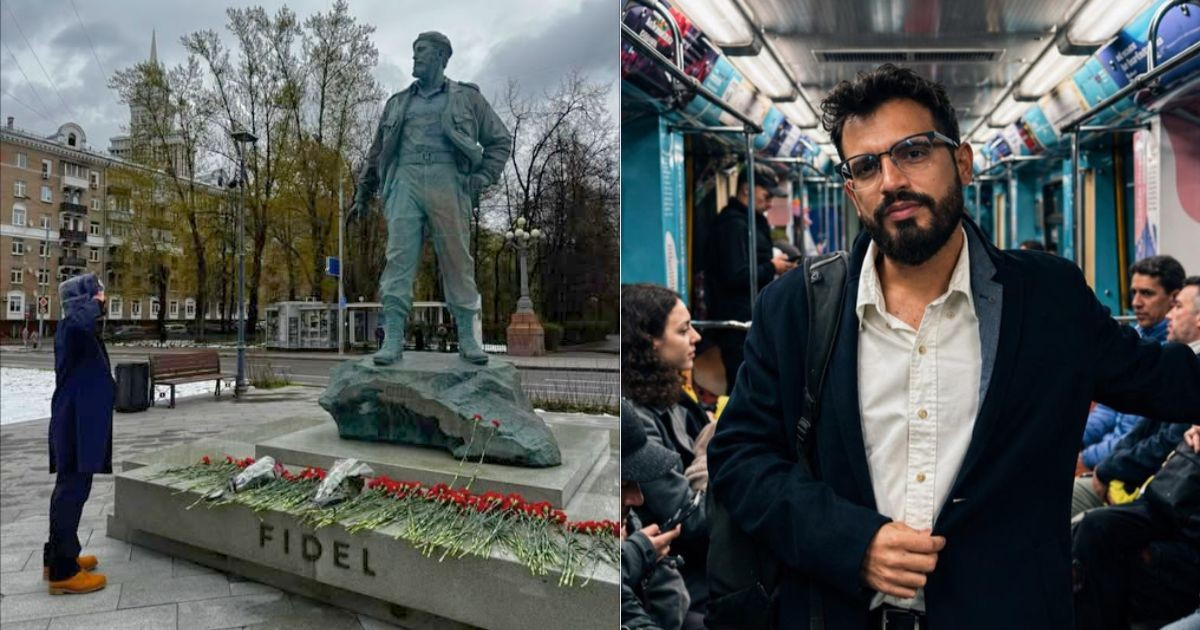
Pedro Jorge Velázquez, a Cuban journalist better known on social media as El Necio, observed International Workers' Day by sharing a "poem" on Facebook from Moscow. In his post, he vowed that the late dictator Fidel Castro would not be forgotten as he approaches the centenary of his birth this year. The post was accompanied by a profile picture of Velázquez standing before the bronze statue of Castro in the Russian capital.
The poem, posted on Friday with the flags of Russia and Cuba as its header, reads as a lyrical conversation between the journalist and Castro. El Necio declares, "We will not let you die in your centennial year. No matter the threats, there is a global memory that will not forget you, and a people ready to give everything for their independence."
He continues, "Today's world only proves you were never wrong. You had everything clear, and we must return to you to understand our duty at this moment. If only they knew back on our small island how much you're talked about everywhere and how much you're missed, Commander."
Velázquez was in Moscow following his participation in the Sovintern Forum, the inaugural meeting of the International Socialist Network, held from April 25 to 27 at the House of Unions in Moscow, with over 300 delegates from 70 countries attending.
During his stay, Velázquez told Sputnik Mundo that there is "much admiration for Putin and the Russian people" in Cuba, citing the Russian oil shipments that temporarily alleviated blackouts in Havana between April 20 and 25.
The irony of the situation is hard to miss: a key propagandist of the Cuban regime pays homage to a deceased dictator from the comforts of Moscow, while Cuban workers marched on Friday under war-like slogans and endured power outages exceeding 20 hours daily. Meanwhile, the GDP is projected to contract by 7.2% by 2026.
The main event for May Day was relocated from Revolution Square to the Anti-Imperialist Tribune, in front of the U.S. Embassy, under the guise of "austerity," as Raúl Castro declared the regime was "ready for the machete charge."
El Necio's post quickly sparked a flood of comments dismantling his revolutionary ode. One user remarked, "He was an extraordinary magician, turning the best country in Hispanic America into a poor island with millions in exile. He brainwashed millions, calling for humility, unity, and work, while living luxuriously in his feudal manor."
Another user pointed out the obvious contradiction with sarcasm: "Why is it that there is always a staunch defender of communism who constantly travels to capitalism? It's like saying you don't eat sugar but are addicted to chocolate." The most resonant question was blunt: "Who funds this guy's travels?"
Others offered perspectives on the celebrated legacy: "Correction: he’s already dead, and in reality, he only served to live like a millionaire king while the rest of the citizens languished in misery." Another was harsh: "He was the best at deceiving everyone."
A more profound comment read, "Don’t you wonder why they have to convince everyone they're good, just, supported? It’s the same need as scammers to sell something they’re not, and by repeating it, they believe it themselves and justify it. One must be truly vile to justify or support a system that hands sticks to groups to oppress their own brothers demanding to live with dignity."
Velázquez, who was subjected to U.S. visa restrictions in February for allegedly participating in harassment campaigns against diplomats, described the measure as a "political reprisal" and stated he had no plans to visit the country. The statue he posed with was unveiled in November 2022 by Vladimir Putin and Miguel Díaz-Canel as a symbol of the alliance between both regimes, and as Castro's centennial—August 13, 2026—approaches, El Necio is gearing up from Moscow, patriotic yet far from the blackouts.
Questions about Fidel Castro's Influence and Legacy
Why did Pedro Jorge Velázquez publish a poem about Fidel Castro from Moscow?
Pedro Jorge Velázquez, known as El Necio, published the poem to commemorate Fidel Castro's upcoming centenary and to express his commitment to keeping Castro's legacy alive. The choice of Moscow as the publication location underscores the historical ties between Cuba and Russia.
What was the public's reaction to El Necio's poem about Fidel Castro?
The poem sparked a wave of critical comments online, with users highlighting the contradictions between praising communism while enjoying capitalist comforts, and questioning the funding behind Velázquez's travels.
What was the significance of the Sovintern Forum in Moscow?
The Sovintern Forum in Moscow was the founding event of the International Socialist Network, bringing together over 300 delegates from 70 countries. It signified a renewed effort to strengthen international socialist ties.