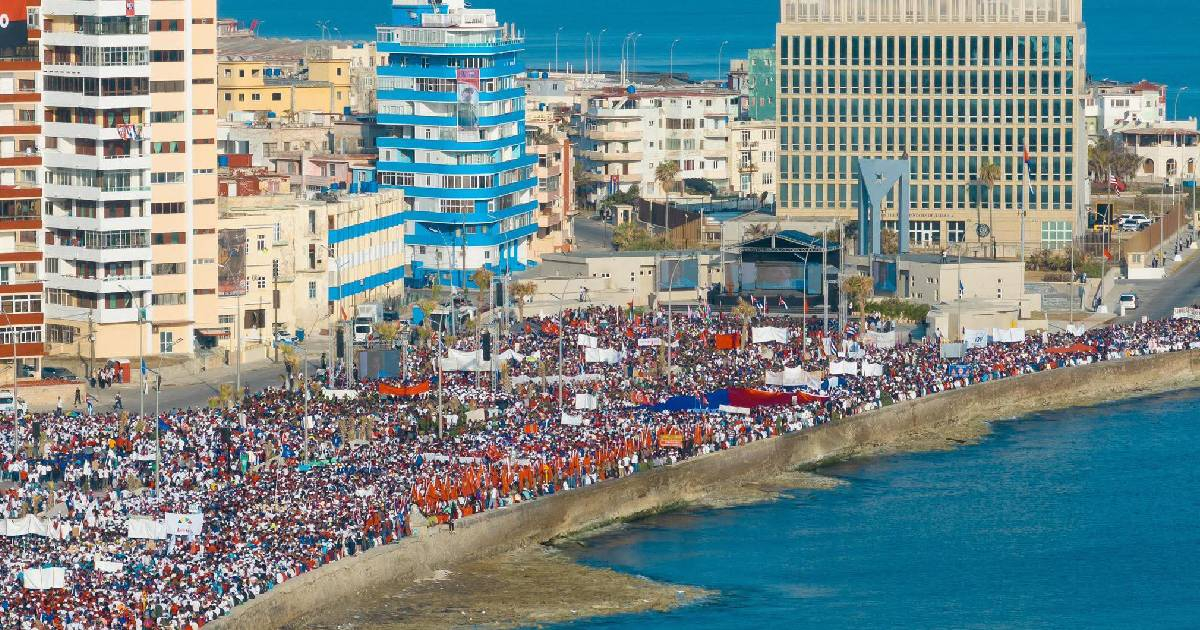
The 2026 May Day march in Cuba, held this Friday, saw a significantly lower turnout compared to previous years. The regime shifted the event from the iconic Plaza de la Revolución to the José Martí Anti-Imperialist Platform, situated in front of the U.S. Embassy along Havana's Malecón. This change was justified under the pretext of "austerity" and the "harsh energy blockade."
Commentator Mag Jorge Castro captured the sentiment of many observers on social media, stating: "They've gone from filling squares with endless parades and speeches to timid early morning marches to avoid the sun," adding that despite the regime's continued coercion and pressure on millions of state workers, it cannot hide its downfall.
The event was led by Miguel Díaz-Canel, alongside Lis Cuesta, Bruno Rodríguez, and Roberto Morales Ojeda. Raúl Castro was also present, presiding over the day's political activities.
Shift in Venue and Timing Raises Eyebrows
Osnay Miguel Colina Rodríguez, the organizer, defended the venue change, citing "austerity" and the "harsh energy blockade." However, critics and analysts interpreted this as an implicit admission of the regime's inability to gather crowds as it once did.
The march took place unusually early, during the pre-dawn and morning hours, a move seen as an effort to avoid the heat and to downplay the sparse attendance. Security was visibly heightened on Havana's streets during the event.
Pressure Tactics and Detentions Highlighted
In stark contrast to past years, the regime had previously claimed that four million Cubans marched nationwide in 2024. To ensure attendance this year, authorities resorted to familiar pressure tactics: reports emerged of children being taken from schools to participate in local marches in San Miguel del Padrón and Santiago de Cuba.
Additionally, independent journalist Ángel Cuza, affiliated with CubaNet, was arrested on April 30th in front of his daughter by State Security agents. This was described as part of a systematic pattern of preventive detentions ahead of politically sensitive dates.
Official Narrative and Economic Struggles
The event was framed under the official slogan "The Homeland is Defended" and dedicated to the centennial of Fidel Castro's birth, the 65th anniversary of the Victory at Playa Girón, and the 22nd Congress of the Central de Trabajadores de Cuba.
A video released by the regime featured a Ministry of Energy and Mines official blaming the country's severe crisis on the "intensification of the blockade and the energy siege imposed by the U.S. government," sidestepping the regime's 67 years of dictatorial mismanagement.
Cuba is currently enduring power outages lasting between 10 to 25 hours daily, a transportation collapse, and widespread shortages. An economic contraction of 7.2% is projected for 2026, making it increasingly challenging for the regime to sustain the illusion of massive popular support, even on its most emblematic day of mobilization.
Understanding Cuba's May Day March 2026
Why was the May Day march in Cuba moved to a different location in 2026?
The regime moved the event from Plaza de la Revolución to the José Martí Anti-Imperialist Platform, citing reasons of "austerity" and the "harsh energy blockade."
What tactics did the Cuban regime use to ensure attendance at the May Day march?
Authorities employed pressure tactics, including removing children from schools to participate in marches and engaging in preventive detentions of independent journalists.
How is the current economic situation in Cuba affecting public events like the May Day march?
Cuba faces severe economic challenges, including daily power outages, transportation issues, and a projected economic contraction, which complicates efforts to maintain the appearance of widespread public support.