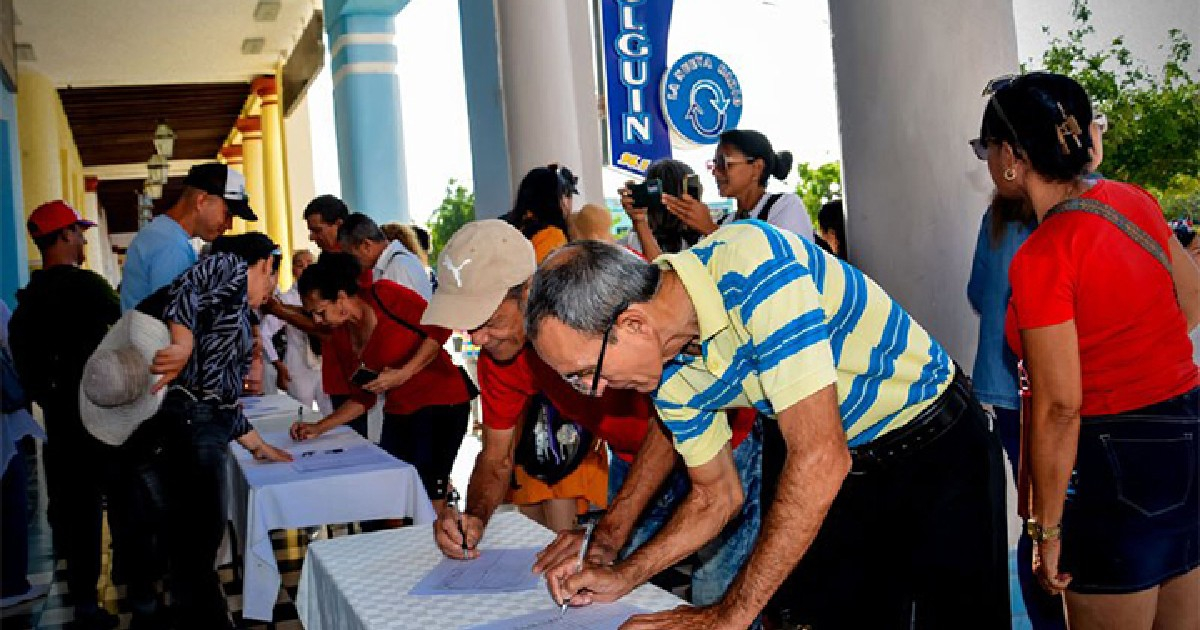
The Cuban regime announced on Friday, during the May Day celebrations, that it had gathered 6,230,973 signatures in the "My Signature for the Nation" campaign. This initiative is portrayed as a massive show of support for national sovereignty and opposition to the U.S. embargo.
The Cuban Presidency declared the figures with the statement, "Over 6 million Cubans have signed for the Nation!"
In a symbolic gesture, the books containing these signatures were handed to Miguel Díaz-Canel during the main event of May Day. This year, the event took place at the Anti-imperialist Tribunal José Martí, located opposite the U.S. Embassy on Havana's Malecón, diverging from the usual venue, the Plaza de la Revolución, citing "austerity" due to the ongoing energy crisis.
The Controversial Campaign's Origins
Launched by the Communist Party of Cuba on April 19, coinciding with the 65th anniversary of the Bay of Pigs invasion, the regime presented the campaign as a spontaneous civil society effort. Nonetheless, it was Díaz-Canel who first signed on April 20 at the Ciénaga de Zapata Memorial Museum in Matanzas, asserting that "the Cuban Revolution will never negotiate its principles."
Coercion Allegations Surface
Despite its portrayal as a voluntary initiative, the campaign has been marred by accusations of systematic coercion. Independent media outlets reported that state enterprise managers were under pressure to secure an 80% signature rate among employees, with threats of dismissal for non-compliance. An anonymous source bluntly stated, "Signing is mandatory at work centers; if you don’t sign, you know the consequence—you're out."
Reports also indicated pressure in local bodegas, educational institutions, and through the Committees for the Defense of the Revolution. On April 24, a Cuban woman publicly refused to participate, calling it "another government circus," and declared, "My dignity is not up for signature." Her stance was followed by another viral incident where a man confronted his local CDR, refusing to partake.
May Day March and Historical Context
The May Day march was dedicated to the centennial of Fidel Castro's birth, the Bay of Pigs anniversary, and the 22nd Congress of the Central Workers' Union of Cuba. Díaz-Canel led the march with his wife Lis Cuesta, Foreign Minister Bruno Rodríguez, Roberto Morales Ojeda, General Raúl Castro, and members of the Politburo. Prime Minister Manuel Marrero Cruz called for a "machete charge" and praised workers who "remain steadfast."
This campaign emerges amid Cuba's worst economic crisis in decades: the GDP has shrunk by 23% since 2019, the electricity generation deficit exceeds 1,900 MW, ten out of sixteen thermal power plants are nonoperational, and power outages can last up to 24 hours daily.
The move echoes a similar tactic from 2002 when Fidel Castro's regime orchestrated the collection of eight million signatures to declare socialism "irrevocable" in the Constitution. This was a counter to Oswaldo Payá's Varela Project, which had gathered over 11,000 signatures seeking democratic reforms. The National Assembly unanimously approved that constitutional amendment on June 25, 2002.
Understanding Cuba's Signature Campaign
What is the "My Signature for the Nation" campaign?
The "My Signature for the Nation" campaign is a government-led initiative in Cuba aimed at demonstrating popular support for national sovereignty and opposing the U.S. embargo.
How has the campaign been perceived in Cuba?
While the Cuban government promotes it as a spontaneous civil effort, there have been widespread reports of coercion, with individuals feeling pressured to sign under threat of job loss or other repercussions.
What historical precedents exist for this campaign?
A similar campaign occurred in 2002 when Fidel Castro's regime collected eight million signatures to entrench socialism in the Cuban Constitution, countering a reform initiative led by dissident Oswaldo Payá.