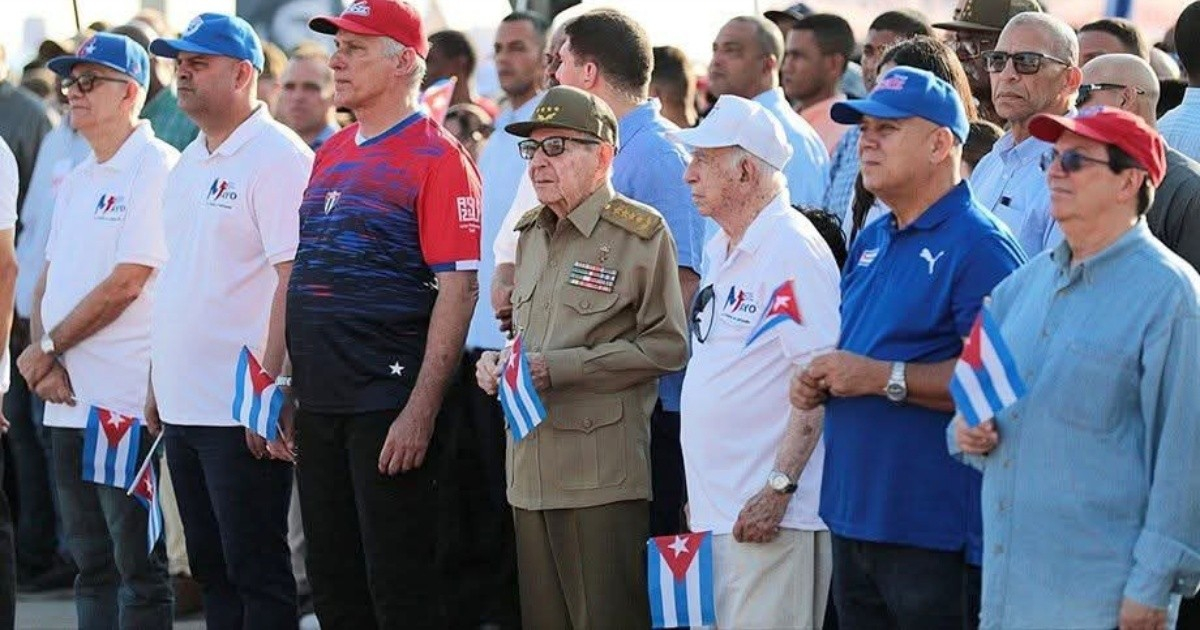
Raúl Castro, at the age of 94, made a public appearance on Friday to lead the main event for International Workers' Day at the José Martí Anti-Imperialist Tribune, directly opposite the U.S. Embassy on Havana's Malecón. This marks his first public sighting since December 2025.
Accompanying the historical leader of the Cuban regime was Miguel Díaz-Canel, the First Secretary of the Communist Party of Cuba and the country's president. Also present were members of the Political Bureau, representatives from the Revolutionary Armed Forces, the Ministry of the Interior, the Union of Young Communists, and various mass organizations.
The official account of the Cuban Presidency on social media platform X reported that more than half a million people gathered under the slogan "Defend the Homeland." However, this figure, provided by the regime itself, lacks independent verification.
Raúl Castro's appearance holds significance as his last documented participation in an official event was on December 2, 2025, during the final session of the National Assembly, where he was described as "frail and having difficulty walking."
He was notably absent from the 9th Congress of the Communist Party in March 2026, where Díaz-Canel was reaffirmed as the first secretary. In an April interview with Telesur, Díaz-Canel acknowledged that Raúl is "alive but retired for health reasons" and is "frail due to his advanced age."
Shift in Venue for May Day Celebration
This year, the central event was moved from the Plaza de la Revolución to the smaller capacity José Martí Anti-Imperialist Tribune, a venue established in 2000 during the Elián González affair. Osnay Miguel Colina Rodríguez, head of the organizing committee of the Central Workers' Union of Cuba, attributed the change to "austerity" and the "severe energy blockade."
Critics argue that the venue shift aims to mask the actual low turnout amid economic collapse and social fatigue. Workers, organized into 15 unions, began their march at dawn from four different points in Havana: 23 and 2, Avenida Salvador Allende and Infanta, Antonio Maceo Park, and Prado and Malecón.
Militarization Amid Economic Hardship
The event aligns with the regime's declaration of 2026 as the "Year of Defense Preparation," a direct response to threats from President Donald Trump. On March 28, Trump stated in Miami that "sometimes military force is necessary, and Cuba is next."
The National Defense Council has approved plans to transition to a state of war, and the regime has been conducting weekly military exercises. Raúl Castro issued a message declaring readiness "to charge with machetes" as "one more fighter against the enemy and our own mistakes."
The military posturing starkly contrasts with the harsh reality faced by the Cuban people: daily blackouts ranging from 10 to 25 hours, widespread shortages, and an economy projected to shrink by 7.2% in 2026.
On the eve of the parade, independent journalist Ángel Cuza was arrested in front of his daughter in Havana by State Security agents. Additionally, children were removed from schools in San Miguel del Padrón and Santiago de Cuba to participate in pre-event marches.
Understanding Recent Developments in Cuba
Why was the May Day event moved to a different location in Havana?
The event was moved to the José Martí Anti-Imperialist Tribune due to reasons cited as "austerity" and a "severe energy blockade," according to the organizing committee. Critics, however, suggest the shift was to hide low participation amid economic and social challenges.
How does Raúl Castro's presence impact the political landscape in Cuba?
Raúl Castro's appearance is significant as it marks his first public event since December 2025, suggesting his continued influence despite being described as frail and retired for health reasons.
What are the current challenges faced by the Cuban population?
Cubans are enduring daily power outages lasting between 10 to 25 hours, widespread shortages, and an economy expected to contract by 7.2% in 2026, adding to the country's ongoing hardships.