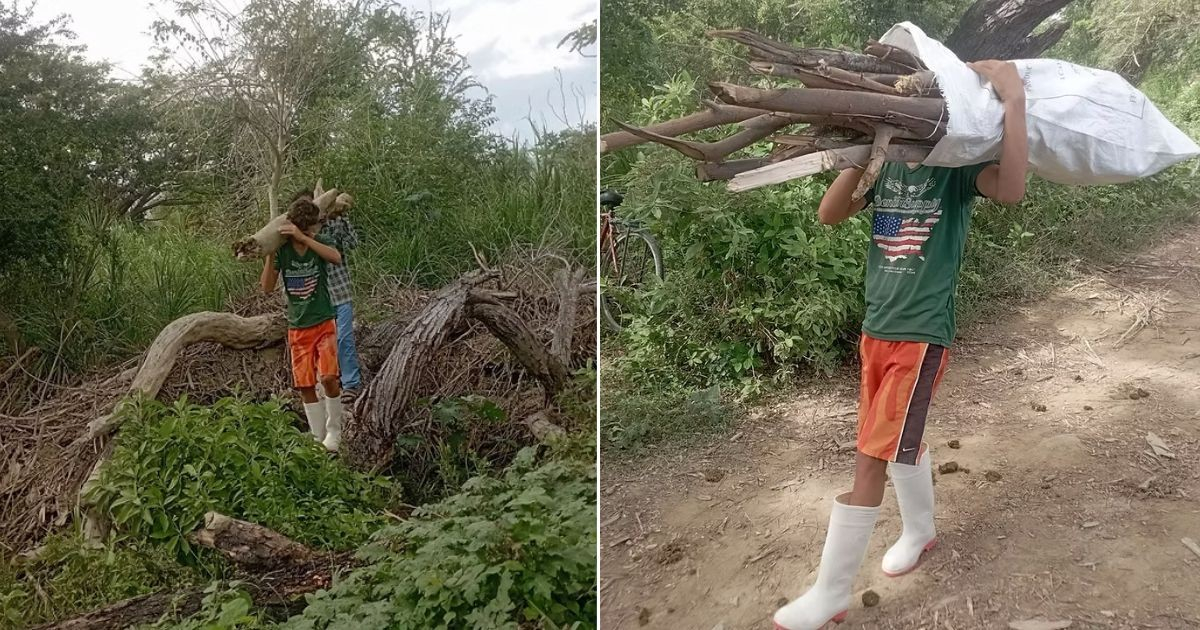
At just 16 years old, Joaquín faces a daily dilemma that no teenager should endure. Living in eastern Cuba, his mornings start not with schoolbooks, but with a trek into the wilderness to gather firewood, essential for his family’s cooking.
His story, recently highlighted by the Food Monitor Program, paints a stark picture of how the Cuban regime's energy crisis has stripped an entire generation of children of their childhoods.
Joaquín's household consists of three members: himself, his mother, and his grandmother. As power outages have become a regular occurrence, firewood has turned into the sole reliable source of fuel for cooking.
The Burden of Firewood Collection
For many families, especially in rural areas of eastern Cuba, the reliance on firewood has surged, often placing the burden of its collection on the shoulders of children and teenagers.
"It's no easy task; I walk long distances, borrow a machete, and it's exhausting. Sometimes, a neighbor helps, but he's not always available," Joaquín shares.
Instead of attending school, Joaquín bears the weight of ensuring his family can cook their meals, risking his education in the process.
Firewood as a Means of Survival
Joaquín has also turned this necessity into a small income opportunity. Each sack of firewood fetches 500 Cuban pesos, which amounts to less than a quarter of the national minimum wage of 2,100 pesos.
"Yes, firewood can be sold. If I gather two sacks, I keep one for our use and sell the other. But finding enough wood requires going further each time, so I can't sell everything I collect," he explains.
There are significant physical risks involved in his work. The areas where he gathers wood—riverbanks and farm peripheries—are becoming increasingly hazardous as accessible wood becomes scarce. Joaquín undertakes this labor without any protective gear.
"Once, I cut my foot and had to walk a kilometer while holding a cloth to the wound. It's dangerous, but I'm not afraid," he states.
Widespread Child Labor Amidst Crisis
Joaquín's plight is not unique. Many Cuban teenagers are forced to abandon school to work in construction, street vending, or wood collection in a nation where 89% of families live in extreme poverty, and basic living costs exceed 50,000 pesos per month.
Although Cuba's laws prohibit child labor, setting the minimum age at 17, these regulations are largely ignored.
The electrical shortfall reached 1,850 MW daily in April 2026, exacerbated by the shutdown of the Antonio Guiteras thermoelectric plant and the cessation of Venezuelan oil supplies in January. Over nine million Cubans now cook without reliable access to gas or electricity.
Environmental Consequences of the Crisis
The environmental repercussions are equally severe. Deforestation and fires are delivering a triple blow to Cuba’s forests. Between 2021 and 2024, the country lost 42,000 hectares of natural forest, with reforestation efforts dropping from 12,615 hectares in 2020 to 8,191 in 2024.
The Food Monitor Program encapsulates the issue with a pressing question: "What kind of country will remain for Cubans when we've exhausted its biodiversity in our struggle to survive?"
Understanding the Crisis in Cuba
Why is firewood essential for cooking in Cuba?
Due to ongoing power outages and the lack of stable access to electricity or gas, many Cuban families, especially in rural areas, rely on firewood as their primary source of fuel for cooking.
How does the energy crisis affect Cuban children?
The energy crisis forces children like Joaquín to focus on collecting firewood instead of attending school, impacting their education and exposing them to physical risks.
What are the environmental impacts of increased firewood use?
The increased reliance on firewood is leading to deforestation and environmental degradation, with significant loss of forested areas and a decrease in reforestation efforts.