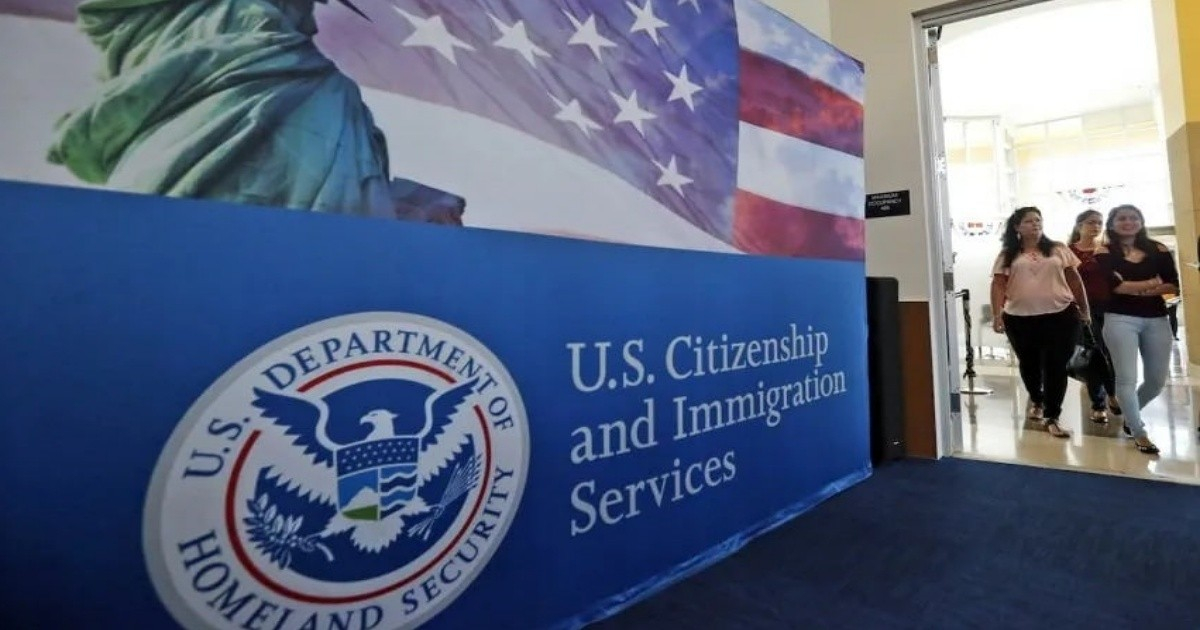
The U.S. Citizenship and Immigration Services (USCIS) implemented a new security verification system from the FBI last Monday, requiring the resubmission of previously filed fingerprints for millions seeking immigration benefits.
This directive has led to a halt in case adjudications, impacting approximately 12 million applications currently in the system, as reported by Univisión.
Zach Kahler, a spokesperson for the agency, stated, "USCIS has adopted enhanced security measures to strengthen the verification and evaluation of applicants by expanding access to federal criminal databases. The processing continues as we apply these improved background check requirements. Any delay in issuing decisions should be brief and resolved shortly."
The measure stems from an executive order signed by Trump in February 2026, titled "Protecting the National Security and Well-being of the United States and its Citizens from Criminal Actors and Other Public Safety Threats." It mandates the Department of Homeland Security (DHS) to access criminal history records maintained by federal criminal justice agencies, including the FBI.
An internal directive circulated the week of April 21 instructs USCIS officials to forward pending immigration benefit applications—such as asylum, permanent resident cards, and citizenship—to the new FBI system, known as Next Generation Identification (NGI). Officials are advised to "refrain from approving any pending cases that have not undergone these expanded background checks," according to CBS News.
Applicants are not required to take any additional action since the fingerprint resubmission is executed internally by the agency's officials.
Impacted Immigration Applications
The affected applications encompass status adjustments (Form I-485), naturalizations (N-400), both affirmative and defensive asylums, and sponsorship petitions for family members or fiancés of citizens or permanent residents.
Processing times were already worsening prior to this new halt: renewing a permanent resident card took at least 10.5 months; an I-130 petition for a citizen's spouse, 62 months; and naturalization between seven to ten months, depending on the city.
By the end of fiscal year 2025, on September 30, USCIS had accumulated 11,651,012 pending cases, compared to 11.3 million recorded at the end of June that same year.
Cuban Nationals Face Severe Impact
The effect on Cuban nationals is particularly harsh. Permanent residency approvals for Cubans plummeted by 99.8% from October 2024 to January 2026: from 10,984 approvals in February 2025 to merely 15 in January 2026, with over 7,000 applications received in that month alone.
In December 2025, the government had already suspended all immigration processes for citizens from 19 restricted countries, including Cubans, halting the processing of residencies and citizenship applications.
Immigration attorney Rosaly Chaviano explained, "Being a Cuban national is enough to be part of this group of countries that needs to pause," warning that "ICE officers' position is that if a person has a pending residency, it is not enough" to avoid detention.
In March 2026, attorneys filed a federal class-action lawsuit against USCIS for delays in over 100,000 Cuban residencies under the Cuban Adjustment Act.
Arrests of Cubans by ICE surged by 463% from October 2024 to January 2026, exceeding 1,000 monthly arrests by the end of 2025, while thousands remain in legal limbo without a resolution date.
Frequently Asked Questions about USCIS Security Checks and Cuban Immigration
What prompted the new USCIS security measures?
The new security measures were prompted by an executive order signed by Trump in 2026, aiming to enhance national security by accessing federal criminal databases.
How are Cuban nationals affected by the USCIS delays?
Cuban nationals face significant delays, with a drastic reduction in permanent residency approvals and increased legal uncertainty due to paused immigration processes.
What actions do applicants need to take regarding the fingerprint resubmission?
Applicants do not need to take any action for fingerprint resubmission, as it is handled internally by USCIS officials.