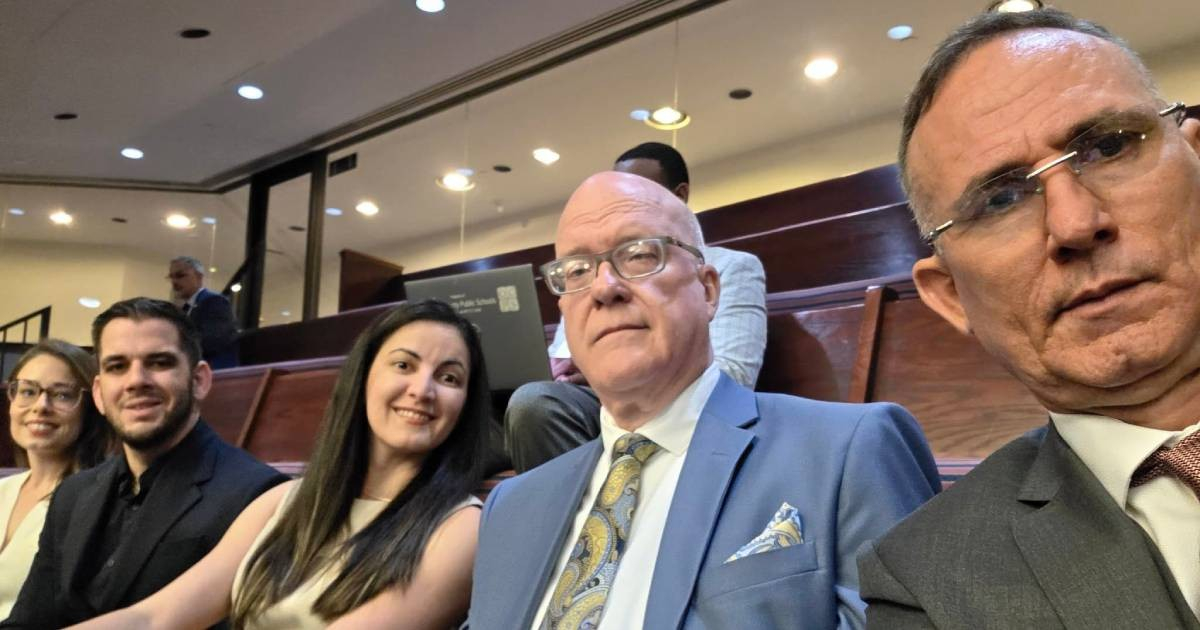
On Wednesday, the Florida State Legislature extended a warm reception to a group of prominent Cuban opposition figures, who visited both the Senate and the House of Representatives. This gesture was a significant institutional endorsement of the Liberation Agreement, a united strategy by the opposition for democratic transition in Cuba.
José Daniel Ferrer García, head of the Patriotic Union of Cuba (UNPACU), captured the moment on video and shared it on Facebook, where lawmakers can be seen applauding from the House floor.
"We were just surprised with a recognition at the Florida State Congress. By the time I started filming, legislators were already applauding us," Ferrer wrote, expressing gratitude "on behalf of all those fighting for Cuba's freedom, especially the political prisoners."
Accompanying Ferrer were Rosa María Payá Acevedo, president of Cuba Decide; Orlando Gutiérrez-Boronat, leader of the Assembly of the Cuban Resistance (ARC); Alian Collazo; and Krista Schmidt.
The Senate's Formal Recognition
The Florida Senate issued an official Proclamation, signed by Senator Alexis Calatayud from District 38, acknowledging the Liberation Agreement as "the pathway to a free and democratic Cuba."
The document highlights that the Cuban people have endured more than sixty years under a communist dictatorship "marked by repression, lack of political freedoms, economic hardships, and human rights violations."
According to the proclamation, the Agreement includes immediate restoration of civil liberties, the release of Cuban political prisoners, the establishment of a transitional government, and the organization of internationally supervised free elections.
Key Elements for National Stability
Additionally, it outlines essential pillars for national stabilization: securing critical infrastructure, providing humanitarian aid, restoring essential public services, and promoting long-term reconstruction through the rule of law, protection of private property, and economic reform.
During the House ceremony, a legislator expressed gratitude, saying, "We appreciate these leaders who have come together to chart a path to democracy and freedom for the Cuban people."
Gutiérrez-Boronat echoed the group's sentiment with a simple phrase: "Grateful for the recognition of the Liberation Agreement."
The Liberation Agreement's Impact
The Liberation Agreement, unveiled publicly on March 2 in Miami by Ferrer and Payá, was symbolically submitted to the Virgin of Charity of Cobre. Signed by the ARC and Cuba Decide, it proposes a three-phase transition: the release of over 1,000 political prisoners and dismantling of the Communist Party, stabilization under a plural provisional government, and democratization through free elections.
Rosa María Payá has championed the agreement from exile, asserting that "the only way out of the crisis is the exit of the dictatorship."
Ferrer arrived in Miami on October 13, 2025, forced into exile after being released from prison in Santiago de Cuba, with the assistance of the U.S. State Department. He spent more than half of the last two decades imprisoned by the regime, and Amnesty International recognizes him as a prisoner of conscience. Upon reaching U.S. soil, he declared, "There are other brothers in Cuba suffering."
The endorsement by Florida's Senate and House of Representatives marks the most significant institutional recognition the Cuban opposition initiative has received since its unveiling, in a state where the Cuban exile community actively rallies for the Island's freedom.
Frequently Asked Questions about the Cuban Liberation Agreement
What is the Cuban Liberation Agreement?
The Cuban Liberation Agreement is a proposed roadmap for democratic transition in Cuba, emphasizing civil liberties restoration, political prisoner release, and the establishment of a transitional government leading to free elections.
Who are the leaders behind the Cuban Liberation Agreement?
The agreement is spearheaded by José Daniel Ferrer García of UNPACU and Rosa María Payá Acevedo of Cuba Decide, among others, who advocate for a transition towards democracy and freedom in Cuba.
How did the Florida State Legislature show support for the Cuban Liberation Agreement?
The Florida State Legislature honored the Cuban opposition leaders with a standing ovation and issued a formal proclamation recognizing the Liberation Agreement as a step towards a free and democratic Cuba.