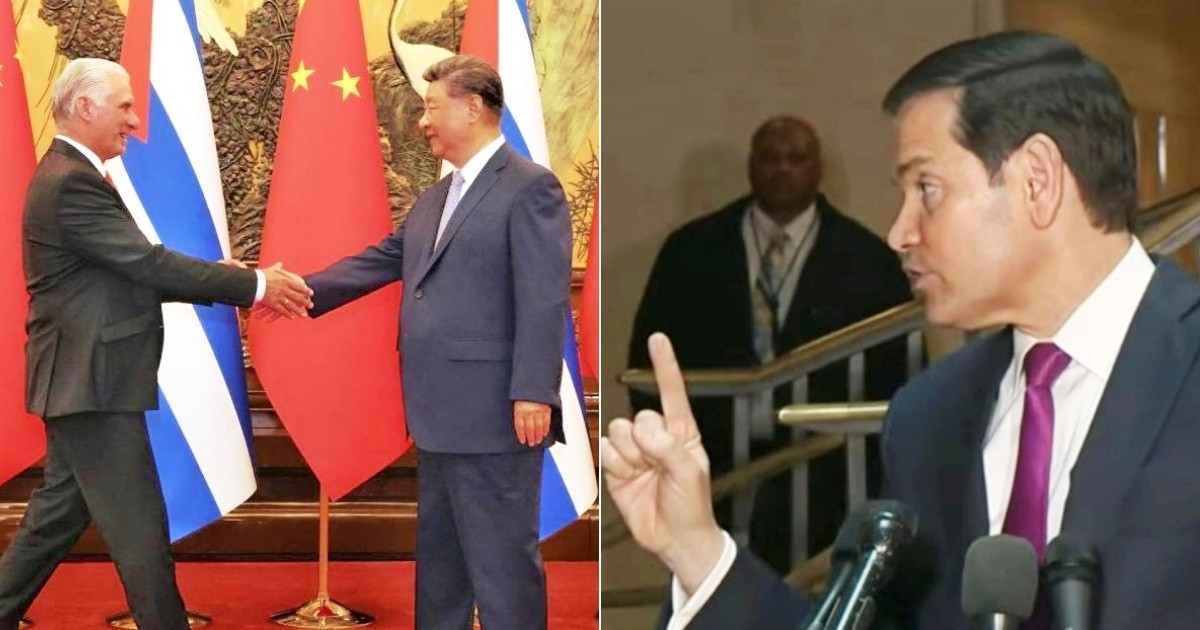
On Wednesday, Lin Jian, the spokesperson for China's Ministry of Foreign Affairs, dismissed accusations made by U.S. Secretary of State Marco Rubio regarding alleged Chinese espionage activities in Cuba. Lin described the cooperation between China and Cuba as "entirely legitimate, transparent, and compliant with international law."
Beijing's response, reported by the Efe agency, came a day after Rubio stated in a Fox News interview that the Cuban regime has "welcomed adversaries of the United States to operate within Cuban territory against our national interests, with complete impunity." Rubio warned that Washington would not tolerate such actions "just 90 miles from the U.S. shores."
Lin Jian firmly rejected these claims, stating, "Creating pretexts and spreading rumors to defame cannot justify the brutal blockade and illegal sanctions imposed by the United States against Cuba."
The Chinese spokesperson further accused Washington of "severely violating the Cuban people's rights to survival and development" and of defying "the fundamental norms of international relations" with an embargo that has lasted over six decades, causing cumulative damage exceeding $170.677 billion.
Beijing went beyond merely rejecting the accusations by issuing a direct demand: "China will firmly support Cuba in defending its national sovereignty and security, and urges the United States to immediately end the blockade and sanctions against Cuba, as well as any form of coercion or pressure."
The Chinese foreign ministry also condemned Washington's actions for "compromising regional peace and stability" and called on the Trump administration to "heed the voice of justice."
In alignment with this stance, Beijing reaffirmed its commitment to "continue supporting and assisting Cuba in the face of repeated threats from the United States" and expressed willingness to collaborate with all parties to safeguard Cuba's national sovereignty and security and oppose external interference.
Why is the U.S. Concerned About Potential Espionage?
Rubio's accusations are based on a report from the Center for Strategic and International Studies, which identified at least four Chinese-operated signal intelligence facilities in Cuba: Bejucal, El Wajay, Calabazar, and El Salao, the latter located just 70 miles from the Guantanamo Naval Base and equipped with systems capable of tracking signals thousands of miles away.
Satellite images analyzed up to March 2024 reveal a steady expansion of these facilities since 2021, and an official U.S. report from December 2024 raised the total number of active sites on the island to at least 12.
Beijing's statements come at a time of heightened tension between Washington and Havana. On Tuesday, the U.S. Senate narrowly rejected, by 51 votes to 47, a Democratic resolution aimed at preventing President Trump from ordering military action against Cuba without Congressional approval.
The firm response from China also reflects the bilateral context between Beijing and Havana. In January, Trump signed an executive order declaring Cuba an "unusual and extraordinary threat" to U.S. national security and imposed tariffs on countries supplying oil to Cuba.
In response to this pressure, Xi Jinping approved $80 million in financial assistance and 60,000 tons of rice for Cuba. Additionally, in March, foreign ministers Wang Yi and Bruno Rodríguez agreed to elevate bilateral relations to "higher levels," according to discussions held between the two foreign ministries.
Back in February, Lin Jian had already foreshadowed Beijing's stance by stating that "China, as always, will provide support and assistance to Cuba as much as possible" in the face of threats from Washington.
Key Questions Regarding U.S.-Cuba-China Relations
What are the accusations against China regarding espionage in Cuba?
The accusations claim that China operates several signal intelligence facilities in Cuba, which are used to track signals and potentially spy on U.S. interests in the region.
How has China responded to these allegations?
China has firmly rejected the allegations, describing its cooperation with Cuba as legitimate and transparent, and accused the U.S. of unjust sanctions and interference.
What is the current state of U.S.-Cuba relations?
The relationship is currently tense, with ongoing sanctions and a recent Senate vote rejecting efforts to limit military action against Cuba without Congressional approval.