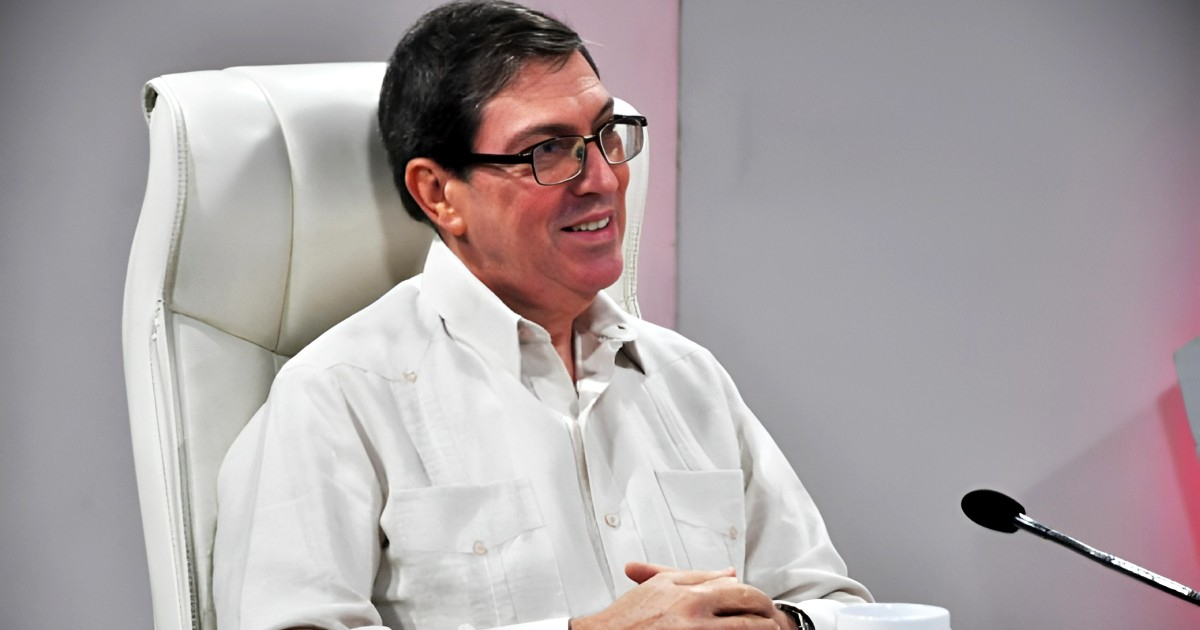
On Wednesday, Cuban Foreign Minister Bruno Rodríguez Parrilla took to social media platform X to dismiss claims by the U.S. State Department that Cuba presents a threat to the United States. He labeled these assertions as "absurd," echoing a familiar narrative of victimhood that the Cuban regime often employs against the backdrop of escalating pressure from the Trump administration.
Rodríguez Parrilla argued, "It's ridiculous that the State Department claims Cuba—a relatively small, developing country subjected to a brutal economic war—could pose a threat to the world's largest military, technological, and economic power." His post emphasized Cuba's peaceful stance, stating that the nation "does not attack others, does not allow its territory to be used against others, and maintains a clean record against terrorism, organized international crime, and violence." He concluded by stating that "such weak and fallacious arguments cannot fabricate pretexts."
The foreign minister's comments arrived three months after President Donald Trump enacted Executive Order 14380, designating Cuba as an "unusual and extraordinary threat" to U.S. national security and imposing tariffs of up to 50% on countries supplying oil to the island.
Washington's rationale is rooted in Cuba's alliances with Russia, China, Iran, and North Korea, harboring fugitives from U.S. justice, sheltering Colombian ELN leaders, and supporting Nicolás Maduro's regime in Venezuela.
Contradictions in Cuban Rhetoric
The stance of Rodríguez Parrilla is strikingly different from the rhetoric historically maintained by the Cuban regime, which portrays itself as a revolutionary David to the imperial Goliath. Between 1975 and 1991, Cuba deployed up to 300,000 troops in Angola and intervened in Ethiopia, Congo, and Syria, cultivating an official identity centered around "proletarian internationalism" and its ability to challenge the "empire."
Recently, in a speech to military units, Miguel Díaz-Canel declared, "The cost of aggression for imperialism must always exceed potential benefits," and during an Extraordinary Plenum of the Communist Party, he stated, "Surrender will never be an option."
Shifts in Diplomatic Language
Yet now, the same regime that prides itself on its defiance appeals to its smallness and non-threatening nature in international forums. This Wednesday, Cuban Ambassador to the United Nations Ernesto Soberón Guzmán accused the U.S. of a "maritime blockade" at the UN. In April, the regime even proposed cooperation with Washington on transnational crimes, a move analysts interpret as a sign of structural weakness amid economic suffocation.
This trend extends to official rhetoric: in 2026, the Ministry of Foreign Affairs (MINREX) released a statement without mentioning "blockade" or "empire," marking an unprecedented shift in the regime's diplomatic language.
Cuba was re-added to the list of State Sponsors of Terrorism by Trump in January 2025, and this April, the U.S. further certified it as a country not fully cooperating in the fight against drug trafficking. These designations, which the regime rejects, frame Washington's position and have been staunchly defended by Secretary of State Marco Rubio.
Understanding U.S.-Cuba Relations
Why does the U.S. view Cuba as a threat?
The U.S. perceives Cuba as a threat due to its alliances with countries like Russia, China, Iran, and North Korea, its harboring of U.S. fugitives, and its support for regimes like Nicolás Maduro's in Venezuela.
What actions has the U.S. taken against Cuba recently?
Recently, the U.S. imposed tariffs on countries supplying oil to Cuba and re-added Cuba to the list of State Sponsors of Terrorism. Additionally, the U.S. certified Cuba as a country not fully cooperating in the fight against drug trafficking.
How has Cuba historically portrayed its relationship with the U.S.?
Historically, Cuba has portrayed itself as a revolutionary David standing up to the imperial Goliath, emphasizing its capacity to challenge the U.S. through "proletarian internationalism."