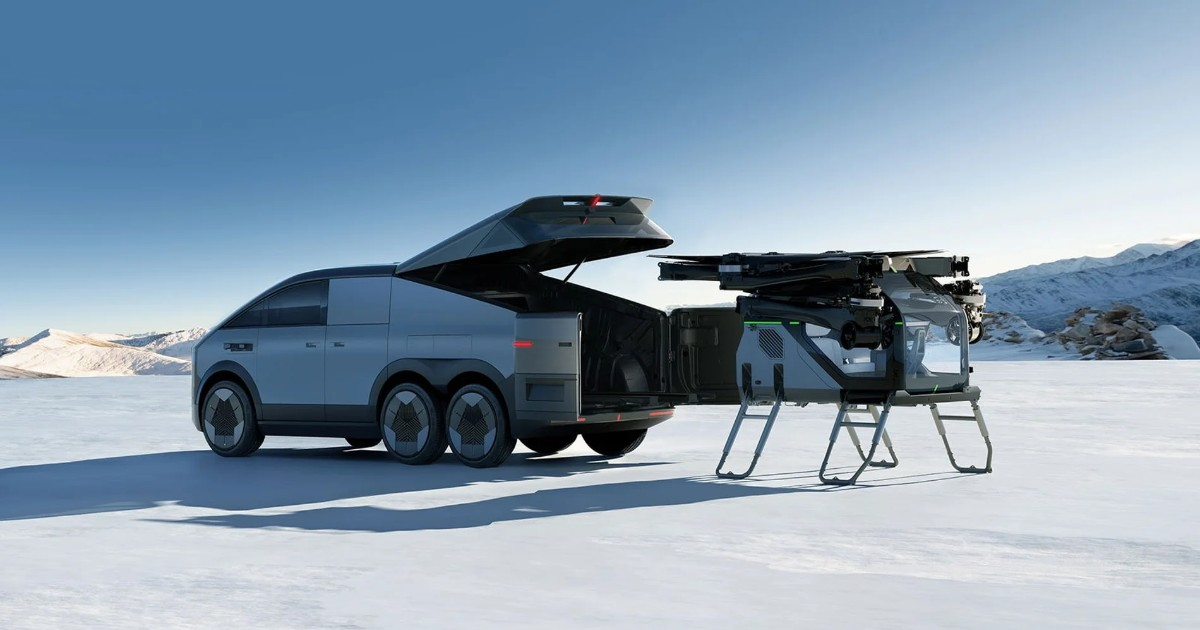
XPeng's urban aviation branch, Aridge, has seen its Land Aircraft Carrier soar past 7,000 pre-orders, with an impressive single-day record of over 90 orders during the 2026 Beijing Auto Show. This positions it as a highly anticipated entrant in the global automotive sector.
On April 24, the opening day of the auto show, XPeng's CEO, He Xiaopeng, announced the 7,000 pre-order milestone during a press event. He also revealed on his Weibo account that the vehicle had attracted 90 orders in just one day, reflecting the vehicle's growing appeal.
The buzz at XPeng's exhibit was palpable, with visitors engaging in virtual reality flight simulations and witnessing live demonstrations of the aerial module detaching from the main vehicle.
Despite the excitement, the Land Aircraft Carrier has not yet hit the market. Mass production has yet to commence, and the aerial module lacks full airworthiness certification. Delivery timelines hinge on the company meeting its ambitious objectives by the end of 2026.
The price point is set below two million yuan, or approximately $300,000, as reported by MarketWatch on April 23.
Design and Features of the Land Aircraft Carrier
The Land Aircraft Carrier is not your typical flying car; it features a dual-module system. The "mother vehicle" is an 800-volt electric range extender platform with six wheels, offering a combined range of over 1,000 kilometers and accommodating four passengers.
The aerial module is an eVTOL (electric Vertical Take-Off and Landing) system housed in the trunk, equipped with six dual-ducted rotors, a 270-degree panoramic cabin, and a single-joystick control. The mother vehicle can recharge the aerial module either while driving or parked, allowing for five to six flights per charge.
In China, operating the terrestrial vehicle only requires a standard class C driver's license.
Production and Market Expansion
Aridge's Guangzhou facility completed its initial pilot production batch in November 2025. At full capacity, it can assemble a vehicle every 30 minutes, with an initial target of 5,000 units annually, scalable to 10,000 units.
With 13 years of development, the project boasts over 500 engineers and more than 1,000 registered patents. In March 2026, Aridge raised nearly $200 million in a funding round, bringing the total to about $750 million. In January, it confidentially filed for an IPO on the Hong Kong Stock Exchange, with JPMorgan and Morgan Stanley as advisory banks.
Challenges and Strategic Outlook
XPeng is strategically shifting from solely being an electric car manufacturer to becoming a player in mobility, robotics, and urban aviation. He Xiaopeng confirmed ongoing negotiations to enter international markets like the Middle East, Indonesia, and Malaysia, with pre-orders already secured from Qatar and the UAE.
The company is also developing a second-generation vehicle to meet European and U.S. standards. However, regulatory hurdles remain a significant challenge, as international regulations for hybrid land-air vehicles are still evolving, limiting short-term global expansion.
China's national strategy aims for 100,000 flying vehicles by 2030 as part of a low-altitude economic initiative, creating a favorable environment for Aridge. Nevertheless, this does not guarantee readiness from the rest of the world.
XPeng's Land Aircraft Carrier: Key Questions and Answers
What is the Land Aircraft Carrier's price point?
The Land Aircraft Carrier is priced below two million yuan, which is approximately $300,000 USD.
When is the expected delivery timeline for the Land Aircraft Carrier?
Deliveries depend on XPeng meeting its ambitious goals by the end of 2026, as mass production has not yet begun.
What are the key features of the Land Aircraft Carrier?
The vehicle consists of a mother vehicle with an 800-volt electric range extender, and an eVTOL aerial module with six dual-ducted rotors and a 270-degree panoramic cabin.
What are the challenges faced by XPeng in global expansion?
The main challenges include evolving international regulations for hybrid land-air vehicles, which currently limit XPeng's global expansion efforts.