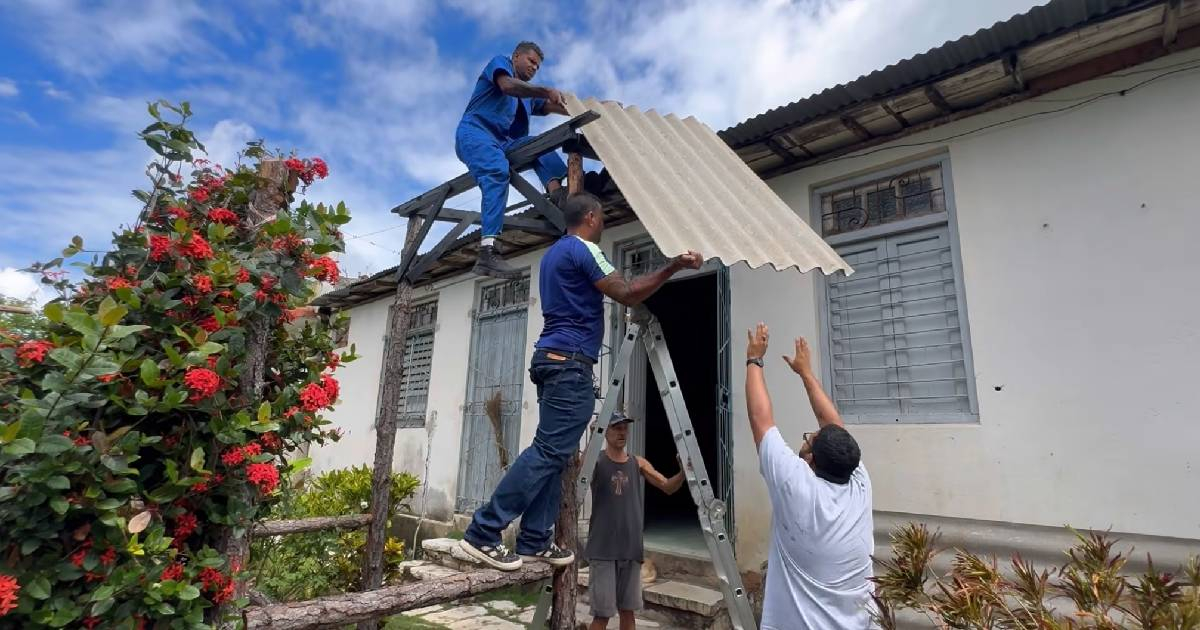
A group of Cubans has captured on video the exhausting ordeal of rebuilding a home devastated by Hurricane Melissa without any state assistance. They meticulously count each nail used and resort to cooking with charcoal, costing 1,000 pesos per sack, to feed the construction workers.
Father Leandro NaunHung's YouTube channel recently released episode 320, offering a first-person account of self-managed reconstruction efforts in eastern Cuba, six months after the hurricane ravaged the area.
The footage shows the group improvising ladders to hoist tiles onto the roof, securing each piece with eight nails sourced from abroad, and enduring power outages that can last three to four days.
"You know there's an issue with the electricity here, but this circuit seems to have a severe problem. When the power does come on, the demand overloads the system, leaving us without electricity for days," explains one participant.
State Absence and Community Solidarity
The group expresses frustration over the complete absence of state support; official technicians never appeared to assess the damage or oversee repairs.
One member sarcastically comments, "When the engineers who never showed up eventually come, they'll see what we've managed to do ourselves."
Despite this, the team acknowledges progress through mutual solidarity: "At least we've managed to stop the house from further water damage, and step by step, we've been fixing it regardless of everything."
Broader Impact of Hurricane Melissa
Once described as a "sieve," the house is slowly being restored through collective effort: "Little by little, with our hard work and the dedication of those here, we're shaping the house that Cyclone Melissa destroyed."
This situation is not unique. Five months after the hurricane, only 17% of the damaged homes in Santiago de Cuba had been repaired, roughly 18,400 out of over 106,500 affected, according to the Provincial Defense Council.
The UN reported that more than 90,000 homes across five eastern provinces were impacted, affecting over 3.5 million people.
Reconstruction progresses at a snail's pace due to a combination of material shortages, fuel scarcity, and corruption in resource distribution. There have been reports of irregularities in the allocation of materials to hurricane victims in Santiago de Cuba's Chicharrones neighborhood, where resources ended up in the hands of regime officials and their associates.
As an emergency measure, the government resorted to using shipping containers as makeshift homes. However, recipients in Guantánamo have complained about leaks, defective plumbing, and prices nearing a million pesos per unit.
Understanding the Challenges of Rebuilding After Hurricane Melissa
What difficulties do Cubans face in rebuilding homes after Hurricane Melissa?
Cubans face challenges such as lack of state support, material shortages, fuel scarcity, and corruption in resource distribution, making the rebuilding process slow and arduous.
How have communities in Cuba managed reconstruction efforts?
Communities have relied on mutual solidarity and self-management to make progress. They use improvisation and shared resources to slowly rebuild their homes.
What alternative housing solutions has the Cuban government provided?
The government has installed shipping containers as temporary homes, though these have been criticized for leaks, faulty plumbing, and high costs.