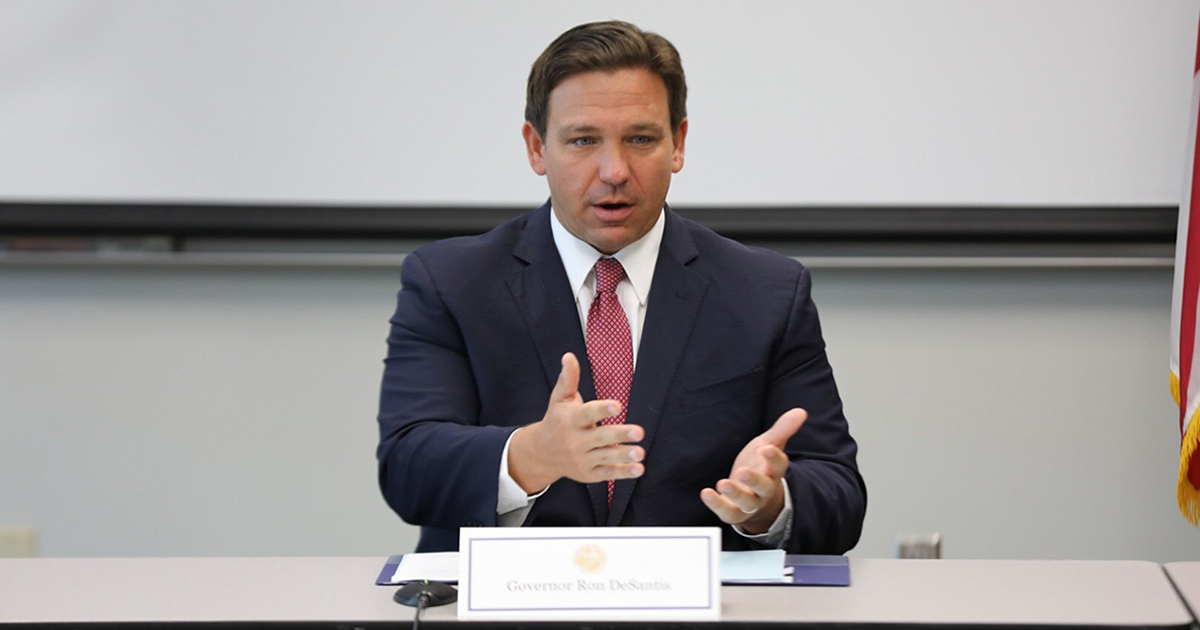
Florida Governor Ron DeSantis defended his proposal on Monday to redraw the state's 28 congressional districts, denying political motives and asserting that the plan addresses demographic imbalances caused by Florida's population surge.
During an interview on "The Ingraham Angle," DeSantis stated that the proposal is "truly independent of Virginia or any of those other states," referencing similar redistricting efforts in Democrat-majority regions.
"We've experienced a significant population boom. For instance, District 14 had approximately 100,000 fewer votes than neighboring District 12. The numbers justify the change," the governor explained.
Republicans Set to Gain with New Map
The proposed map, currently under discussion in a special session of the state legislature, would shift the congressional delegation in Florida to a 24-4 Republican advantage, from the existing 20-8 split.
Democratic representation would be reduced from eight to four seats, retaining only Districts 10, 20, 23, and 24 in South Florida.
Controversy Over Racial Gerrymandering
DeSantis also contended that the new map removes a racially gerrymandered district in South Florida, continuing a stance he took in 2022 when he vetoed a map that would have created a minority-access district in Duval County.
The governor further argued that the Fair Districts Amendment, approved by Florida voters in 2010 to prevent partisan gerrymandering, violates the equal protection clause of the federal Constitution.
Opposition and Criticism
Democratic House Leader Hakeem Jeffries vehemently opposed the plan, labeling it "blatantly illegal and political malpractice."
"Florida voters overwhelmingly passed the Fair Districts Amendment in 2010, which explicitly prohibits partisan gerrymandering. By targeting communities of color to intentionally dilute their voting power, DeSantis' map also clearly violates the 14th Amendment," Jeffries asserted.
DeSantis offered a direct challenge to the Democratic leader: "Nothing would benefit Florida Republicans more than voters seeing Hakeem Jeffries as the alternative. I welcome him to Florida."
Internal Republican Concerns
The warnings are not only coming from Democrats. Former George W. Bush adviser Karl Rove cautioned about the risks of the strategy, noting that creating new favorable districts would require pulling Republican voters from safe seats, thus making them vulnerable.
An analysis by Republican consultant Alex Alvarado for the Civic Data and Research Institute suggested that aggressive redistricting could increase competitive seats from four to seven without yielding any net gains for Republicans.
Republican congressmen Mario Díaz-Balart, Carlos Giménez, Greg Steube, and Daniel Webster have expressed concerns that their safe seats might be jeopardized.
This initiative is part of a national redistricting battle driven by President Donald Trump, who reiterated on Sunday that Florida should change its map, especially following a Virginia referendum that Trump criticized as a rigged election.
National Context and Legal Implications
Florida would become the eighth state to alter its maps before the November 2026 elections, following Virginia, Utah, Ohio, North Carolina, Missouri, California, and Texas.
DeSantis had previously linked the need for the special session to a pending Supreme Court ruling in Louisiana v. Callais, which could potentially invalidate minority-access districts.
Although that decision has yet to be issued, the special session, which runs until May 1, progresses with Republicans holding a supermajority ready to approve the map without drafting a new one.
Frequently Asked Questions about Florida's Redistricting
What is the main reason for Florida's redistricting proposal?
Governor Ron DeSantis claims the redistricting proposal addresses demographic imbalances caused by a population surge in Florida.
How would the proposed map affect Florida's congressional representation?
The proposed map would give Republicans a 24-4 advantage in Florida's congressional delegation, reducing Democratic representation from eight to four seats.
What are the legal challenges to the redistricting plan?
Critics, including Democratic leaders, argue that the plan violates the Fair Districts Amendment and the 14th Amendment by engaging in partisan and racial gerrymandering.