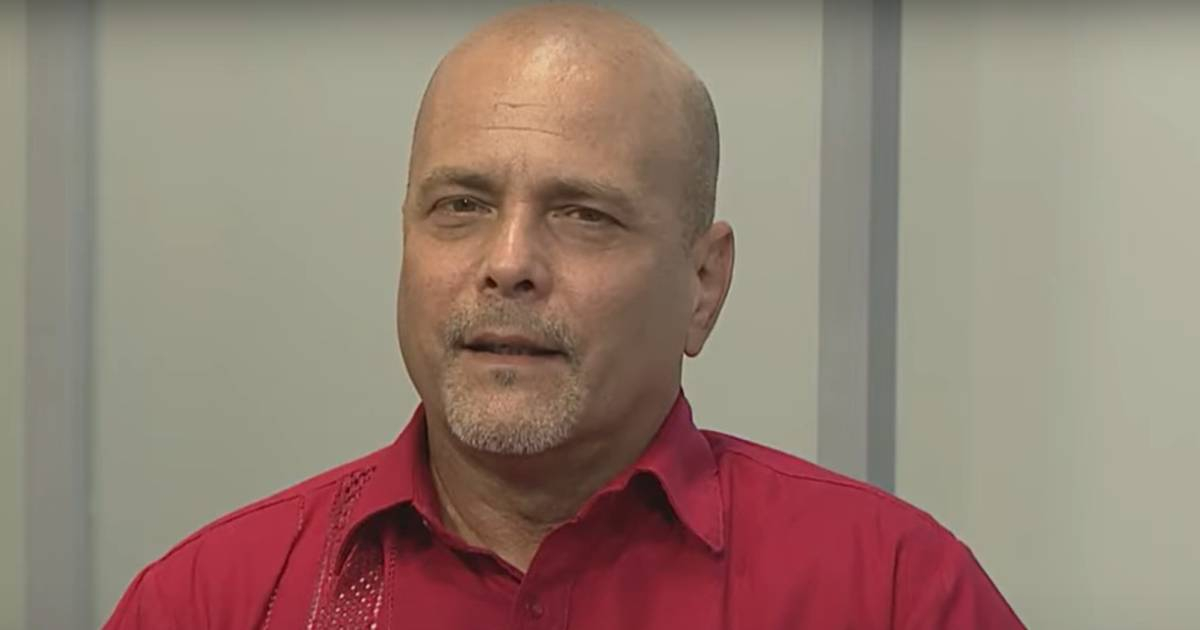
Gerardo Hernández Nordelo, the national coordinator of Cuba's Committees for the Defense of the Revolution (CDR) and one of the regime's so-called "Five Heroes," recently took to Facebook to share a sardonic take on the presence of U.S. military aircraft near Cuba. His post, however, backfired as it attracted a flood of criticism.
The controversy began with a post by journalist Mario Vallejo, who has a verified Facebook account. Vallejo warned, "THIS IS NOT A CASUAL DEPLOYMENT: IT'S AN INTELLIGENCE SIEGE ON CUBA," sharing screenshots from the public app Flightradar24. These images showed U.S. military aircraft, including a tanker plane, an MQ-4C Triton drone, an unmanned aerial vehicle, and another unidentified aircraft, flying over the Caribbean and near Cuba.
Satirical Remarks Gone Wrong
Seizing the moment, Hernández quipped, "Cuba doesn't need agents; it has voluntary informants! For sharing less information than this, #TheFive were labeled 'foreign agents' and three were convicted of 'espionage'... It's interesting to see some now offer this service without facing prison." However, this attempt at irony was met with a barrage of rebuttals pointing out a fundamental flaw: Flightradar24 is a publicly accessible, free platform available to anyone with a smartphone. The data it displays comes from signals emitted by the aircraft or vessels themselves, including those from the United States, which can be restricted or turned off in certain situations. Thus, it's not confidential or restricted information.
One user commented, "That news is public, not secret." Another echoed, "You know that's a public page, right? That's no state secret." Others emphasized the obvious, "That app is free and open, and if this is 'privileged information' for you, may God help you."
Public Access vs. Espionage
Some comments were more blunt in challenging Hernández's argument: "You realize how foolish you can be when you don't see that platform is public," or "He pretends to be smart and funny. He knows full well that's public information." Others reminded everyone that any citizen can access this data: "Something any Cuban on the island with a phone could find out."
The harshest criticism came from comparisons drawn: "The difference is that this information is public, consultable, but you were a criminal spy engaged in international espionage and were tried as such." One comment starkly added, "You were spies for Cuba directly in the USA, enough with the show."
Military Context
The immediate backdrop to Hernández's post is the FLEX2026 military exercise taking place in Key West, officially confirmed by the U.S. Naval Forces Southern Command and the Fourth Fleet. This exercise, running from April 24 to 30, incorporates artificial intelligence, unmanned systems, and traditional naval forces.
This exercise is part of an increased surveillance effort documented since January 2026, involving MQ-4C Triton drone flights and other aircraft publicly tracked via Flightradar24. On April 17, a Triton flew over Cuba, including stretches over Pinar del Río and Havana, and on April 21, another operated in the Gulf of Mexico north of the island.
Hernández was sentenced in December 2001 to two life terms for conspiracy to commit espionage and his role in the shootdown of Brothers to the Rescue planes, as the head of the Wasp Network, a Cuban spy ring in Miami. He was released on December 17, 2014, amid the thaw between Barack Obama and Raúl Castro, and since 2020 has led the CDRs and is a member of the Council of State.
While Hernández attempts humor at the expense of the U.S. military's activities, Cuban leader Díaz-Canel, just days prior, emphasized that Cuba must brace itself for potential confrontation with the United States, in a regime notorious for criminalizing access to information for decades.
Frequently Asked Questions about U.S.-Cuba Relations
What is the FLEX2026 military exercise?
FLEX2026 is a military exercise conducted by the U.S. Naval Forces Southern Command and the Fourth Fleet in Key West. It involves the use of artificial intelligence, unmanned systems, and traditional naval forces and is part of ongoing surveillance efforts in the region.
Who is Gerardo Hernández Nordelo?
Gerardo Hernández Nordelo is the national coordinator of Cuba's Committees for the Defense of the Revolution and a member of the Council of State. He was one of the "Five Heroes" of the Cuban regime and was previously imprisoned for espionage activities in the United States.