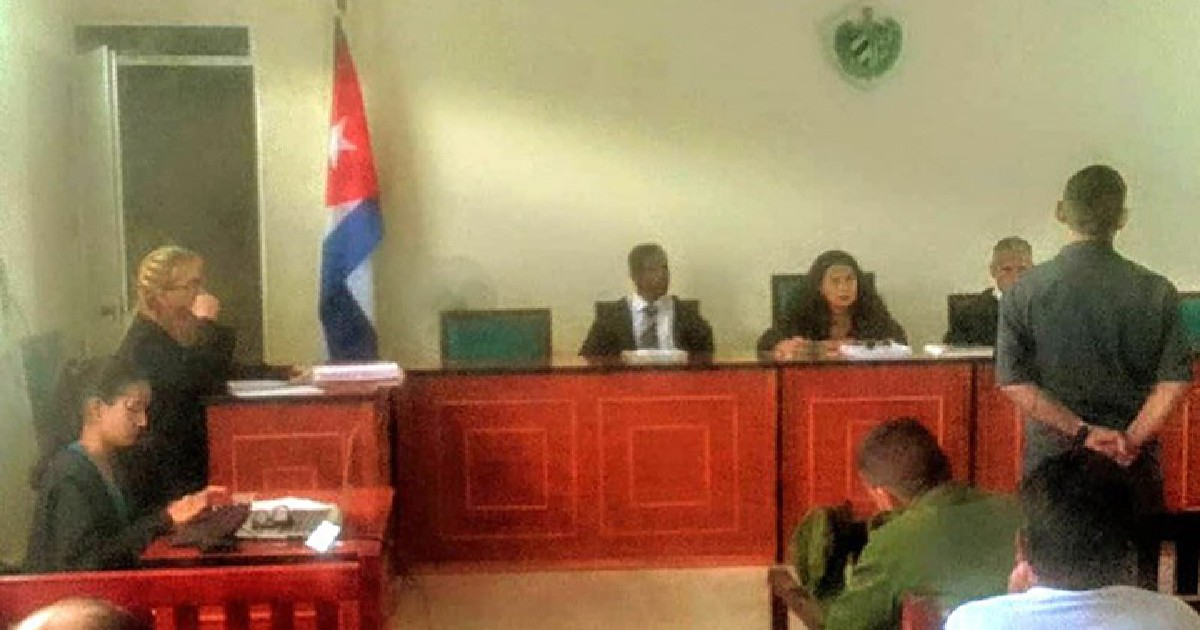
A man has been sentenced to 14 years in prison by the People's Provincial Court of Holguín for cultivating and selling marijuana in the Jagüeyes de Puerto Rico area, located in the municipality of Banes. The Cuban regime portrayed the trial as a "model" proceeding, fitting into its "zero tolerance" policy against drugs.
Originating from investigations launched by the Territorial Unit of Criminal Investigation III in Banes in 2025, the case, known as Case 2 of 2026 in the Third Criminal Chamber, revealed the defendant's long-standing involvement in drug-related criminal activities. Consequently, the National Anti-Drug Directorate began monitoring and compiling evidence under the "Jagüeyes Case" file.
The arrest occurred on the morning of May 6, 2025, during a police operation. Officers apprehended the suspect hiding among bushes near a field enclosed by a fence of wooden stakes and wire, according to a Facebook post by the "Héroes de azul en Cuba" page of the PNR.
Upon capture, authorities seized 429 Cannabis Sativa L. ssp. Indica plants, ranging from 14 to 77 centimeters in height, with a total net weight of 2,420 grams, as well as 11,280 Cuban pesos in cash. This information was shared by Yeisys González Escalona, vice president of the People's Provincial Court of Holguín, to the Cuban News Agency.
The unnamed individual was prosecuted for drug trafficking and received a 14-year prison sentence, as per Article 235.1 d). 2 g) of the current Penal Code's Law 151 of 2022, which prescribes penalties ranging from 10 to 30 years. The court also considered the defendant's repeat offenses as an aggravating factor, González Escalona mentioned.
In addition to imprisonment, the individual faced supplementary penalties, including the revocation of civil rights, a 14-year travel ban from leaving the country, and the confiscation of all seized cash.
The report emphasized that the trial respected all the accused's legal and procedural rights as mandated by the nation's current legislation.
Legal Implications and Broader Context
It was noted in the publication that Cannabis Sativa Indica, widely known as marijuana, is classified under the group of hallucinogenic psychotropics. It is subject to international regulation according to the 1961 Single Convention on Narcotic Drugs, appearing on Schedules I and IV, to which Cuba is a signatory.
In a similar case earlier this year, the Holguín Provincial Court sentenced a Cueto resident to eight years for being the primary drug dealer in the region, referred to as the "Ghost Case."
In September 2025, three more Cubans were convicted of drug trafficking in another high-profile trial by the same court.
Rising Drug Trafficking Concerns
Nationally, the drug trafficking problem shows no signs of slowing down. In 2024, the Ministry of the Interior seized over a ton of narcotics across Cuba and prosecuted 1,157 individuals. By 2025, the independent Cuban Citizens' Audit Observatory (OCAC) recorded 437 incidents of drug production, sale, and consumption, marking a 115% increase compared to the previous year.
Authorities have also identified at least 40 varieties of synthetic cannabinoids circulating in Cuba, colloquially referred to as "chemical" or "papelillo," indicating that harsher penalties have not effectively curbed the spread of narcotics on the island.
In a recent March ruling, the Provincial Court of Artemisa sentenced two Cubans to 15 years for possessing just 1.74 grams of synthetic cannabinoid, reflecting the regime's stringent punitive approach.
Key Legal Questions on Drug Trafficking in Cuba
What are the penalties for drug trafficking in Cuba?
Under the current Cuban Penal Code, penalties for drug trafficking can range from 10 to 30 years in prison, depending on the severity and circumstances of the case.
How does Cuba's zero-tolerance policy affect drug-related offenses?
Cuba's zero-tolerance policy results in harsh sentences for drug-related offenses, aiming to deter drug trafficking and consumption through severe legal consequences.
What substances are regulated under international conventions that Cuba is part of?
Cuba adheres to the 1961 Single Convention on Narcotic Drugs, which regulates substances like Cannabis Sativa Indica, listed under Schedules I and IV as controlled substances.