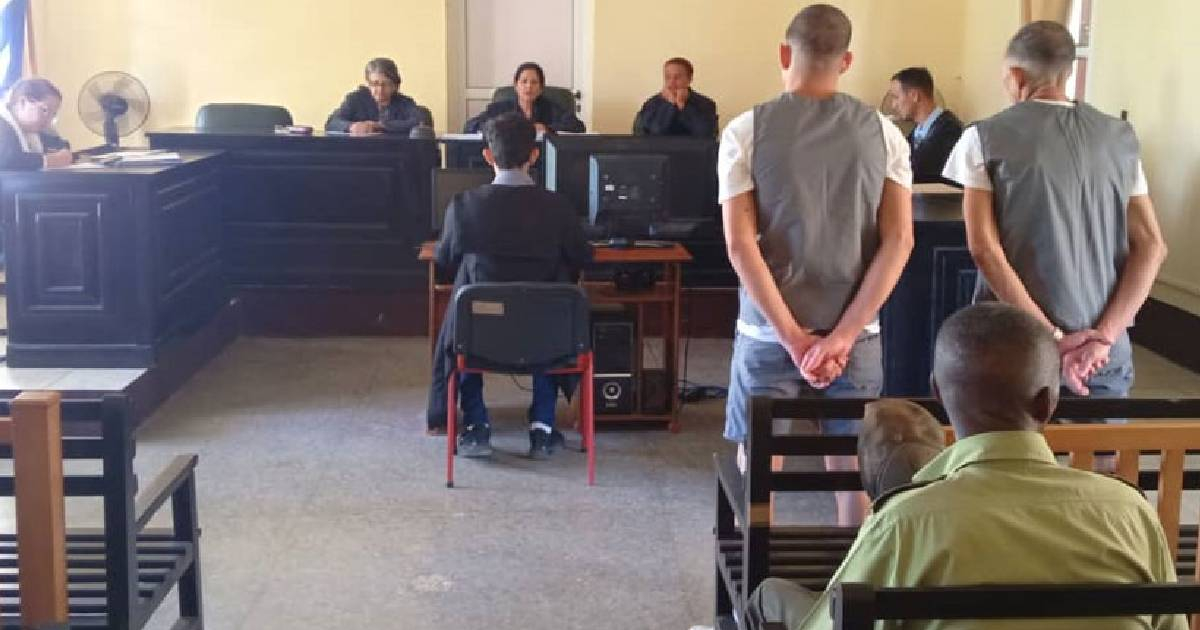
The First Criminal Chamber of the Popular Provincial Court in Santiago de Cuba has handed down sentences ranging from 10 to 15 years in prison to three individuals found guilty of embezzling state funds. This is part of case 19 of 2026 concerning administrative corruption.
The criminal scheme began after a bank loan of 20 million pesos was approved for a Basic Business Unit under the Vegetable Preserves Company in Santiago de Cuba.
Acting in concert, the accused executed four fraudulent transfers totaling 5,175,504 pesos to the personal account of one of the conspirators. They subsequently split 3,986,504 pesos among themselves.
Amarilis Téllez Torres, an accountant at the state entity, received the harshest sentence: 15 years of imprisonment. Her accomplice, Julio César Palacios Peralta, head of the Financial Accounting Group of the same company, was sentenced to 14 years.
María Luisa Creme Quiroga, an economist at the Rodolfo Rodríguez Benítez Credit and Services Cooperative, was sentenced to 10 years. She was the one who received the diverted funds into her personal account.
Creme Quiroga used part of the stolen money to purchase two thousand U.S. dollars from a fourth accomplice, Kenly Hierrezuelo Téllez, paying over 1,195,000 pesos for the transaction.
Hierrezuelo Téllez was fined 600 installments of forty pesos each for the crime of illegal trafficking in national currency and foreign exchange.
The court classified the acts as continuous forgery of banking and commercial documents to commit embezzlement, which is punishable by eight to twenty years of imprisonment.
As additional penalties, the three principal defendants face deprivation of public rights and a ban on leaving the national territory.
Téllez Torres and Palacios Peralta are also barred from holding positions related to economic activities. Furthermore, they must compensate the affected entity for the total amount defrauded.
This case fits into a broader pattern of corruption within state-run enterprises, which the regime has sought to combat with increased judicial visibility. In July 2025, the Cuban regime initiated a formal campaign against corruption, warning of penalties of up to twenty years.
The most recent precedent in Santiago de Cuba occurred in May 2024 when 78 people were arrested for diverting basic products from the Guillermón Moncada port to informal markets, causing damages valued at at least nine million pesos.
Nationally, the most notable case of 2026 is the life sentence of former Economy Minister Alejandro Gil Fernández, confirmed by the People's Supreme Court in January, for espionage and corruption crimes, including embezzlement, bribery, and money laundering.
In Sancti Spíritus, five officials from an agricultural company were sanctioned in August 2025 for negligence and embezzlement that resulted in losses exceeding 97 million pesos, highlighting the structural problem within Cuban state enterprises.
Both the convicted individuals and the Prosecutor's Office can file the appropriate legal appeals against the verdict issued this past Sunday.
Details on Corruption and Sentencing in Cuba
What were the sentences given to the individuals involved in the corruption case in Santiago de Cuba?
Amarilis Téllez Torres received 15 years, Julio César Palacios Peralta was sentenced to 14 years, and María Luisa Creme Quiroga got 10 years. Kenly Hierrezuelo Téllez was fined for illegal currency trafficking.
What actions led to the embezzlement charges?
The accused conducted fraudulent transfers totaling over 5 million pesos from a state enterprise to a personal account, later splitting nearly 4 million pesos among themselves.
How is the Cuban regime addressing corruption in state enterprises?
The regime has increased judicial visibility and launched a formal campaign against corruption, with warnings of severe penalties, to tackle widespread corruption within state enterprises.