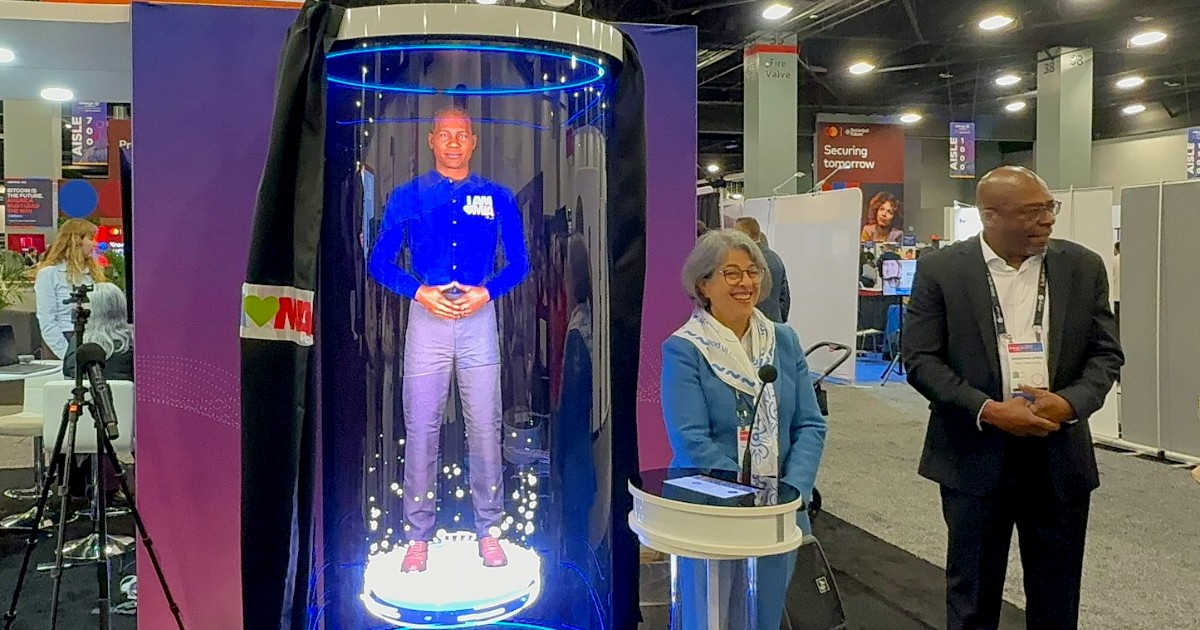
Miami International Airport (MIA) has made history as the first airport globally to launch a large-scale holographic chatbot powered by artificial intelligence to assist travelers, as announced by Miami-Dade County on April 20.
The high-tech innovation was officially introduced by Miami-Dade Mayor Daniella Levine Cava during the eMerge Americas 2026 tech conference, which took place at the Miami Beach Convention Center.
“Miami-Dade is leading the way at eMerge Americas 2026. From AI-driven government services to MIA's new virtual assistant, the future is being built right here. We are Future Ready!” the mayor declared on the social media platform X last Thursday.
This advanced system was developed through a collaboration with three companies: Mappedin (for indoor mapping), Satisfi Labs (for conversational AI), and Hypervsn (for 3D holograms).
Advanced Holographic Technology at MIA
The hologram has been strategically placed at four key entry points within the airport, including a location near the Transportation Security Administration (TSA) checkpoint 4. It aims to guide passengers seamlessly from curbside to the boarding gate.
According to OnlyinDade, "the hologram provides real-time, location-based assistance to travelers through natural conversational interaction, available on-site screens, kiosks, mobile, and web platforms."
A standout feature of this system is its geo-awareness: it precisely detects a passenger's location within the airport and delivers accurate real-time directions in multiple languages.
The 'Future-Ready' Vision
This launch is part of Miami-Dade County's 'Future-Ready' initiative, which also includes sanitation robotics and AI-powered computer vision for traffic flow management at PortMiami.
Hypervsn, the company behind the holographic technology, has previously implemented similar solutions at Keflavík Airport in Iceland to inform passengers about safety regulations, which reduced baggage rejections and wait times. However, the integration with geo-aware conversational AI at the scale of MIA is touted as a world-first innovation.
Infrastructure Challenges and Criticism
The announcement was met with some criticism. Social media users pointed out the irony of investing in holograms while unresolved infrastructure issues persist at the airport.
"This doesn't enhance the passenger experience at all and is further evidence of the county wasting taxpayer money on third-party gimmicks, rather than addressing the fact that the airport resembles a 1970s third-world bus terminal," commented a user on X, as reported by the Miami New Times.
In August 2025, MIA was ranked among the worst airports globally due to the deterioration of elevators, escalators, and walkways.
For years, the airport has been undergoing a $9 billion modernization project, which includes new parking facilities and infrastructure upgrades. In December 2025, it also introduced facial recognition gates in TSA PreCheck lines.
Handling 55.9 million passengers in 2024, MIA is one of the busiest airports in the United States, making it a significant venue for testing traveler assistance technologies.
With airports in South Florida bracing for record-breaking numbers in the coming years, there is mounting pressure to enhance passenger experiences both in infrastructure and digital services.
FAQs on Miami International Airport's AI Hologram
What is the purpose of the AI-powered hologram at Miami International Airport?
The AI-powered hologram at MIA is designed to assist travelers by providing real-time, location-based guidance from the curbside to their boarding gates, enhancing the overall passenger experience.
Who developed the holographic system at MIA?
The holographic system was developed in collaboration with Mappedin for indoor mapping, Satisfi Labs for conversational AI, and Hypervsn for 3D holograms.
What challenges does the Miami International Airport face despite the new technology?
Despite the introduction of new technology, MIA faces ongoing challenges with its infrastructure, including deteriorating elevators, escalators, and walkways, which have drawn criticism from travelers.