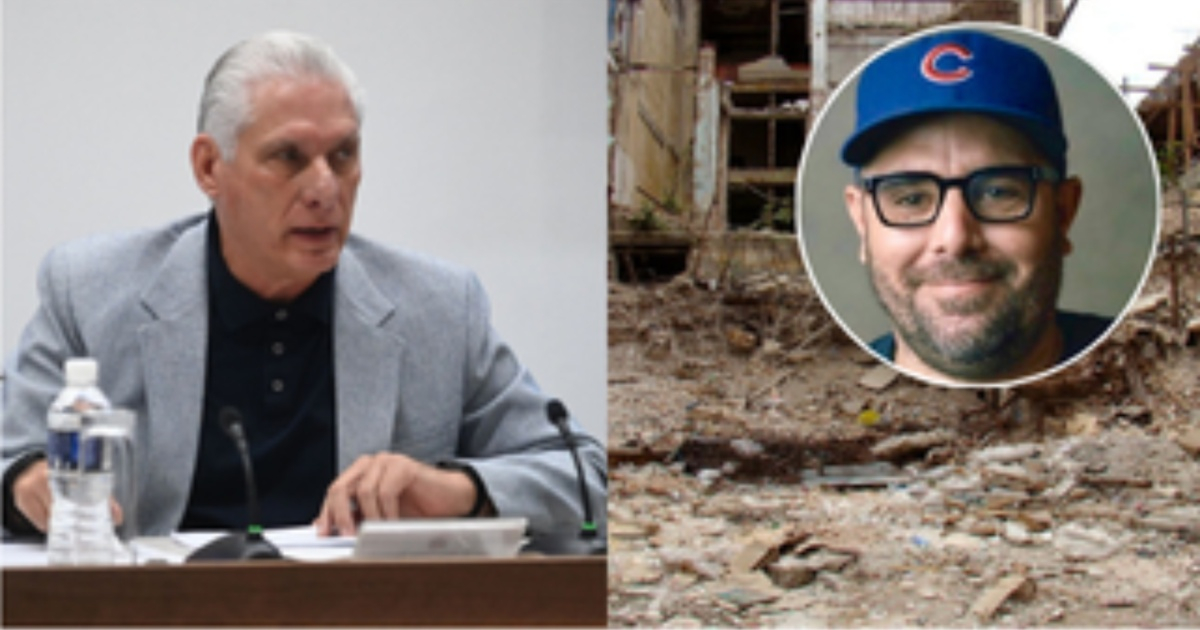
The Cuban filmmaker and activist, Ian Padrón, released a video on his official Facebook page this past Saturday, highlighting a glaring contradiction within the Cuban regime. While for decades, the regime accused the opposition of being "paid by the empire," it now opts for clandestine meetings with Washington rather than addressing the demands of the Cuban people.
"We've always been told in Cuba that the Cuban dissidents, all who oppose the Cuban dictatorship, are financed by the empire, are subjects of an empire, of the enemy, and are playing into the enemy's hands," Padrón remarks in the video, which encourages a more extensive analysis on his YouTube channel "Derecho a Réplica."
Hypocrisy at the Core of Official Discourse
The central argument presented by the activist directly targets the hypocrisy within the official narrative: the regime, which for decades built its legitimacy on the threat of the "Yankee enemy," now finds its leaders negotiating with this very government behind the people's backs.
"They prefer to talk with the United States government, heed what the U.S. government desires, and meet secretly with the U.S. government, supposedly their enemy, rather than listen to the people of Cuba," Padrón asserts.
Secret Diplomacy Amid Rising Tensions
The video surfaces amid heightened diplomatic activity between Havana and Washington. Early in 2026, secret contacts were disclosed between Raúl Guillermo Rodríguez Castro and Secretary of State Marco Rubio starting in February, culminating in an official meeting in Havana on April 10—the first official U.S. aircraft in Cuba since 2016.
On April 20, the United States issued a two-week ultimatum to Cuba, demanding the release of high-profile political prisoners and progress in reforms.
Miguel Díaz-Canel acknowledged the existence of "very preliminary and initial" talks but rejected any conditions on the political system, threatening to halt negotiations if Washington insists on internal political changes.
"Our internal issues are not on the table," Díaz-Canel declared last Tuesday.
Padrón's Unyielding Critique
Padrón's analysis dismantles this stance: the regime shows willingness to negotiate with any foreign power but refuses to acknowledge a legitimate opposition within the island itself.
"They would rather hand over the island to China, to Russia, to the United States, to any power before listening to the Cuban people who think differently," the filmmaker emphasizes.
Meanwhile, the Trump administration enacted Executive Order 14380 on January 29, 2026, cutting 80 to 90% of Cuban oil imports, worsening an energy crisis that already caused blackouts lasting up to 25 hours daily across the island.
Padrón, who in November 2020 reported to the Ministry of Culture that "State Security has taken over the country," has consistently highlighted the contradictions in official rhetoric and championed the right of Cubans—both on the island and abroad—to be heard.
"They would prefer to do this rather than acknowledge there is an opposition, rather than recognize that millions of Cubans disagree," the activist concludes in the video.
Key Questions on Cuba-U.S. Relations
What are the central accusations made by Ian Padrón against the Cuban regime?
Ian Padrón accuses the Cuban regime of hypocrisy, negotiating secretly with the U.S. while ignoring the demands of the Cuban people, despite having historically accused dissidents of being "paid by the empire."
What recent diplomatic activities have occurred between Cuba and the United States?
Recent diplomatic activities include secret contacts between Cuban officials and the U.S. Secretary of State, culminating in a meeting in Havana and a U.S. ultimatum for Cuba to release political prisoners and implement reforms.