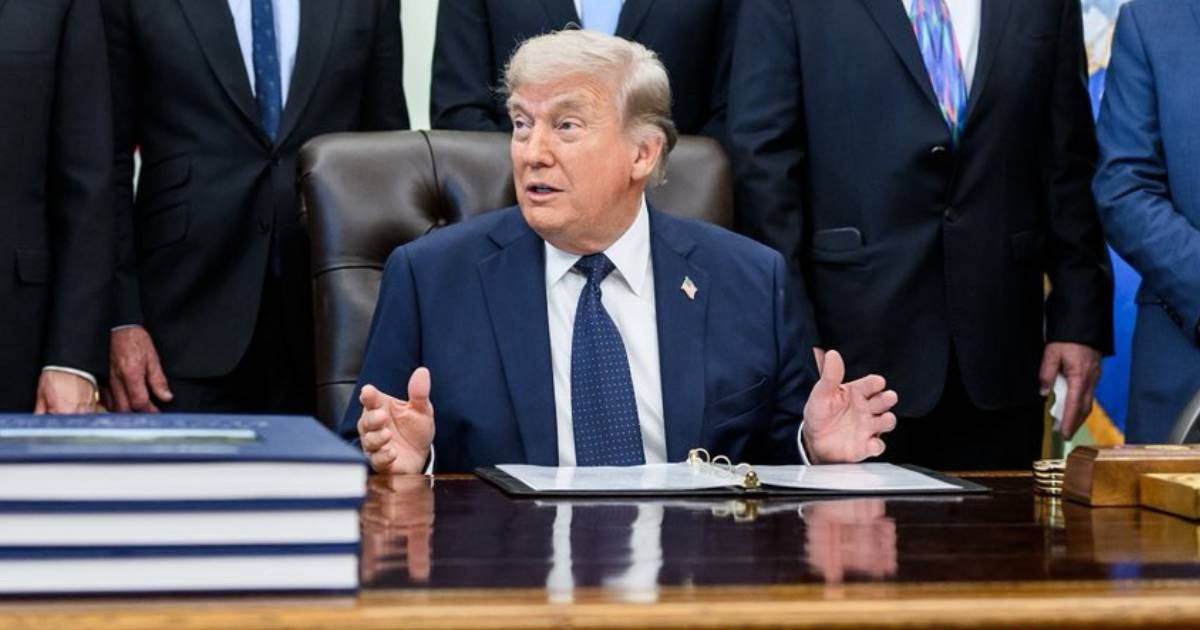
On Saturday, President Donald Trump declared that he had called off the visit of U.S. envoys to Islamabad, Pakistan, where they were scheduled to engage in nuclear talks with Iranian officials. Instead, Trump insisted that Iran reach out to him directly if they wish to negotiate.
"I just canceled the trip of my representatives to Islamabad, Pakistan, to meet with the Iranians. Too much time wasted traveling, too much work," Trump posted on Truth Social. "Moreover, there’s overwhelming confusion and infighting within their 'leadership.' No one knows who's in charge, including themselves. We hold all the cards, they hold none. If they want to talk, all they need to do is call."
This announcement follows the confirmation by White House spokeswoman Karoline Leavitt on Fox News, stating that Trump had dispatched his envoys "to listen to the Iranians."
The planned representatives for this third round of discussions were Steve Witkoff, special envoy for the Middle East, and Jared Kushner, Trump's son-in-law and advisor.
Stalled Negotiations Amid Iranian Leadership Turmoil
The decision arises amid stalled negotiations and escalating chaos within Iran's leadership. The initial round of discussions in Islamabad, held from April 10 to 12, ended without an agreement after 21 hours of talks. The second round, scheduled for April 21 and 22, was rejected by the Iranian delegation itself, demanding the end of the U.S. naval blockade, the release of frozen assets, and a resolution to the crisis in Lebanon.
The positions of both sides remain at odds. The U.S. demands the complete dismantling of Iran's nuclear program and a 20-year moratorium on uranium enrichment, while Iran offers only a five-year pause and seeks $270 billion in compensation.
Leadership Confusion in Iran
The leadership confusion in Iran highlighted by Trump is supported by documented evidence. After Supreme Leader Ali Khamenei's death on March 1, 2026, during Operation Epic Fury—a joint U.S.-Israeli offensive—his son Mojtaba Khamenei was appointed as the new supreme leader on March 8. However, Mojtaba Khamenei suffered severe injuries in the attacks, including the loss of a limb. According to sources cited by The Telegraph, Iranian commanders have no real contact with him: "No one knows anything about Mojtaba... He has no control over the war because he is not present."
This paralysis has left the Islamic Revolutionary Guard Corps (IRGC), led by General Ahmad Vahidi, as the dominant faction, actively obstructing diplomatic efforts by the pragmatist wing led by Foreign Minister Abbas Araghchi. Iranian negotiator Mohammad Bagher Ghalibaf has reportedly considered withdrawing from the delegation due to internal divisions.
U.S. Naval Blockade and Iranian Retaliation
Since April 13, the U.S. has enforced a naval blockade on Iranian ports with more than a dozen ships, 100 aircraft, and 10,000 troops, costing Iran around $500 million daily. In retaliation, Iran closed the Strait of Hormuz on April 19.
In response, Iranian Foreign Ministry spokesperson Esmaeil Baghaei stated on Saturday that "no meeting is planned between Iran and the U.S." and that Tehran's observations would be conveyed through Pakistan, a key mediator in the process.
Trump indefinitely extended the ceasefire on April 21 at the request of Pakistan, which has been mediating between the parties since the talks began.
FAQs on U.S.-Iran Negotiation Dynamics
Why did Trump cancel the trip to Islamabad?
Trump canceled the Islamabad trip citing wasted time and effort, and demanded that Iran contact him directly for negotiations.
What are the key demands of the U.S. and Iran in the negotiations?
The U.S. demands the complete dismantling of Iran's nuclear program and a 20-year uranium enrichment moratorium, while Iran seeks a five-year pause and $270 billion in compensation.
How has Iran responded to the U.S. naval blockade?
In retaliation to the U.S. naval blockade, Iran shut down the Strait of Hormuz, a key maritime route.