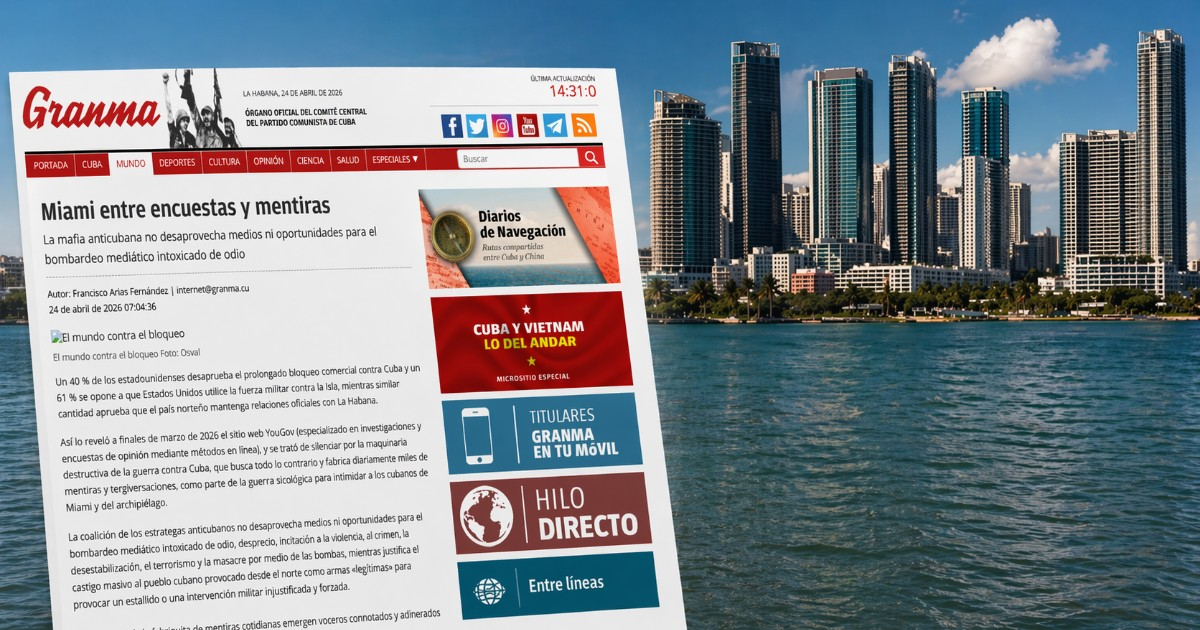
The official newspaper of the Communist Party of Cuba, Granma, has expressed its discontent with a survey conducted by El Nuevo Herald. The survey revealed that a significant 79% of Cubans and Cuban Americans in South Florida support some form of U.S. military intervention in Cuba.
Conducted between April 6 and 10 by Bendixen & Amandi International and The Tarrance Group, the survey polled 800 individuals across Miami-Dade, Broward, Palm Beach, and Monroe counties. The results carry a margin of error of ±3.5 percentage points.
Support for Intervention and Criticism of the Cuban Government
Within that 79% who favor intervention, 36% support it solely to overthrow the communist regime, while 38% advocate for it in conjunction with humanitarian aid. Moreover, 73% of those surveyed blame the Cuban government for the nation's crisis rather than U.S. sanctions, and 78% oppose any negotiations with Havana without a prior democratic transition.
Granma accused El Nuevo Herald of manipulating participant selection to achieve favorable results: "They commissioned a survey with 800 deliberately chosen individuals, mostly Republicans and opponents of bilateral relations, to ensure responses that favored military intervention in the country."
Granma's Denouncement and Media Bias Claims
The state-run newspaper, acting as a mouthpiece for the regime, goes further, labeling exile media as a "factory of daily lies," accusing them of a "media bombardment filled with hate, contempt, incitement to violence, crime, destabilization, terrorism, and massacre through bombs."
This reaction from Granma stands in stark contrast to their positive reception of a YouGov survey published in March, which delivered more favorable results: 40% of Americans disapprove of the trade embargo against Cuba, and 61% oppose a military attack on the island.
Cuban Foreign Minister Bruno Rodríguez was quick to highlight these figures on March 23, arguing that the "U.S. government ignores its own people." Granma now claims that this survey was "silenced by the destructive machinery of the war against Cuba."
Political Backing and Criticism of the Survey
Conversely, the Herald's survey received public support on April 17 from Cuban American Republican Congresswoman María Elvira Salazar, who remarked that Cuban Americans are "fed up" and that the results serve as a "green light" for Trump's administration to take military action against Díaz-Canel's regime.
Fernand Amandi, president of Bendixen & Amandi International, echoed these sentiments in his description of the results.
Critics of the survey argue that its sample—comprising 57% Republicans, 17% Democrats, and a majority over fifty years old, concentrated in South Florida—does not accurately represent the entire Cuban diaspora. Nonetheless, it reflects the sentiment of the Cuban American community concentrated in this region, historically the most politically influential nucleus of the exile.
Granma's article emerges amid escalating tensions between Cuba and the United States under the Trump administration, which since January 2026 has intensified the embargo with an energy blockade, exacerbating the island's severe power crisis, leading to blackouts lasting up to 25 hours a day.
Understanding the Controversial Survey on U.S. Intervention in Cuba
What was the main finding of the El Nuevo Herald survey?
The survey found that 79% of Cubans and Cuban Americans in South Florida support some form of U.S. military intervention in Cuba.
How did the Cuban government react to the survey results?
The Cuban government, through its official newspaper Granma, criticized the survey and accused El Nuevo Herald of deliberately selecting participants to achieve desired outcomes.
What was the sample composition of the survey?
The survey's sample included 57% Republicans, 17% Democrats, and a majority over fifty years old, focusing on the South Florida region.
Why is the survey considered controversial?
The survey is controversial because it suggests significant support for military intervention, which contrasts sharply with the Cuban government's narrative and raises questions about participant selection and representation.