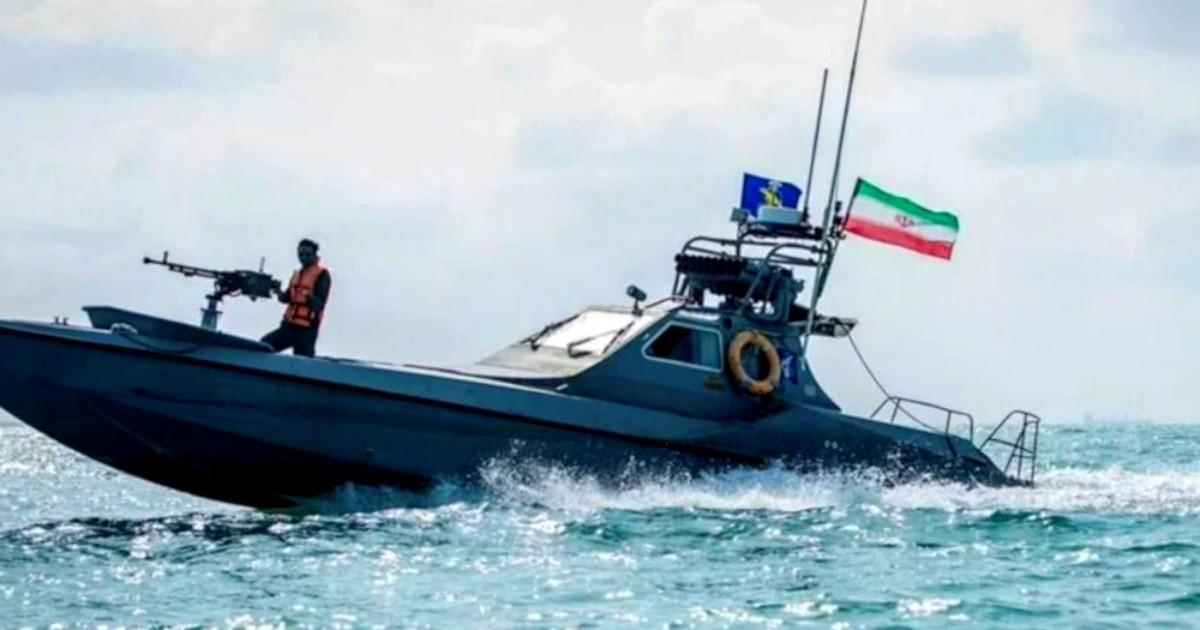
An armed vessel belonging to Iran's Revolutionary Guard opened fire on a container ship in the Strait of Hormuz on Wednesday. The attack caused damage to the ship and complicated diplomatic efforts aimed at resuming negotiations between Washington and Tehran in Pakistan.
The incident occurred just hours after President Donald Trump announced an indefinite extension of the ceasefire with Iran—originally set to expire on Wednesday—to give Tehran time to prepare a "unified proposal" for potential talks in Islamabad.
The UK Maritime Trade Operations (UKMTO), a monitoring agency operated by the British military, reported that the Revolutionary Guard vessel did not issue any radio warnings before firing on the ship.
Conflicting Accounts
The ship's captain confirmed that the entire crew was safe and no fire or environmental damage resulted from the attack.
Iran, however, offered a different narrative: Nour News claimed the Guard only fired after the ship "ignored warnings from the Iranian armed forces," while the semi-official Fars agency described the action as Iran "legitimately asserting its control over the Strait of Hormuz."
Ongoing Tensions
In a statement released Wednesday, the Revolutionary Guard vowed to deal "crushing blows beyond the enemy's imagination" to its remaining assets in the region.
This incident is part of a recent escalation: over the weekend, the United States seized the Iranian cargo vessel MV Touska in the northern Arabian Sea after the USS Prudence destroyer fired on its engine room. Additionally, a second tanker linked to Iranian oil trade was boarded in the Indian Ocean. Iran labeled these actions as "armed piracy" and vowed retaliation.
President Trump confirmed that the U.S. naval blockade of Iranian ports would persist even with the ceasefire extension, a move deemed "unacceptable" by Tehran, costing Iran approximately $500 million daily. Iran has yet to formally acknowledge the ceasefire extension announced by Trump.
Diplomatic Efforts Continue
Pakistani Prime Minister Shehbaz Sharif expressed gratitude to Trump for the decision, noting that it would allow ongoing diplomatic efforts to progress. "Pakistan will continue its sincere efforts for a negotiated resolution of the conflict," he stated on X.
Pakistan is working to organize a second round of negotiations in Islamabad, although Iran has not confirmed its participation. The first round, held on April 11 and 12, ended without an agreement after 21 hours of talks. Key sticking points included Iran's nuclear program, regional groups allied with Tehran, and control over the Strait.
UN Secretary-General António Guterres expressed hope that the ceasefire extension would create crucial space for diplomacy and trust-building between Iran and the U.S., according to his spokesman Stephane Dujarric.
The Cost of Conflict
The conflict, which began on February 28 with a coordinated attack by the U.S. and Israel on over 1,000 Iranian targets, has severely restricted traffic through the Strait of Hormuz. In peacetime, this waterway handles 20% of the world's oil and natural gas shipments. Brent crude was trading near $98 a barrel on Wednesday, a rise of more than 30% since the war's onset.
The human toll of the conflict has reached at least 3,375 fatalities in Iran, over 2,290 in Lebanon, 23 in Israel, more than a dozen in Gulf Arab states, 15 Israeli soldiers, and 13 U.S. military personnel in the region.
Strait of Hormuz Conflict: Key Questions Answered
Why did Iran's Revolutionary Guard open fire on the container ship?
According to Iranian sources, the ship ignored warnings from the Iranian armed forces, prompting the Revolutionary Guard to fire. However, other accounts suggest there was no prior radio communication before the attack.
What impact does the conflict have on global oil markets?
The conflict has disrupted traffic through the Strait of Hormuz, a crucial chokepoint for global oil and gas shipments, leading to a significant rise in oil prices.
How is the international community responding to the ceasefire extension?
The UN Secretary-General and Pakistan have welcomed the ceasefire extension, seeing it as an opportunity for diplomatic efforts to resolve the conflict peacefully.