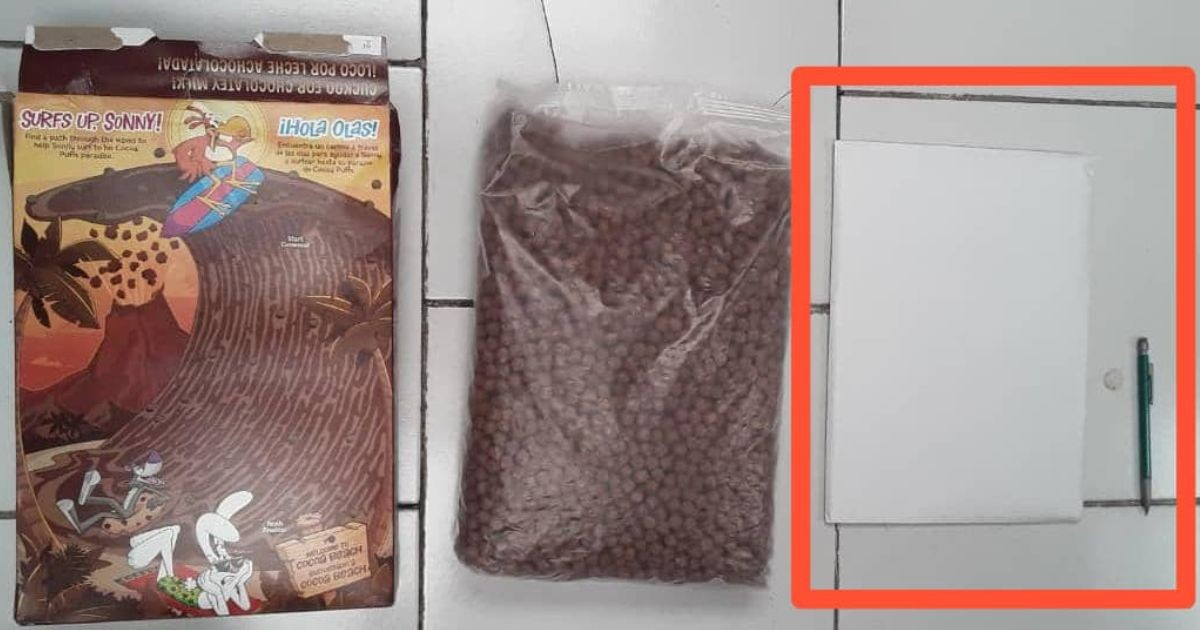
The Cuban Customs and the Anti-Drug Directorate of the Ministry of the Interior intercepted 19 sheets saturated with synthetic cannabinoids—referred to as "el químico"—hidden inside a Cocoa Puffs cereal box shipped from the United States.
This discovery was revealed by William Pérez González, the First Deputy Chief of the General Customs of the Republic, on his official account on X.
"Nineteen sheets soaked with synthetic cannabinoids, known as the 'chemical,' were discovered concealed in a cereal box in a shipment from the USA, the primary source of this drug. The Customs of Cuba and the anti-drug agency prevented the consumption of 22,800 doses," Pérez González stated.
The pictures released display the cereal box, the extracted contents in a clear plastic bag, and the sheets laced with the substance, using a coin for size comparison.
This seizure occurred just a day after authorities found methamphetamine hidden in a bag of Verde Valle rice in a passenger’s luggage, highlighting a persistent trend of drugs being smuggled camouflaged in food products sent from the US to Cuba.
Back in January 2026, Cuban Customs had already confiscated marijuana concealed in cereal and instant drink packets at Havana’s José Martí International Airport.
Known as "the chemical," this synthetic cannabinoid is 50 to 100 times more potent than marijuana and is also referred to as "papelillo" or "kimiko." In Cuba, its cost ranges from 150 to 250 Cuban pesos per dose, making it cheaper than many basic food items on the island.
Since May 2025, a more lethal version containing fentanyl, formaldehyde, benzodiazepines, phenobarbital, and veterinary anesthetics has circulated in Cuba.
Cuban authorities have identified at least 40 variations of synthetic cannabinoids circulating in the country, with the highest prevalence in Holguín and Havana. Official sources indicate that 90% of users become addicted.
Concealment in everyday foods is feasible because a dose occupies just 0.5 cubic centimeters on an impregnated sheet, facilitating its hiding in various containers. Documented methods include yogurt, gelatin, dietary supplements, medications, diapers, and aromatic plants.
Between 2024 and December 2025, Cuban authorities thwarted 72 operations related to synthetic cannabinoids and other drugs originating from 11 different countries.
In response to the surge, the Supreme People's Court approved Ruling 476 in August 2025, intensifying penalties: one to three years of imprisonment or fines up to 1,000 quotas for possession or distribution.
Last March, two individuals were sentenced to 15 years in prison for trafficking only 1.74 grams of 5-fluor ADB in the province of Artemisa.
Understanding the Rise of Synthetic Cannabinoids in Cuba
What are synthetic cannabinoids?
Synthetic cannabinoids are human-made chemicals that mimic the effects of THC, the active component in marijuana, but can be significantly more potent.
Why are these drugs concealed in food products?
Smugglers hide drugs in food products because small doses can be easily concealed in everyday items, making detection more difficult for authorities.
How has Cuba responded to the increase in drug trafficking?
Cuba has intensified its anti-drug measures, including stricter penalties for possession and distribution, and increased vigilance at customs checkpoints.