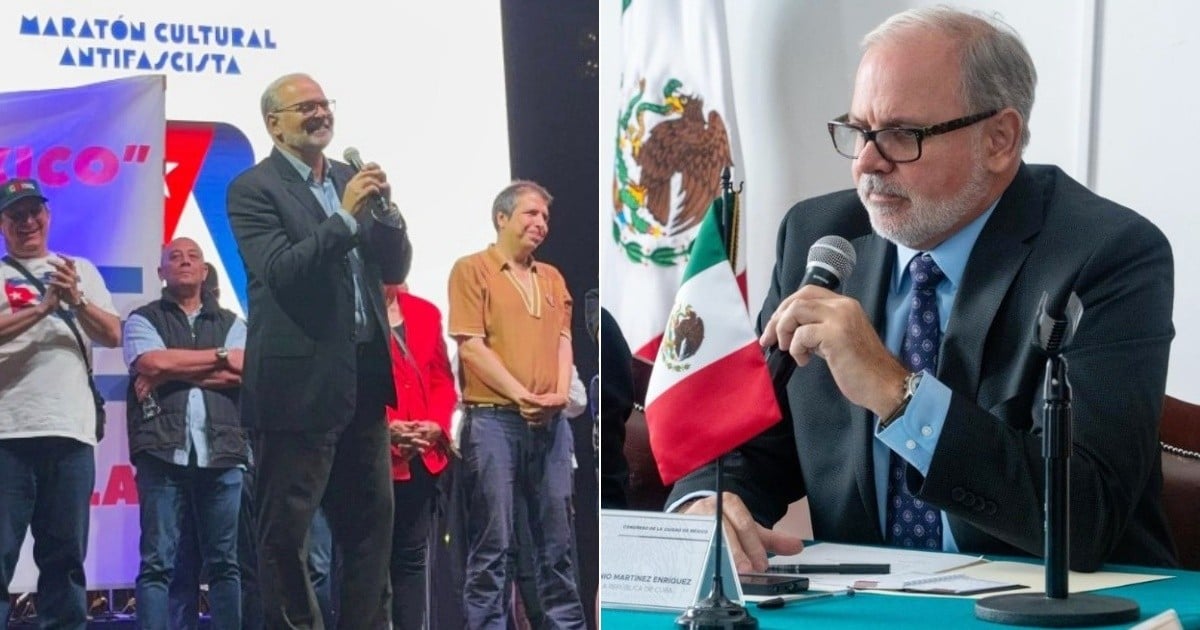
Eugenio Martínez Enríquez, the Cuban ambassador to Mexico, sparked controversy with his remarks suggesting that if the United States were to intervene militarily in Cuba, many Cubans could perish, yet the only viable response would be to stand firm.
“Of course, many Cubans will fall, but Cuba's choice is to resist,” the diplomat stated during the Antifascist Cultural Marathon in Support of Cuba, held at the Monument to the Revolution in Mexico City, as reported by the newspaper La Jornada.
Instead of downplaying the human toll of such a conflict, Martínez Enríquez emphasized that resistance remains the sole option. “When that happens, no nation submits, there is no surrender until one chooses to. The Cuban people will never surrender,” he said, assuming that the Cuban populace collectively supports the current regime.
His comments are part of a broader speech in which he warned of “threats” from certain U.S. government factions considering military action. “There are threats… of using military options, which would be catastrophic,” he declared, while reiterating that resistance would be the steadfast stance regardless of the situation.
Resilient Spirit in the Face of Conflict
During another segment of his address, he bolstered his rhetoric with an epic tone. “You and I will not witness Cuba's defeat; we will be participants in its victory,” he proclaimed, adding, “The decision is to resist and triumph. And I assure you, we will prevail.”
The ambassador also criticized Washington's policy towards the island, labeling several measures as “crimes.” “The threat of sanctioning any country that dares to supply fuel to Cuba is a crime. The energy blockade against Cuba is a crime. The reinforced economic, commercial, and financial embargo against Cuba is a crime,” he asserted.
In alignment with this, he called on the international community, urging, “We call on humanity not to be complicit in this crime.”
International Support and Political Context
The event, organized by the Antifascist Cultural League and lasting over 12 hours, coincided with the 65th anniversary of the Bay of Pigs invasion. The day featured both cultural and political activities and included the collection of 15 tons of goods for the island.
From the stage, Martínez Enríquez also expressed gratitude for the support of Mexican President Claudia Sheinbaum, who days earlier at the Summit for the Defense of Democracy in Barcelona, advocated for a joint declaration against potential military intervention in Cuba. “An awakening of dignity… the precise words to reject interference against Cuba,” he remarked.
The ambassador's statements come amid escalating tensions between Washington and Havana. At the end of January 2026, President Donald Trump signed an executive order labeling the Cuban government as an “extraordinary threat” to U.S. national security. In April, U.S. media reported that the Pentagon was assessing scenarios for military action.
Simultaneously, recent activities, such as U.S. Navy surveillance flights near the island, have been interpreted as additional pressure signals on Miguel Díaz-Canel's regime.
In the same vein, Cuban Deputy Foreign Minister Anayansi Rodríguez Camejo recently declared in Berlin that Cuba would resist a potential attack “to the last breath of every patriotic Cuban,” echoing the sentiments expressed by the ambassador in Mexico and Díaz-Canel himself.
Nevertheless, Martínez Enríquez's words have stirred debate by presenting potential loss of life not as a tragedy to avoid but as an accepted cost within the official narrative of resistance.
Implications of U.S.-Cuba Tensions
What did Cuban Ambassador Eugenio Martínez Enríquez say about U.S. intervention?
He stated that many Cubans might fall in the event of U.S. military intervention, but emphasized that resisting is the only option for Cuba.
How did Martínez Enríquez describe U.S. policies towards Cuba?
He criticized them as “crimes,” particularly the energy blockade and the threat of sanctions against countries supplying fuel to Cuba.
What recent actions by the U.S. have increased tensions with Cuba?
Recent U.S. Navy surveillance flights near Cuba and President Trump's executive order labeling Cuba as a threat have heightened tensions.