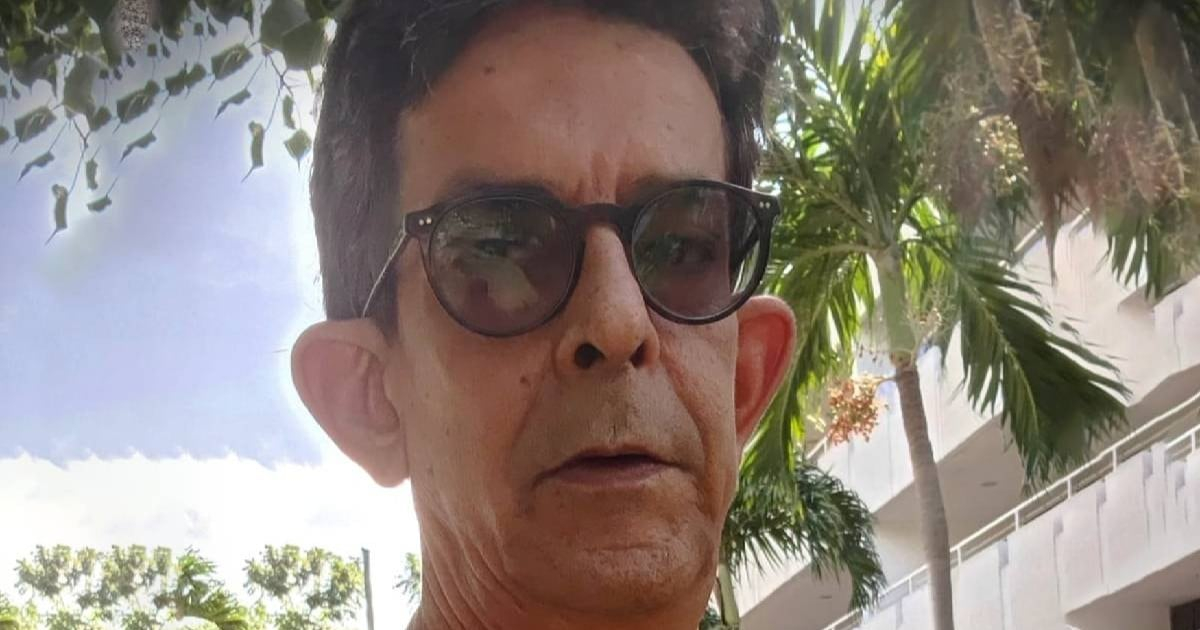
Cuban comedian Ulises Toirac took to Facebook on Monday to make a bold accusation against the State Security. He revealed that he is under physical surveillance, faces photographic tracking, and is targeted by anonymous social media accounts meant to attack him.
Addressing "the comrade who handles my case"—a direct nod to his State Security agent—Toirac posted this message a day after being banned from performing at a comedy club in the Bertolt Brecht Theater in Havana's Vedado district. This venue is managed by the National Council of Performing Arts and the Ministry of Culture.
"To the comrade overseeing me: I think something is missing; the shortages aren't just in material things," Toirac began his complaint, detailing the various forms of harassment he alleges.
He pointed out that on social media, he is surrounded by "detractors" who, besides being "uncultured, rude, and loud," have restricted profiles without visible identities.
"The fact that they are unanimously like this (much like the voting here) shows more cowardice than what I was taught since I was a child: to face challenges head-on," he wrote.
Toirac also disclosed that people are sent to photograph him as he walks on the street and outside his home.
With his trademark irony, he offered to send the images himself: "You could ask me, and without spending a dime of the budget you drain from the economy, I'll send them to you via email. Not just from outside, but I'll take photos of the rooms, the kitchen, and the bathroom (even without flushing the toilet if you're interested)."
The ban on live performances, Toirac noted, is not just an artistic restriction; it directly affects his ability to "earn a living," impacting his financial well-being.
Given the quality of those monitoring him, he requested, "Send different personnel to carry out the tasks, as these did not pass their schooling. Not even the general education ones."
His post concluded with a question summarizing his grievance: "I think something is missing. And I don't know if it's brains, courage, or the loyalty to the dispossessed you proclaim so much about and that seem non-existent to you. Or all three?"
Ongoing Patterns of Repression
The most recent incident stemmed from being barred last Sunday at the Bertolt Brecht Theater, which Toirac described as part of a "list" that "gets darker."
This isn't the first occurrence: he was similarly prevented from performing at the same venue in April 2024.
In July 2025, he managed a live reunion with his audience, yet the restrictions persisted.
Additionally, in September that year, he faced a pro-government troll campaign for seeking treatment at a state hospital.
Leading up to this post, Toirac had been particularly vocal in criticizing the regime. Last Wednesday, he condemned on Facebook the official event by Díaz-Canel at 23 and 12 for the 65th anniversary of the socialist declaration of the Revolution, calling it a "waste of resources" amid power outages reaching a deficit of 1,872 megawatts.
This Monday, he also mocked the temporary improvement of the power supply in Havana during the V Patria Colloquium, accusing it of being a deliberate manipulation.
Toirac's case is not unique. The First Comprehensive Report on Digital Surveillance in Cuba, released by Prisoners Defenders in January 2026 based on 200 testimonies, found that 98.5% of respondents faced reprisals for activities on social networks like Facebook and WhatsApp, and 88% were directly reprimanded for digital posts during summons and interrogations.
The Cuban Institute for Freedom of Expression and Press recorded 114 assaults on freedom of expression in January 2026 alone, a 67.6% increase from January 2025, placing Toirac's complaint within a growing trend of repression.
Understanding the Impact of Surveillance on Cuban Society
How does the Cuban government monitor its citizens?
The Cuban government employs physical surveillance, digital monitoring, and orchestrates social media attacks using anonymous accounts to keep track of and control dissent.
What are the repercussions for criticizing the Cuban regime online?
Individuals who voice dissent online may face harassment, bans from public performances, and even direct reprimands during interrogations, as seen in the case of Ulises Toirac.
Is the harassment of Ulises Toirac an isolated case?
No, the harassment of Ulises Toirac is part of a broader pattern of repression in Cuba, where many citizens face similar retaliations for their online activities.