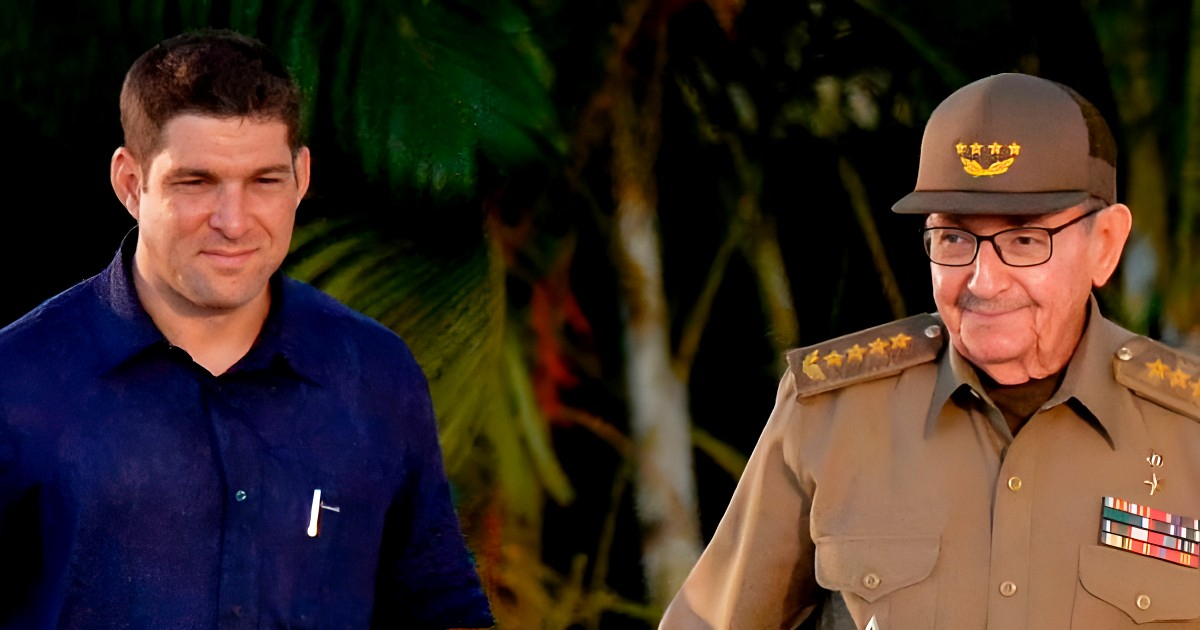
A senior official from the U.S. Department of State conducted a distinct and formal meeting with Colonel Raúl Guillermo Rodríguez Castro, commonly referred to as "El Cangrejo" or "Raulito," the grandson of Raúl Castro, during a visit by an American delegation to Havana on April 10th.
The confirmation was provided by a State Department spokesperson in a communication sent to the outlet Café Fuerte in response to inquiries by journalist Wilfredo Cancio Isla.
"A senior State Department official also met separately with Raúl Guillermo Rodríguez Castro ('Raulito') while in Cuba," the spokesperson stated, without revealing the identity of the official or providing further details about the specific meeting.
The Cuban Ministry of Foreign Affairs (MINREX) also confirmed the meeting on Monday, noting that deputy secretaries from the State Department represented the U.S., while Cuba was represented by a vice minister of Foreign Affairs.
This marks the first official acknowledgment of Rodríguez Castro as a significant figure in the diplomatic communications between Washington and Havana, following earlier rumors about the negotiation process that began circulating earlier this year.
El Cangrejo remained behind the scenes until March 13th, when he was seen seated among top regime leaders during Miguel Díaz-Canel's press briefing to announce ongoing bilateral negotiations.
Just a day prior, he had appeared at a meeting with Díaz-Canel and other senior figures from the Political Bureau, the Council of State, and the Executive Committee of the Council of Ministers to discuss talks with the United States, despite not holding any official position that would justify his presence among the government elite.
At 41, Rodríguez Castro serves as a lieutenant colonel in the Ministry of the Interior (MININT) and since 2016 has led the General Directorate of Personal Security, responsible for safeguarding Raúl Castro. He is the son of Débora Castro Espín and the late General Luis Alberto Rodríguez López-Calleja, former president of GAESA, the military conglomerate that experts claim controls 40% of the country's economy.
The State Department spokesperson informed Café Fuerte that the visit was directly overseen by Secretary of State Marco Rubio and marked the first landing of a U.S. government aircraft on Cuban soil since 2016.
Discussion topics for the U.S. delegation included demands for the release of political prisoners and greater freedoms for the Cuban people, a proposal to introduce Starlink satellite internet service with free connectivity on the island, and concerns over the presence of foreign intelligence and military forces less than 100 miles from U.S. territory.
The delegation also addressed the need for economic and governance reforms, compensation for properties confiscated from American citizens and companies, and warned that the Cuban economy is in freefall, with a narrow window of opportunity to act before conditions become irreversibly dire.
Cuban official Alejandro García del Toro, deputy general director for the United States at MINREX, described the exchange as "respectful and professional," denying that Washington imposed any conditions or deadlines, seemingly contradicting a USA Today report that revealed a two-week ultimatum for Cuba to release high-profile political prisoners such as Luis Manuel Otero Alcántara and Maykel Osorbo.
Key Issues in U.S.-Cuba Diplomatic Talks
Who is Raúl Guillermo Rodríguez Castro?
Raúl Guillermo Rodríguez Castro, also known as "El Cangrejo," is the grandson of Raúl Castro and a lieutenant colonel in the Cuban Ministry of the Interior. He leads the General Directorate of Personal Security.
What were the main topics discussed by the U.S. delegation in Havana?
The U.S. delegation discussed the release of political prisoners, increased freedoms for Cubans, the potential introduction of Starlink satellite internet, and the presence of foreign intelligence and military forces near the U.S.
Did the U.S. impose any conditions during the talks with Cuba?
Cuban officials denied any imposed conditions or deadlines by the U.S., although a report suggested a two-week ultimatum for releasing certain political prisoners.