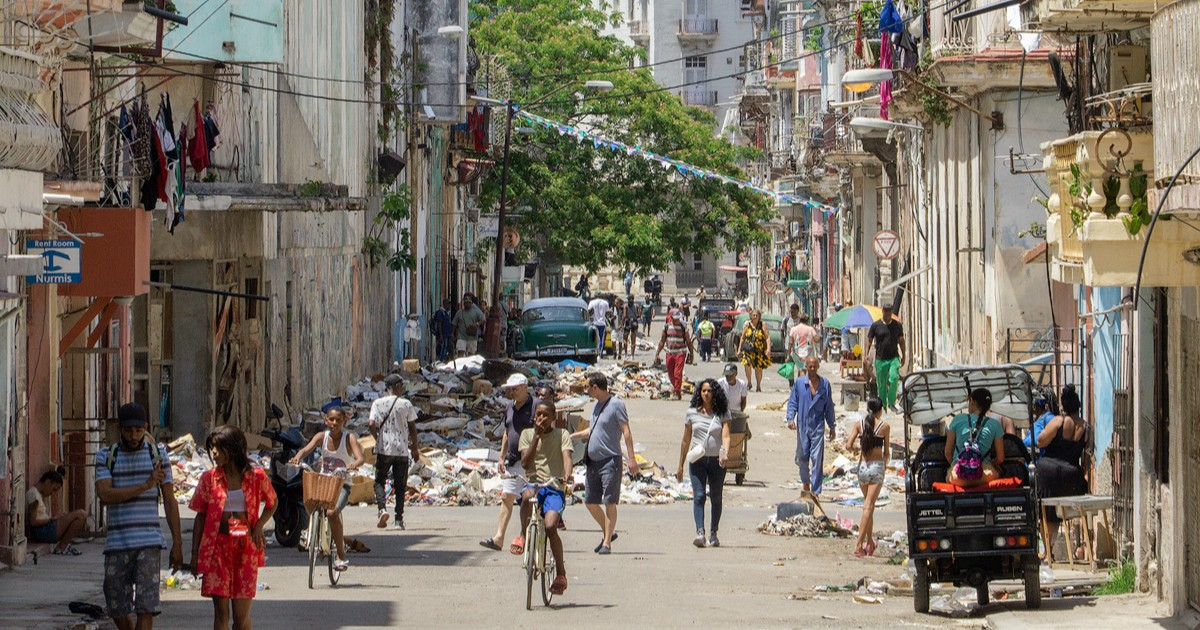
This past Monday, officials from Aguas de La Habana held a press briefing to address the "complex situation" surrounding the water supply in Cuba's capital. However, it swiftly became apparent through the torrent of comments on the state-run Cubadebate site that this candor merely ignited a wave of public outrage, reflecting widespread dissatisfaction among citizens.
Yosvany Rubi Bazail, the general director of the organization, alongside Abel Fernández Díaz, the director of the Aqueduct, revealed that approximately 200,000 residents of Havana—accounting for 11% of the population—are experiencing some form of disruption. These range from complete water shortages to extended intervals between supplies or recurring service failures.
Rather than assuaging concerns, these figures provoked immediate skepticism. One user scoffed, "It's unbelievable how they downplay the situation, claiming it's ONLY 11%. When you go weeks without water, it's not 'complex,' it's catastrophic." Another remarked bluntly, "Just 11%? That's far from the truth."
The Impact Across Havana
Officials acknowledged that nearly every municipality has been affected, sparing only parts of Plaza, Marianao, and Centro Habana. Yet, even in these areas, sporadic interruptions are reported. The causes cited include the deterioration of pumping equipment (40%), power outages (39%), and breakdowns in pipelines (10%), highlighting an infrastructure heavily reliant on an unstable electrical supply.
Beyond statistics, the accounts from citizens laid bare the gravity of the crisis. A resident of Víbora Park lamented, "35 days without water, and the Party, the government, and Aguas de La Habana are all aware, yet nothing is done. It's every man for himself." In Luyanó, a resident reported more than eight days without service, while in Vedado, several comments noted weeks or even months without regular water delivery.
Public Outcry and Criticism of Management
The feeling of exasperation echoed through countless messages: "We can't live like this," expressed one user. Another summarized the pervasive sentiment with a phrase increasingly common on social media: "If it's not the electricity, it's the water."
Critiques extended to management inefficiencies and the absence of concrete solutions. "Everything is just excuses without solutions," lamented a commenter, with another questioning, "What works here?" A user condemned the normalization of the crisis, stating, "They dare to say it's not significant, trying to normalize every misfortune in Cuba."
Structural Issues Exacerbating the Crisis
The issues extend beyond the immediate lack of water supply. Numerous comments highlighted the massive leaks that have gone unrepaired for years. "In Vista Alegre, there are leaks nearly 19 years old," complained a local, pointing to a structural deterioration that worsens scarcity.
Criticism also targets the lack of coordination and transparency. "They don't face the issue or provide necessary explanations," another user criticized, with many demanding clearer information on distribution schedules and interruptions.
Some comments drew a stark contrast between the official narrative and political priorities. "We saw the country's leadership at a conference for a whole week, sitting happily, while the people... Do problems get solved at a conference?" questioned one reader, referencing recent government events.
The accumulation of shortages—water, electricity, gas, and food—reinforces a perception of a widespread crisis. "Everything is scarce in Cuba, living like this is impossible," summarized another comment, while yet another pointedly stated, "All of Cuba has problems with everything."
Cuba's water system has suffered decades of neglect, with aging infrastructure and thousands of active leaks, in an environment where electrical supply—crucial for pumping—remains unreliable. In this backdrop, solutions remain contingent on variables beyond the immediate control of the authorities.
Amid official statistics and technical explanations, the comments underscored a different reality: a profound social exhaustion. As one user succinctly put it, "Until when."
Understanding Havana's Water Crisis
How many people in Havana are affected by the water crisis?
Approximately 200,000 residents, or 11% of Havana's population, are facing some form of water supply disruption.
What are the main causes of Havana's water supply issues?
The primary causes include deteriorating pumping equipment, frequent power outages, and pipeline breakdowns, all compounded by an aging infrastructure.
What has been the public response to the water crisis in Havana?
The public response has been one of widespread frustration and criticism, with citizens expressing disbelief and dissatisfaction over the handling of the crisis.