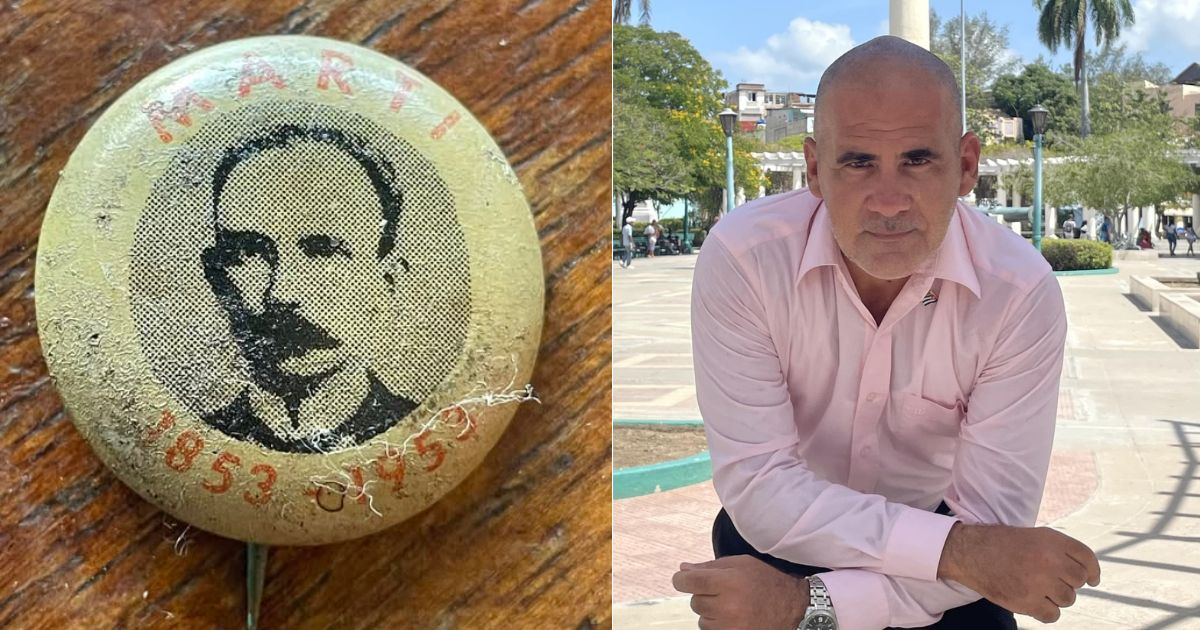
Renowned legal expert and former university professor, René Fidel González García, shared a powerful message on Facebook this past Sunday from Santiago de Cuba. He argued that there are more compelling reasons today than in 1953 for a new generation of Cubans to eliminate "this infernal plague of undesirable rulers and insatiable tyrants that have plunged Cuba into ruin."
The phrase he references is not his own; it originates from the 26th of July Hymn, penned by Agustín Díaz Cartaya in 1953 as an expression of public outrage against the dictatorship of Fulgencio Batista. González García now uses it, with significant historical irony, to critique the regime that has for decades adopted this very hymn as its own emblem.
The impetus for González García's post was a postage stamp commemorating the 100th anniversary of José Martí’s birth, issued in Cuba in 1953. He recounts how he came across a couple of these stamps years ago, giving one to his mother, who cherished it with the silent devotion typical of Martí’s followers. After her passing, his father returned it so that another generation might preserve it.
Reflecting on this family memory, González García draws a historical arc spanning 73 years: "Looking back, and upon reading or listening to the speeches, articles, and arguments from that time, the ideals and aspirations for democracy, justice, and prosperity that many believed were our destiny, it’s impossible not to calmly observe that today in Cuba, there are even more political, economic, and social reasons than back then."
He believes it is crucial for a new generation to embody “the doctrines of the Master in their hearts” — as Fidel Castro proclaimed in his 'History Will Absolve Me' speech — and to uphold them boldly in the face of all challenges, exercising utmost integrity.
The post coincided with Miguel Díaz-Canel presiding over the main events in the Ciénaga de Zapata for the 65th anniversary of Playa Girón, launching the "My Signature for the Homeland" campaign, a movement organized by the Communist Party of Cuba to support the official statement "Girón is today and always." Just days earlier, on April 16, Díaz-Canel had led an event in Havana’s Vedado district, where he blamed the U.S. embargo for the country's woes and urged Cubans to prepare for resistance.
This stark propaganda effort stands in painful contrast to the reality faced by the Cuban population: power outages lasting over 20 hours daily, 89% of Cubans living in extreme poverty, severe shortages of food, fuel, and medicine, and a projected GDP contraction of 7.2% for 2026, accumulating a 23% decline since 2019.
The energy crisis worsened after the downfall of Nicolás Maduro in January 2026, which halted Venezuelan crude shipments to the Island, compounded by U.S. government pressure that also cut off supplies from Mexico.
González García is not an unknown dissenter. He holds a Doctorate in Legal Sciences, is an essayist, and was a Full Professor at the University of Oriente in Santiago de Cuba until November 11, 2016, when he was dismissed and professionally blacklisted for publishing critical articles in outlets like La Joven Cuba, Rebelión, and Cuba Posible.
Since then, he has faced systematic harassment by the State Security, threatened with criminal charges for "enemy propaganda," "disrespecting the president," and "disobedience." In October 2025, he filed a lawsuit against President Díaz-Canel and Attorney General Yamila Peña Ojeda in the Supreme Court for constitutional violations, warning he would go on a hunger strike if prosecuted. Nevertheless, this past Sunday, he expressed his reflection, affirming his peace of mind.
The scholar concludes his post with a 19th-century quote from José Martí, serving as a warning against authoritarian governance models, applicable both to Batista in 1953 and implicitly to the current regime: "A nation is not founded, General, like a military camp is commanded."
Understanding the Current Cuban Crisis
Why does René Fidel González García believe there are more reasons now to challenge the Cuban government?
He argues that due to accumulated political, economic, and social issues, there are more compelling reasons today to challenge the Cuban government than there were in 1953.
What historical reference does González García use in his message?
González García references the 26th of July Hymn, initially a protest against Batista's dictatorship, but now used ironically to criticize the current regime.
What impact has the energy crisis had on Cuba according to González García?
The energy crisis, exacerbated by the halt in Venezuelan oil shipments and U.S. pressure on Mexican supplies, has led to extensive power outages and worsened living conditions.