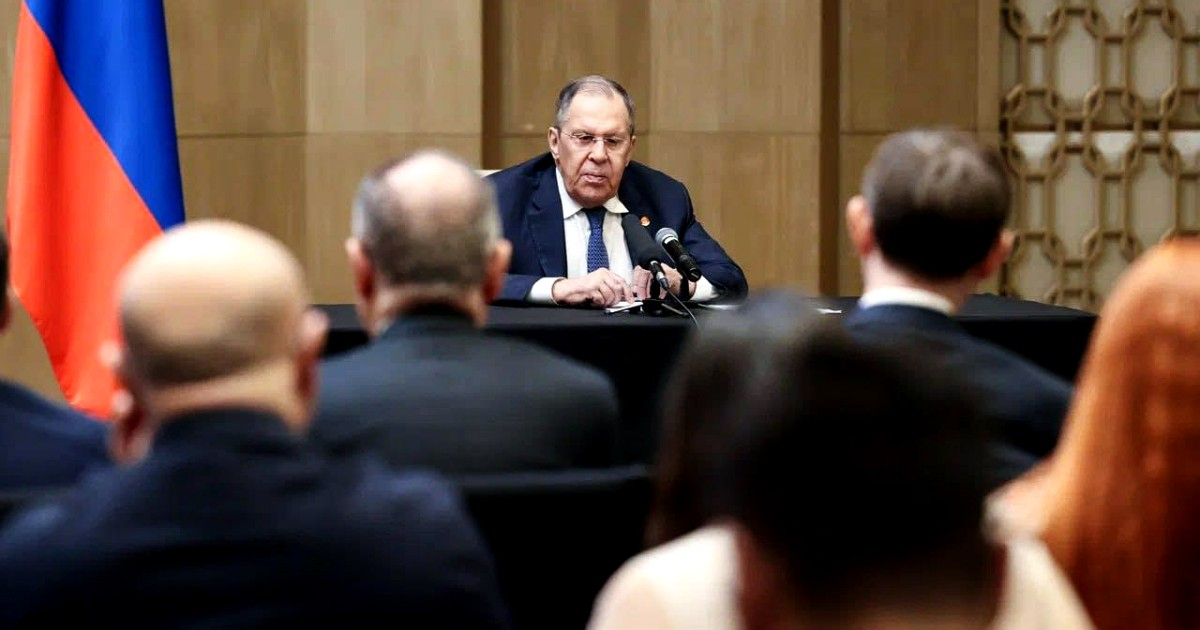
The Russian embassy in Cuba recently shared a Facebook post featuring statements from Foreign Minister Sergei Lavrov, emphasizing Moscow's support for Havana while steering clear of any military commitment in response to potential U.S. intervention.
As tensions between Washington and the Cuban regime continue to mount, Lavrov spoke on April 15 following his official visit to China. He responded to inquiries about President Donald Trump's threats, where Trump suggested that the U.S. might "deal with Cuba" after addressing its issues with Iran.
"I will not speculate on possible outcomes of this move. We have heard various statements from Washington, and not all have resulted in practical actions," stated the seasoned diplomat and close ally of Vladimir Putin, as reported by the Russian foreign ministry.
Lavrov reaffirmed Moscow's "political, economic, and humanitarian support," but made it clear that defending the island is primarily the responsibility of the Cuban government: "Statements from Cuban leadership, including President Miguel Díaz-Canel, confirm their resolve to defend their freedom to the very end, by any means necessary."
The foreign minister also revealed that Russia dispatched "the first ship carrying one hundred thousand tons of oil to Cuba," which he admitted is sufficient "for a couple of months."
The post triggered a wave of reactions on social media, with many interpreting it as a sign that Moscow might distance itself in the event of a military conflict with the U.S., potentially leaving the Cuban regime vulnerable.
This pattern is not entirely new. In late January, during a severe fuel crisis in Cuba following the cessation of Venezuelan supplies, Russian Ambassador Viktor Koronelli remarked that the solution lay with the Cuban government, although he extended Moscow's support, according to TASS news agency.
The apparent estrangement stands in contrast to the formal strengthening of bilateral defense ties. In March 2025, Russia and Cuba signed an intergovernmental military cooperation agreement, which Putin ratified as law in October of the same year.
Simultaneously, the U.S. Department of State estimated that between 1,000 and 5,000 Cubans are currently involved in military operations with Russia in Ukraine, while Ukrainian military intelligence placed that number at a minimum of 20,000 recruits since the conflict began.
The strain with Washington has intensified since January 2026, when Trump enacted Executive Order 14380, declaring the Cuban government an "extraordinary threat to national security" and imposing tariffs on countries selling oil to the island.
In mid-March, Trump declared from the White House: "I think I will have the honor of taking Cuba." On March 27, in Miami Beach, he added: "Cuba is next, but pretend I didn't say that."
Meanwhile, the Pentagon has been quietly ramping up plans for potential military operations on the island, according to recent reports by USA Today. In response, Díaz-Canel, last Wednesday, warned of a potential military aggression and urged the Cuban populace to brace for a confrontation, drawing comparisons to the 1961 Bay of Pigs invasion.
Lavrov, for his part, urged Washington to resume dialogue: "During the Obama administration, agreements were reached with Cuba. Havana accepted them. These were agreements of mutual respect and beneficial for both parties."
He concluded with a veiled warning: "It is said that with courtesy and good manners, one can achieve far more than with the opposite traits of human character."
Cuba and Russia: Political Support vs. Military Commitment
What support has Russia promised to Cuba?
Russia has pledged political, economic, and humanitarian support to Cuba but has avoided any military commitments.
How has the U.S. responded to the situation with Cuba?
The U.S. has intensified its stance, with President Trump declaring Cuba an "extraordinary threat" and imposing tariffs on countries selling oil to Cuba.
What was the reaction to Russia's Facebook post about Cuba?
The post sparked numerous reactions on social media, with many interpreting it as a sign of Russia distancing itself from potential military conflict with the U.S. over Cuba.