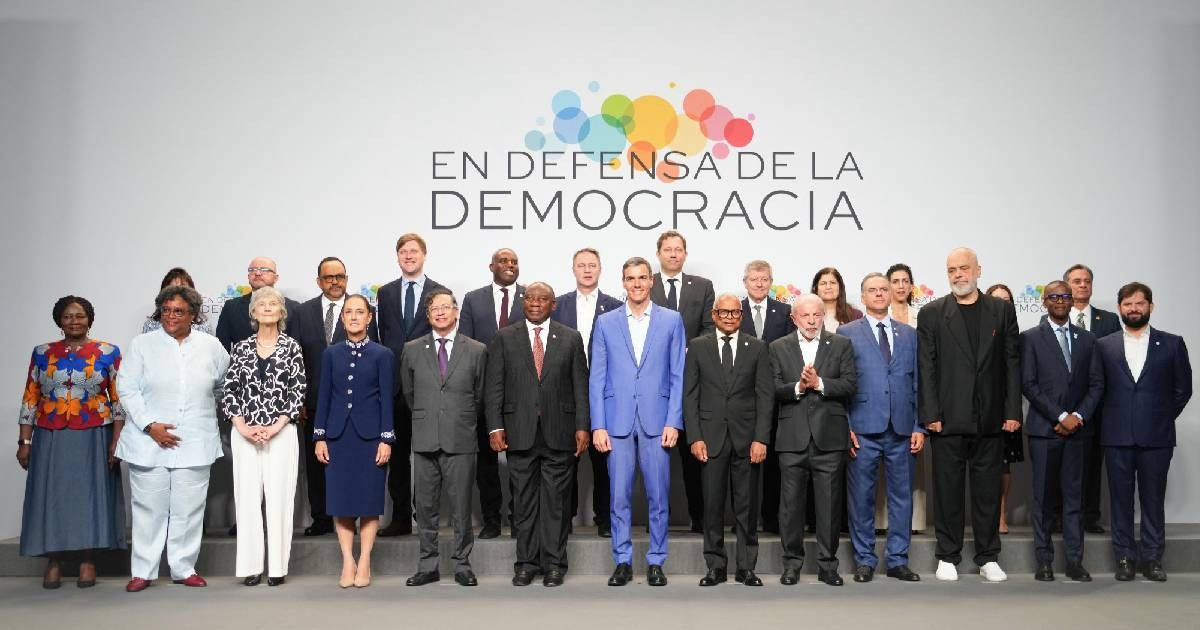
On Saturday, the governments of Spain, Brazil, and Mexico issued a joint statement expressing their deep concern over the severe humanitarian crisis in Cuba, while advocating respect for the island's "territorial integrity, sovereign equality, and peaceful resolution of disputes" without external interference.
This declaration, aligning with the principles outlined in the United Nations Charter, was signed during the Fourth Summit for the Defense of Democracy held in Barcelona. Spanish Prime Minister Pedro Sánchez hosted the event, welcoming Brazilian President Luiz Inácio Lula da Silva, while Mexican President Claudia Sheinbaum contributed via a recorded message.
The communiqué urged a "genuine, respectful dialogue in accordance with International Law" to find a lasting solution to Cuba's predicament, explicitly excluding U.S. intervention. Furthermore, the three nations pledged to enhance their coordinated humanitarian efforts "to alleviate the suffering of the Cuban people" and called for "necessary measures to improve the situation," urging the avoidance of actions that could worsen the living conditions of the population.
Commitment to Human Rights and Multilateral Solutions
The participating governments reiterated their "unwavering commitment to human rights, democratic values, and multilateralism," emphasizing that the objective of the dialogue is to "find a sustainable resolution to the current situation." They stressed that it should be "the Cuban people themselves who choose their future freely."
This statement emerges amid escalating U.S. pressure on Cuba. Since January 2026, the Trump administration cut off Venezuelan oil supplies to Cuba following Nicolás Maduro's capture, eliminating between 26,000 and 35,000 barrels per day, which previously met 80-90% of Cuba's energy needs.
Impact of U.S. Policy and Energy Crisis
On January 29, Trump signed Executive Order 14380, labeling Cuba as an "unusual threat to national security" and imposing tariffs of up to 50% on countries supplying oil to the Cuban government, further hindering shipments from Mexico. The resulting energy crisis has led to 64% power outages, transportation shutdowns, school closures, and the collapse of essential services like health, water, and food supply.
The trilateral communiqué also arrives amid increasing military rhetoric from Washington. On April 15, USA Today reported that the Pentagon had received a White House directive to expedite military planning in Cuba. In response, Trump ambiguously remarked, "It depends on what you mean by military action."
Analysts suggest that the emphasis on "territorial integrity" in the communiqué is aimed at deterring potential U.S. military intervention, although the document does not demand specific political reforms from the Cuban regime nor address the repression faced by Cubans under Miguel Díaz-Canel's dictatorship.
The United Nations launched a $94.1 million emergency plan for fuel in Cuba's critical services, though as of March 2026, only $26 million had been secured.
Key Questions about the Cuba Crisis
What was the purpose of the joint statement by Spain, Brazil, and Mexico?
The joint statement aimed to express concern over Cuba's humanitarian crisis and call for respect for its territorial integrity, advocating for a peaceful resolution without external intervention.
How has the U.S. policy affected Cuba's energy situation?
The U.S. policy, particularly the cessation of Venezuelan oil supplies and the imposition of tariffs on oil imports, has led to an energy crisis in Cuba, causing widespread power outages and the collapse of essential services.
What is the significance of the emphasis on "territorial integrity" in the communiqué?
The focus on "territorial integrity" is likely intended to discourage any potential U.S. military intervention in Cuba, though the statement does not specifically address the need for political reforms in the country.