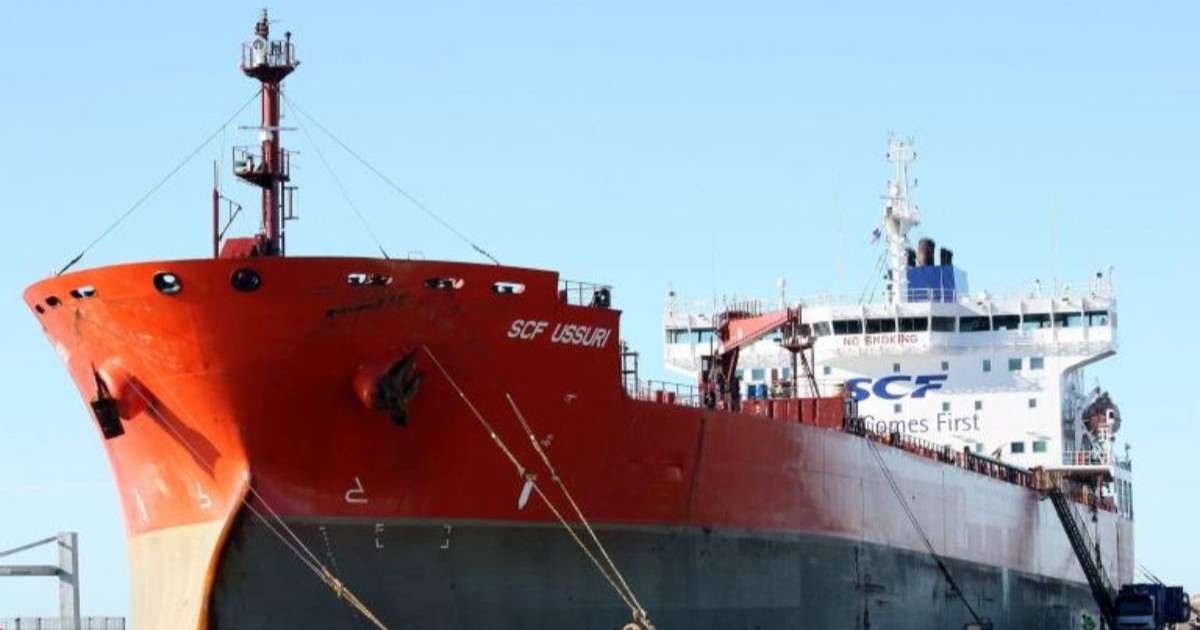
The Russian tanker Universal, which has been sanctioned by the United States, the European Union, and the United Kingdom, is currently navigating the North Atlantic towards the Caribbean. Tracking data indicates it could reach Cuba in approximately 15 days.
Although the tanker lacks a declared final destination on its automatic identification systems, it is anticipated to deliver a second shipment of Russian fuel to the island. This follows the arrival of the tanker Anatoly Kolodkin at the Matanzas port on March 31, carrying 730,000 barrels of crude oil.
"Given its profile, there is a high likelihood that its destination is Cuba," stated Jorge Piñón, a researcher at the University of Texas's Energy Institute, in an interview with EFE.
The Universal is operated by the Russian state-owned shipping company Sovcomflot, the same company responsible for the first Russian oil shipment to Cuba with the Anatoly Kolodkin, also under Western sanctions.
This tanker, built in 2009, is specialized in transporting petroleum products and chemical derivatives. It measures 183 meters in length and has a deadweight carrying capacity of 50,923 tons.
Setting sail from a Baltic Sea port in early April, the vessel traversed the English Channel last Wednesday, escorted by a Russian frigate to avoid issues with British authorities.
Energy Tensions Between Russia and Cuba
Just days prior, Russian Energy Minister Serguéi Tsiviliov announced a second fuel shipment to Cuba during the Energoprom-2026 forum in St. Petersburg on April 2, while the Anatoly Kolodkin was still unloading in Matanzas.
"A Russian ship broke through the blockade. A second ship is currently being loaded, and we won't leave the Cubans in a bind," Tsiviliov declared at the forum.
However, the Anatoly Kolodkin's cargo only covered about seven to ten days of supply for the island, which requires between 90,000 and 110,000 barrels daily, but produces merely 40,000.
Cuban Government Criticizes U.S. Energy Blockade
Cuban Foreign Minister Bruno Rodríguez accused the U.S. government of issuing contradictory statements concerning oil supplies to Cuba in a message posted on X.
Rodríguez claims the Trump administration aims to "create confusion to continue obstructing fuel entry into Cuban territory."
The Cuban regime labels Washington's measures as an extraterritorial "energy blockade" that "intimidates, pressures, and extorts those who trade sovereignly with Cuba."
Conversely, between February and March, the U.S. exported over $2.5 million in gasoline and fuel oil to Cuba, purportedly for the private sector.
Fuel Crisis Deepens in Cuba
The energy crisis in Cuba worsened dramatically on January 3, 2026, following the capture of Venezuelan President Nicolás Maduro by U.S. forces, which disrupted the Venezuelan oil flow that had sustained the island for over two decades.
Mexico halted its fuel sales to Cuba on January 27, 2026, cutting off the regime's two primary external suppliers simultaneously.
Cuban President Miguel Díaz-Canel acknowledged after the arrival of the first Russian shipment that the fuel "will help in the coming weeks," but admitted "it is not enough."
Experts warn that Cuba would need an investment between $8 billion and $10 billion to modernize its energy infrastructure and overcome the crisis sustainably, as the national economy has contracted by 15% from 2020 to 2025.
Understanding Cuba's Fuel Dilemma
Why is the Universal tanker significant to Cuba?
The Universal tanker is significant because it represents a potential second shipment of Russian oil to Cuba, which is crucial due to the island's current fuel shortages.
What challenges does Cuba face in obtaining fuel?
Cuba faces challenges such as U.S. sanctions, a disrupted supply from Venezuela, and a lack of sufficient domestic production, leading to a severe energy crisis.
How has the political climate affected Cuba's fuel supply?
The political climate, including U.S. sanctions and tensions with external suppliers like Mexico and Venezuela, has significantly impacted Cuba's ability to secure stable fuel supplies.