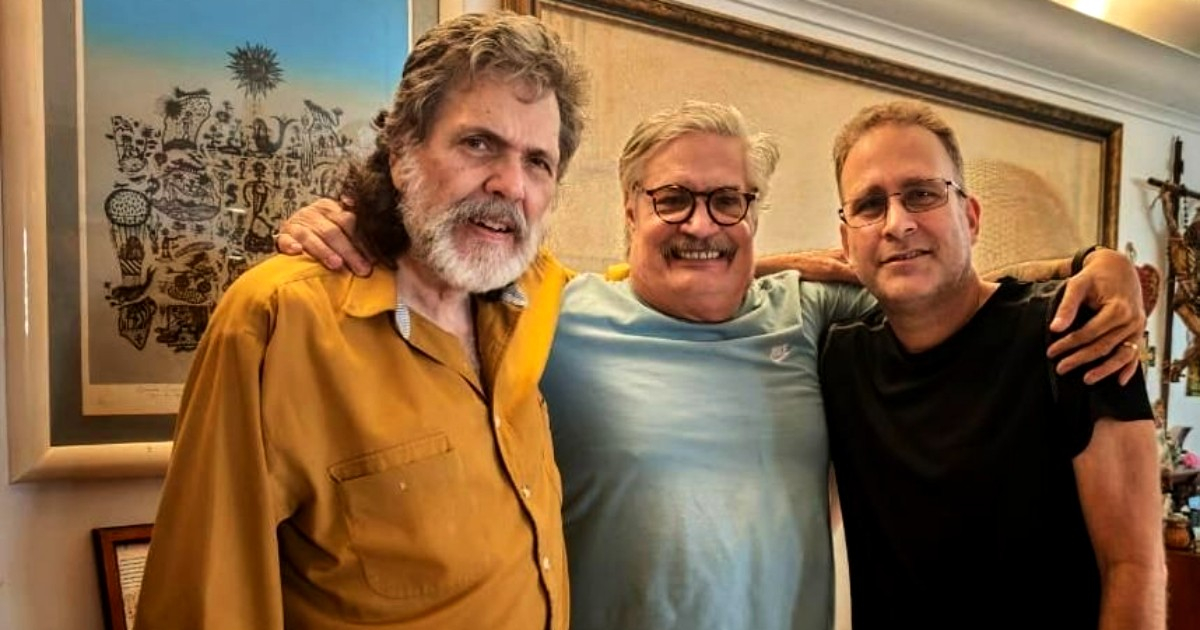
Abel Prieto, former Cuban Minister of Culture and current president of Casa de las Américas, took to Facebook to share a photo with singer-songwriter Amaury Pérez and official Luis Morlote, the head of the Union of Writers and Artists of Cuba. The post recounted an emotional visit where they reminisced about John Lennon and his tragic assassination in 1980.
In his post, Prieto shared a poignant story from Pérez, who recalled celebrating his birthday on December 26, 1980—just 18 days after Lennon's death—amidst tears and rum. "He and his friend Pepe had hung a photo of Lennon adorned with a black mourning ribbon on the wall. They drank, cried, and toasted to the disembodied spirit of John," Prieto recounted.
Prieto used this moment to politically co-opt Lennon's legacy, claiming that the former Beatle would today be a peace activist, opposing figures like Trump, Netanyahu, and other so-called "fascist genocidal fauna."
Hypocrisy and Regime's Cultural Control
The scene was strikingly hypocritical, given Prieto's role as a key figure in the Cuban regime's cultural apparatus—the same system that banned Beatles music for decades, deeming it "ideological diversionism," as reported by Reporters Without Borders (RSF). Cuban youths faced discrimination and were sent to the Military Units to Aid Production (UMAP), forced labor camps active between 1965 and 1968, simply for listening to this music. Even Silvio Rodríguez faced suspension from Cuban TV for expressing his admiration for the Beatles.
Prieto's Controversial Past
Prieto served as president of the Union of Writers and Artists of Cuba, Minister of Culture from 1997 to 2012, and advisor to Raúl Castro. During his tenure, he supported Decree 349, a law seen as a censorship tool that restricted critical artistic expressions, sparking protests among Cuban artists.
In 2019, Prieto issued an apology for the "Grey Quinquennium"—a period of intense cultural repression from 1971 to 1976—describing it as a "temporary mistake" by former officials, denying direct government responsibility. His remarks were widely criticized for downplaying the repression.
Regime's Shift on Lennon
The regime's official pivot towards Lennon came on December 8, 2000, when dictator Fidel Castro unveiled a bronze statue of the musician in a Havana park, declaring, "I deeply regret not having met you earlier." This symbolic rehabilitation lacked an apology to the generation of Cubans who suffered repression for admiring him, yet it paved the way for the nostalgic tears of those once persecuted by the same regime they now embrace.
Cuban leader Miguel Díaz-Canel has continued this appropriation, publicly professing his fandom for the Beatles, a move critics see as an attempt by the so-called revolutionary "continuity" to mask past repression by embracing figures once targeted by the regime.
Pérez himself was not immune to this logic. He was expelled from the Cuban New Trova Movement in the early 1980s, and his album "Retrato de Navidad" was banned from Cuban radio and TV, adding another layer of irony to Prieto's symbolic embrace in the post.
Prieto's post concluded with an anecdote about how Pérez's grief on that night in 1980 ended when his future partner arrived: "Our troubadour's eyes miraculously absorbed the tears, ending the mourning and beginning a beautiful love story."
"Lennon would undoubtedly approve of this happy ending," Prieto concluded, indulging in his fragile fiction about the author of "Revolution," a song that would have made the "spiritual leader of humanity" and "paradigm" cover his ears, recalling the "stoic" dictator who was bothered by the "tight pants, some guitars, and Elvis-like attitudes" of the youth listening to the Beatles.
Exploring Cuba's Cultural Repression and Legacy
What was the impact of the Beatles' music ban in Cuba?
The ban on Beatles' music in Cuba led to discrimination against young fans and their persecution in forced labor camps, known as UMAP, for engaging with the so-called "ideological diversionism" represented by the Beatles.
How did Abel Prieto contribute to Cuba's cultural policies?
Abel Prieto, as Minister of Culture, supported Decree 349, which restricted artistic expression critical of the government. His tenure is marked by controversy, including a criticized apology for the "Grey Quinquennium" repression.