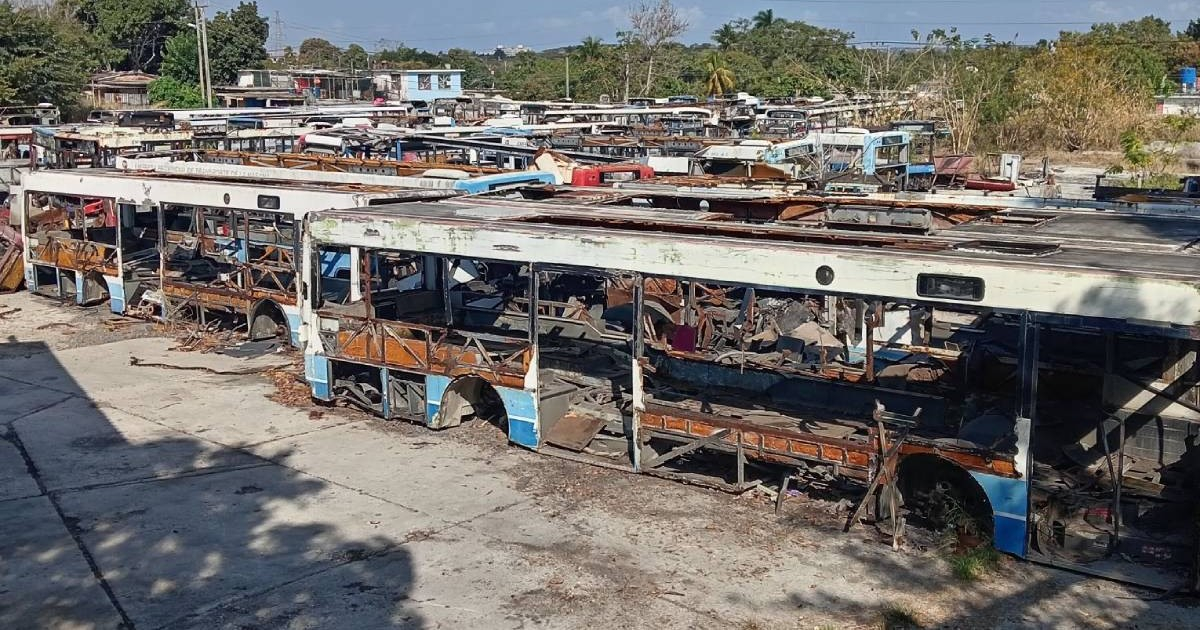
A recent chart released by Cuban economist Pedro Monreal starkly illustrates the drastic decline in Cuba's bus manufacturing industry. From 473 buses produced in 2019, projections suggest a mere 12 will be built by 2026, marking a staggering 97.5% decrease over seven years.
Monreal shared this chart on his X account, dubbing it "The Unstoppable Evaporation of Cuba's Transportation Equipment Industry." This phrase encapsulates decades of accelerated deterioration under the regime's centralized model.
The data paints a grim picture with no signs of recovery: 473 buses in 2019, dropping to 344 in 2020, 154 in 2021, just 60 in 2022, a slight rebound to 72 in 2023, falling again to 53 in 2024, and projections of only 17 for 2025 and 12 for 2026.
The Struggles of CAISA
The only bus assembly plant in Cuba, the Empresa Productora de Ómnibus Evelio Prieto Guillama (CAISA) in Guanajay, Artemisa, has a history spanning over 52 years with more than 35,000 vehicles produced. At its peak, CAISA manufactured 350 units of the Diana model in 2016, earning a Labor Achievement Award. However, in 2024, CAISA planned to produce five Diana buses but delivered just one due to difficulties in importing parts.
Faced with the inability to sustain bus production, CAISA shifted its focus in January 2025 to manufacturing two-wheeled Diana motorcycles as a means of industrial survival, according to the official newspaper Trabajadores.
Government Efforts and the Transportation Crisis
In January 2026, the government announced the repair of 100 buses thanks to a $10 million donation of parts from China received in August 2025, with a stabilized rate of eight units per month. The original goal of repairing 20 buses by the end of 2025 was not met, reported Juventud Rebelde, another official media outlet.
The production collapse directly impacts public transportation. In March 2026, Transportation Minister Eduardo Rodríguez Dávila acknowledged that national buses operate with only one departure per day, trains run every eight days, and the ferry to Isla de la Juventud has a mere two weekly trips.
On January 31, 2026, the regime admitted that public transportation covers just 42% of the planned targets.
A Broader Economic Crisis
This sector's collapse is part of a broader economic crisis. The Cuban economy shrank by 5% in 2025, accumulating a decline of more than 15% since 2020, as reported by the Center for the Study of the Cuban Economy.
Furthermore, The Economist Intelligence Unit forecasts an additional 7.2% contraction for 2026, according to the Efe news agency.
Monreal, who also criticized the conservative approach of Decree 127/2025 regarding economic reforms, pointed out that the fulfillment of plans in 2025 was only 51%. This is evidence that the centralized model is incapable of reversing a decline that, in the case of buses, is nearing industrial extinction.
Frequently Asked Questions about Cuba's Bus Manufacturing Decline
What has caused the decline in Cuba's bus production?
The decline is attributed to decades of deterioration under a centralized economic model, difficulties in importing parts, and broader economic challenges facing the country.
How has the decline in bus production affected public transportation in Cuba?
The decline has led to a severe reduction in public transportation services, with limited bus departures, infrequent train services, and reduced ferry trips.
What measures has the Cuban government taken to address the transportation crisis?
The government has attempted to repair existing buses with donated parts from China, but initial targets for repairs have not been met.