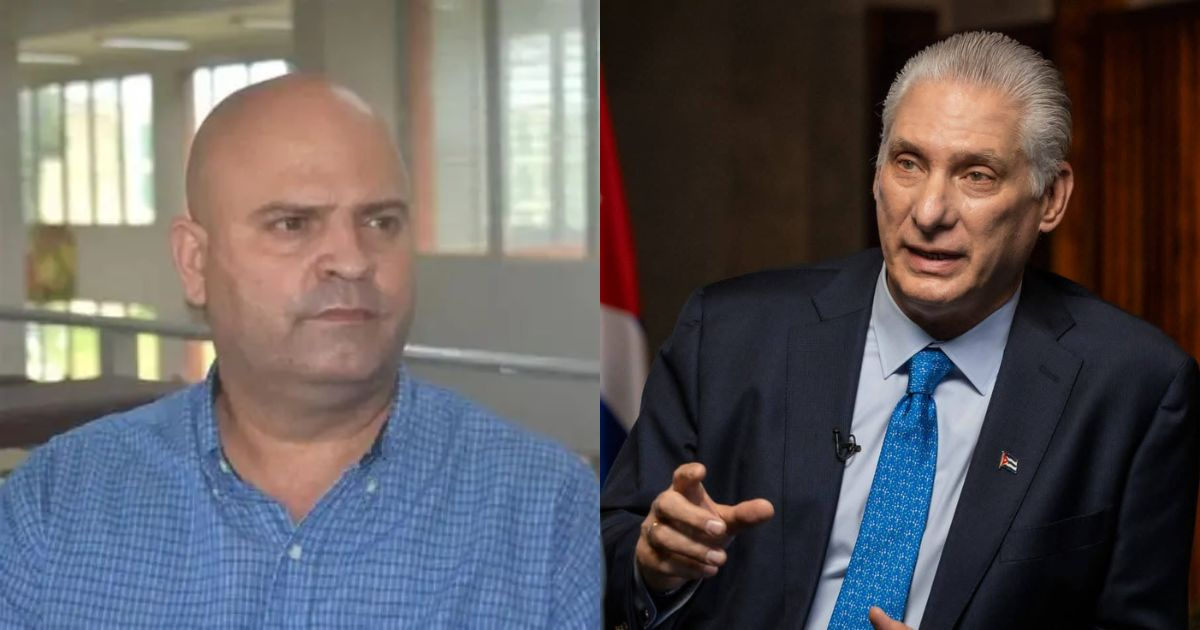
In the not-so-distant future, there ought to be a monument dedicated to the absurdity, flattery, and rural romanticism with which Cuban leaders consistently shower each other with praise.
This time, Osnay Miguel Colina, head of the organizing committee for the XXII Congress of the Central Workers' Union of Cuba (CTC), has published a fervent ode to Miguel Díaz-Canel, portraying him as little less than a hero: "the blonde youth [who] roamed Santa Clara on a bicycle at any hour, whether in the darkness of blackouts or the early morning hours" during the 1990s; the one who cut sugarcane, picked coffee in the mountains, and faced hurricanes head-on.
Those who claim that Díaz-Canel "came out of nowhere," lacking "political substance," are mistaken, Colina asserted. They overlook that during the Special Period, he had to "face the bullets" [...] "and rose to continue creating and building, pushing a country forward." Indeed, between the pushes given by the writer and namesake Miguel Barnet and those of the "blonde youth," one might understand why the Island seems to be tumbling down a cliff.
The post, accompanied by photographs from various stages of Díaz-Canel's political career, spares no exclamation: "How many times did he climb the Escambray amid floods from any cyclone, how many times did he visit bakeries, factories, schools with only the protocol of a man trying to understand the needs of every corner!
Colina then recounts Díaz-Canel's tenure as the first secretary of the PCC in Holguín province, where, he claims, "he won the affection of a people who did not see his birth, yet embraced him with the respect and gratitude that made him a son of the land of Fidel and Raúl."
And, inevitably, the epic poem of "canelian" praise culminates in the current situation, describing the Homeric hero "at the center of a war that tries by all means to break or ridicule him, but they forget that, as he confessed in his recent exchange with the American media NBC News: 'in the concept of revolutionaries, surrender is not an option.'
The patriotic verses conclude with the hashtags "#YoSigoAMiPresidente" and "#LaPatriaSeDefiende." The latter serves as the central slogan with which, hours before the "declaration of love" to the leader, Colina had launched, on behalf of the CTC, the official call for May Day 2026, with a combative tone reflecting the tension between the White House and the Palace of the Revolution.
Apparently, the current CTC leader is unaware of the adjective with which, from Pinar del Río to Guantánamo, many Cubans refer to the "blonde youth," appointed as president by Raúl Castro in 2018. Nor has he likely seen the spontaneous popular polls on social media inviting him to graciously step down, in line with what he stated in the NBC News interview, that it should be the people who evaluate his competence.
Oh, portraits of pandering tenderness, what loving poetry the people will offer when it is their turn to push you out of the country.
Understanding the Political Climate in Cuba
Why does the article criticize the Cuban leadership?
The article criticizes Cuban leadership for its perceived insincerity and inefficacy, highlighting the self-congratulatory nature among officials and the discontent among the populace.
What is the significance of the hashtags mentioned?
The hashtags "#YoSigoAMiPresidente" and "#LaPatriaSeDefiende" symbolize support for Díaz-Canel and a defensive stance against perceived external threats to Cuba's sovereignty.
How does the article portray Díaz-Canel's leadership?
The article portrays Díaz-Canel's leadership as controversial, with some seeing him as a heroic figure while others view him as lacking political substance and effectiveness.