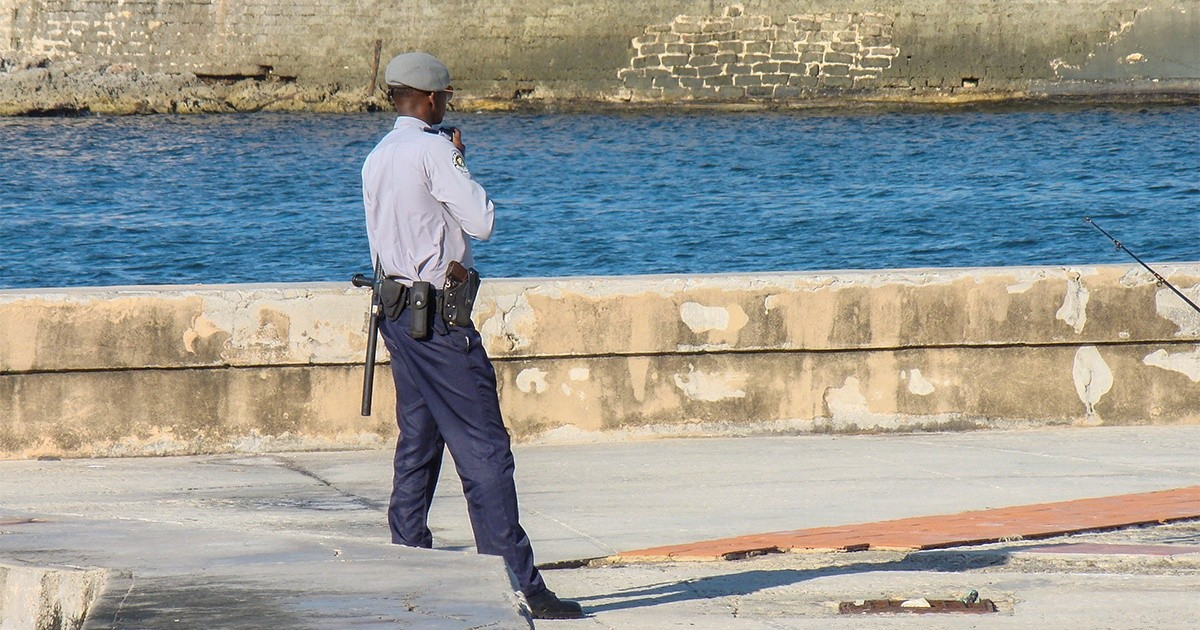
In Havana, the Cuban government has reportedly initiated a new police tactic known as "Operation Rake" or "Operation Containment." This strategy involves the deployment of the National Special Brigade (BEN), commonly called the Black Berets, alongside the Revolutionary National Police (PNR), to patrol strategic points across the capital. Their objective is to identify, detain, and pressure individuals with outstanding state fines.
According to Martí Noticias, officers are stopping pedestrians in parks and squares, checking their identities against the Police Operational Registry. If unpaid fines are discovered, these individuals are taken to police stations where they face psychological pressure to enforce immediate payment.
One of the most documented cases involves independent journalist Pablo Morales Marchant, who was intercepted last Wednesday at the Fraternity Park in Old Havana.
Officers reviewed the police registry and found a debt of 32,000 Cuban pesos under his name, a sum that had doubled over months due to non-payment of an original fine imposed by State Security for "illicit economic activity."
"They told me: 'Hold on, we're going to run your record to see what comes up,'" Morales Marchant recounted to Martí Noticias.
After being identified as a debtor, he was taken on foot to the police station on Dragones Street, where he remained detained for 17 hours under psychological pressure to pay the penalty.
Before his release, he was forced to sign a "warning act," committing to the payment.
"They say this is initially a prophylactic measure where they inform you about the fine and if you don't pay, it becomes an act of disobedience," the journalist explained.
Morales Marchant described to the aforementioned outlet what he witnessed inside the police unit.
"There were many young men in the unit, around 20, mostly Afro-descendants under 30, including two teenagers. About a third were debtors, with amounts ranging from 118,000 to 32,000, to 8,000. They're being conditioned that if they don't pay, they'll go to prison," he noted.
The authorities are also urging citizens to sell their personal belongings to settle the fines.
"What these henchmen are doing is abusive, taking people out of prison and putting others in, advising them to sell their belongings to pay fines imposed arbitrarily and abusively," Morales Marchant emphasized.
"Operation Rake" occurs amidst a severe economic crisis and a wave of protests that, since early March, has led to at least 156 demonstrations in various Cuban provinces due to power outages lasting up to 15 hours and shortages of essential goods.
For human rights observers, the use of elite forces from the Ministry of Interior—like the Black Berets, sanctioned by the United States under the Magnitsky Act in July 2021 for their role in the July 11th repression—to collect administrative fines highlights the militarization of everyday surveillance and represents an economic and legal stranglehold strategy over the Cuban populace.
Understanding the Impact of "Operation Rake" in Cuba
What is "Operation Rake" in Havana?
"Operation Rake" is a police tactic in Havana where the National Special Brigade and the Revolutionary National Police patrol strategic areas to identify, detain, and pressure individuals with unpaid state fines.
Who is affected by "Operation Rake"?
The operation targets individuals with outstanding fines, often intercepting them in public places like parks and squares, and pressuring them to pay these fines under threat of further legal action.
How does "Operation Rake" relate to Cuba's current economic situation?
The operation is unfolding amid a deep economic crisis in Cuba, characterized by widespread shortages and long power outages, which have sparked numerous protests across the country.