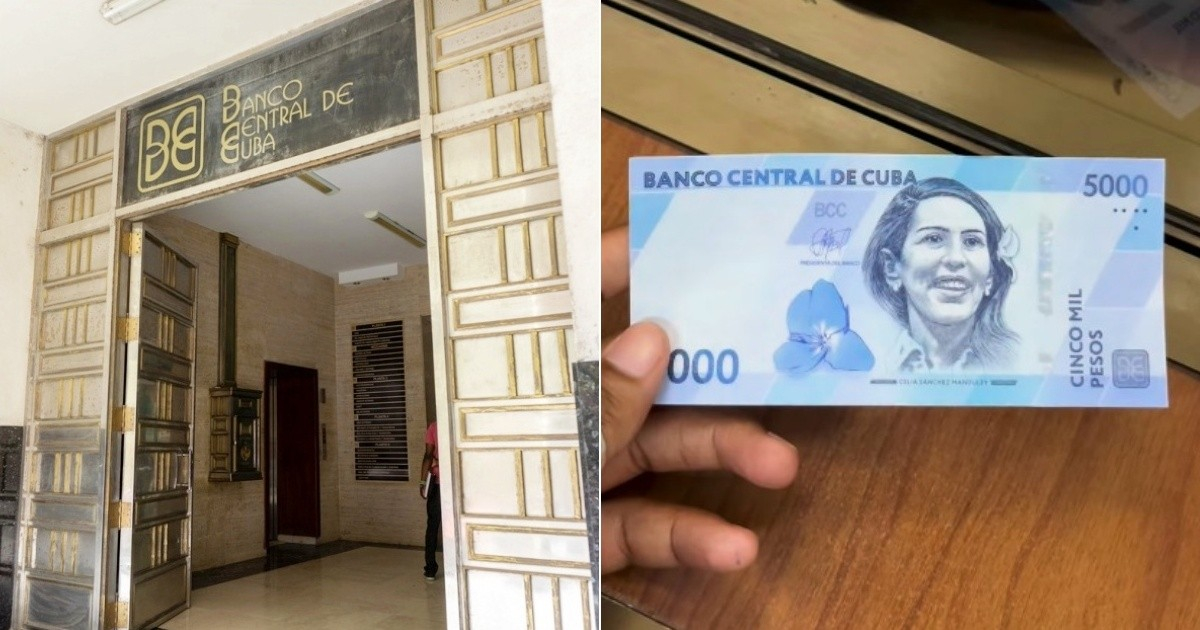
The recent introduction of 2,000 and 5,000 Cuban peso banknotes has sparked immediate reactions among the public, including anxiety, skepticism, and a pressing question echoed across streets and social media: Does the increase in banknotes equate to more inflation?
While many Cubans instinctively link this measure to a rise in prices, the Central Bank of Cuba (BCC) has stepped in to challenge this assumption. The institution argues that the connection, though seemingly logical, is not straightforward.
According to an expert from the BCC's Economic Studies Directorate, the belief that more banknotes automatically lead to increased inflation is "a reasonable intuition, but it's incomplete."
The Misconception of Money Creation
The Central Bank acknowledges that a widespread misunderstanding exists: the belief that money is created when banknotes are printed. However, they assert that, in practice, the opposite is true.
"Money doesn't originate from a printing press," explains the official analysis, highlighting that in modern systems—including Cuba's—the majority of money exists as accounting records within banks.
In this context, the BCC emphasizes a crucial point: "Banknotes do not create money; they are merely the 'visible face' of money that already exists."
This means that when someone withdraws cash from their account, they are not generating new money but merely converting a digital balance into physical form. Thus, the total amount of money in the economy remains unchanged.
The Reality of Money Creation in Cuba
The BCC outlines three main ways through which money enters circulation:
- Bank credit: when banks approve loans and create new account balances.
- Government spending: through the sale of debt to the Central Bank and its subsequent use in payments.
- Conversion to cash: this does not create money but rather transforms it.
Regarding the last point, the BCC is adamant: "It's the only one that produces physical banknotes, but […] DOES NOT CREATE NEW MONEY."
The Rationale Behind High-Denomination Banknotes
So, why issue high-denomination banknotes? The Central Bank points to a different issue: the shortage of cash in the face of high demand for physical money.
In an environment marked by inflation, economic informality, and technological limitations, cash remains the predominant mode of transaction in Cuba. This situation creates tension between the money held in banks and the banknotes available on the street.
"The logical solution […] is to expand the currency structure," explains the specialist, meaning the introduction of higher-value banknotes to facilitate transactions.
Far from being the root cause of the problem, the BCC maintains that this measure is a response to the current situation and that, "rather than creating inflation, this measure adapts the payment system to an inflation that already exists."
Inflation, Crisis, and an Implicit Admission
Nevertheless, the issuance of these banknotes occurs amid a critical economic scenario.
The Central Bank has acknowledged that the decision is directly tied to rising prices and the increased circulation of money.
As Julio Antonio Pérez Álvarez, the director of issuance and securities at the BCC, admitted recently, the move was made "to respond to the demand created by price increases and the rise in circulation."
In practice, this implies an implicit acknowledgment of the deteriorating purchasing power of the Cuban peso, which in the informal market hovers around 520 CUP per dollar, while salaries remain largely stagnant.
Public Perception: A Different Reality
Despite the Central Bank's technical explanation, the popular reaction has been largely critical.
Expressions like "my salary in one bill" or "a piece of paper solves nothing" reflect a widespread sentiment: that the new banknotes fail to address the underlying problem.
For many Cubans, the logic is more straightforward: if higher-denomination banknotes are needed to buy the same goods, it's because the money's value has decreased.
And although the BCC insists that "the distribution of cash […] is a reflection of the capacity to generate income," in practice, the phenomenon is intertwined with deeper issues: distrust in the banking system, the expansion of the informal economy, and inflation eroding salaries daily.
More Banknotes, But No More Solutions
Ultimately, the debate is not just technical but profoundly social.
The Central Bank defends that the new banknotes do not generate inflation but are a response to it. However, in daily life, where prices climb and money buys less, the distinction between cause and consequence becomes irrelevant.
Because, beyond how money is created, what defines citizens' perception is how much they can buy with it. And in today's Cuba, that purchasing power continues to decline.
Understanding Cuba's Economic Challenges
How does the introduction of new banknotes affect inflation in Cuba?
The Central Bank of Cuba argues that the introduction of new banknotes does not cause inflation but is a response to existing inflation. The banknotes are a tool to better facilitate transactions in a cash-dependent economy.
Why is Cuba introducing high-denomination banknotes?
High-denomination banknotes are being introduced to address the shortage of cash in circulation and to accommodate the high demand for physical money in a context of inflation, economic informality, and technological constraints.
What is the public perception of the new banknotes in Cuba?
The public reaction has been largely critical, with many viewing the new banknotes as insufficient to solve deeper economic issues and as indicative of the declining value of the peso.