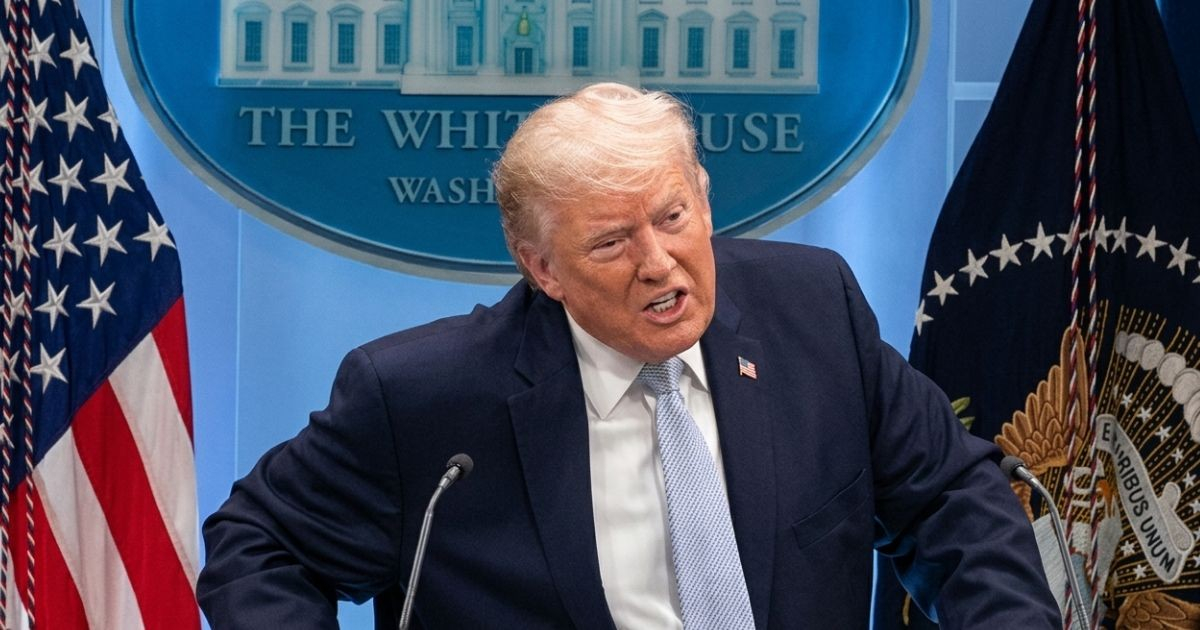
On Saturday, President Donald Trump issued a stern warning to China, stating that the nation would encounter significant repercussions if it proceeds with delivering arms to Iran. His remarks were made to reporters outside the White House.
This warning followed a CNN report, which, citing U.S. intelligence sources, claimed that Beijing was planning to send portable anti-aircraft missile systems to Iran in the upcoming weeks. The report suggested that China might be attempting to disguise the origin of these shipments through third-party countries.
"If China does that, China is going to have big problems," Trump stated emphatically.
The Chinese Embassy in Washington denied these allegations, asserting that "China has never provided weapons to any party involved in the conflict" and labeled the information as "false."
This is not the first time Trump has issued such a warning. Last Tuesday, he took to Truth Social to declare that "any country supplying military weapons to Iran will face an immediate 50% tariff on all goods sold to the United States, effective immediately," specifically targeting Russia and China.
Both nations had previously blocked a UN Security Council resolution that aimed to reopen the Strait of Hormuz on the same day.
The conflict between the U.S. and Iran erupted on February 28, 2026, with Operation Epic Fury, a joint military effort with Israel that eliminated 90% of Iran's missile arsenal and killed 49 high-ranking officials, including Supreme Leader Ali Khamenei.
Iran retaliated by closing the Strait of Hormuz on March 4 using mines, drones, and missiles, causing a 97% collapse in naval traffic and driving up Brent crude oil prices from $67 to over $126 per barrel.
Last Tuesday, Pakistan brokered a fragile 14-day ceasefire conditioned on the reopening of the strait and formal negotiations in Islamabad. However, Iran closed it again the following day after Israeli attacks on Hezbollah in Lebanon.
On Saturday, Trump described the negotiations with Iran as "very deep," although he insisted that whether an agreement is reached or not, "we win either way."
The President also mentioned the use of minesweepers in the Strait of Hormuz due to the potential presence of Iranian mines and did not rule out military action if Iran fails to comply with the ceasefire terms, indicating that U.S. warships are equipped with "the best ammunition."
The diplomatic complexity is heightened by Trump's upcoming visit to China in early May to meet with President Xi Jinping, making his public warnings a signal of maximum pressure ahead of that meeting.
Key Questions about U.S.-China-Iran Tensions
What prompted President Trump to warn China about sending arms to Iran?
President Trump warned China following reports that Beijing was planning to send portable anti-aircraft missile systems to Iran, which could escalate tensions in the region.
How did China respond to the accusations of arms shipments to Iran?
The Chinese Embassy in Washington refuted the accusations, stating that China has never provided weapons to any party involved in the conflict and dismissing the information as false.
What are the potential consequences if China proceeds with arms shipments to Iran?
If China proceeds with the arms shipments, it could face significant repercussions from the U.S., including a 50% tariff on all goods sold to the United States.