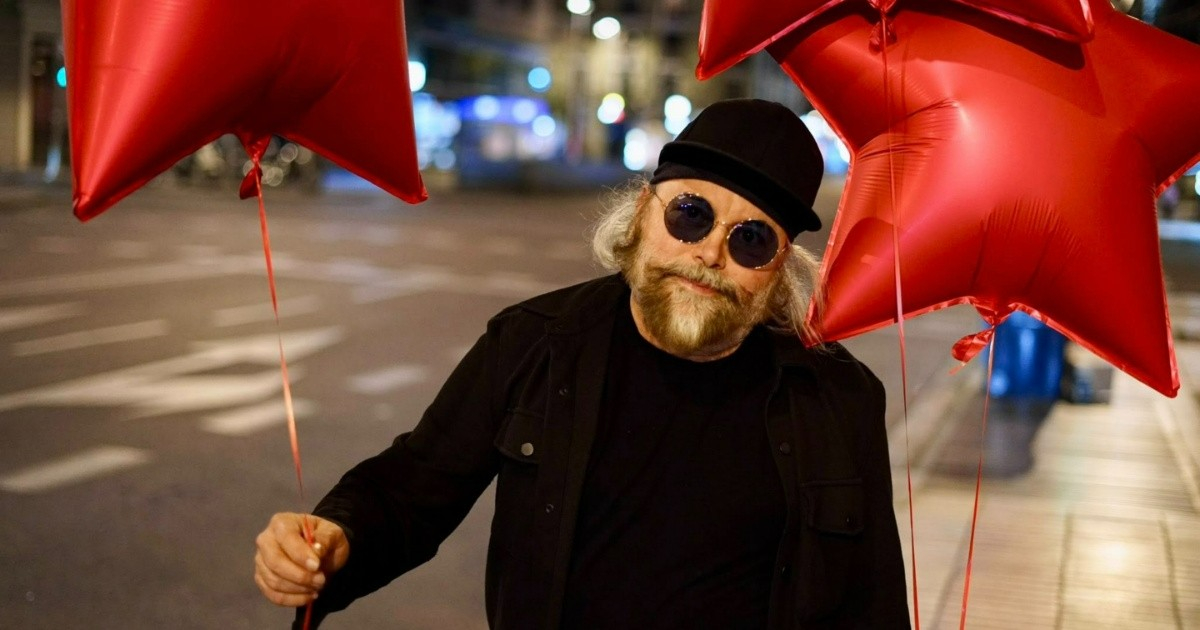
Carlos Varela, the renowned Havana-born singer-songwriter often referred to as the "Cuban Bob Dylan," commemorated his 63rd birthday this Saturday. He shared a heartfelt message of gratitude on his Facebook account, accompanied by nighttime photographs of himself holding star-shaped red balloons, dressed in black with his signature gray beard and round glasses.
"Every year on my birthday, I find myself reflecting on the journey so far—on the years, the friends, my neighborhood, the stories, the songs that remain by my side, and those that have fallen by the wayside. Thank you all for being there, for accompanying me... and for so much love and warmth. God bless you all!" Varela expressed in his post.
Born on April 11, 1963, in Havana, as Carlos Victoriano Varela Cerezo, and also known as "El Gnomo," Varela is considered one of the most impactful singer-songwriters in Cuban music history. He belongs to the "novísima trova," the third generation of the Cuban Nueva Trova movement, along with Santiago Feliú, Frank Delgado, and Gerardo Alfonso. This generation, following legends like Silvio Rodríguez and Pablo Milanés, dubbed themselves "the mole generation" for their challenging stance against censorship.
Varela's Unique Musical Influence
Unlike his predecessors, Varela incorporated rock influences and a more direct urban vernacular, becoming a voice for those who came of age during the Special Period of the 1990s. They grew up with the promise of socialism but witnessed its collapse. His debut album, "Jalisco Park" (1989), recorded in the Canary Islands, catapulted him to fame with songs depicting Cuba's social decay, some of which were immediately banned from state radio.
His track "Guillermo Tell" became an anthem for a generation: reversing the classic legend so that the son asks the father to hold the apple, it was widely interpreted as a message from Cuban youth to their leaders. In 1995, Varela embarked on an extensive tour across Spain with Joaquín Sabina. He recorded "Como los Peces," which earned him the Ondas Award for Best Latin Newcomer, and co-wrote "Tan Joven y Tan Viejo" with Sabina, which appeared on Sabina's album "Yo, Mí, Me, Contigo."
Global Recognition and Continued Influence
His song "Una palabra" from the album "Nubes" (2000) was selected by Alejandro González Iñárritu for a BMW short film in 2005 and by Tony Scott for the closing scene of "Man on Fire" (2006), starring Denzel Washington. The song became his most covered and translated work, available in over a dozen languages. In 2015, HBO Latino released the documentary "The Poet of Havana," featuring testimonials from Benicio del Toro, Jackson Browne, and Iván Lins, exploring Cuba's influence and politics in his art.
Varela's discography spans over thirty years, culminating in "Nada es como antes" (2024), which includes the track "Elefantes" with critical verses like "This can’t be tolerated anymore." His stance against the Cuban regime has been consistently critical. In a February 2025 interview with PBS News, Varela stated: "I don't like politics, and I don't like politicians. All politicians should be on Animal Planet. But I do have social concerns, and that’s why I've been writing songs that make politicians uncomfortable in Cuba and beyond for 43 years."
Varela's Vision for a Free Cuba
In the same interview, Varela expressed his dream of a free Cuba: "Of course, democracy in Cuba is possible. I have faith and dream that it will be, and I hope very soon," adding that "many dinosaurs must disappear" to achieve this, referencing the so-called "historical generation" of Castroism. The Díaz-Canel regime continues to censor his music on official radio stations. In November 2020, Varela defended the San Isidro Movement with a statement summarizing his philosophy: "Being critical in the society in which one lives must be an untouchable right." In November 2021, he supported the 15N march by quoting his song "Muros y puertas": "Freedom only exists when it belongs to no one."
In July 2025, Varela joined Leoni Torres on stage in Madrid and shouted Viva Cuba Libre, sparking an immediate ovation. Months later, in November and December 2025, he had to postpone twice his sold-out concerts in Miami due to his U.S. work visa not being approved by the consulate in Madrid.
"I deeply love my country. It could be a wonderful and prosperous place simply by opening the doors and unlocking the individual freedom of all Cubans to develop their talents in their own land. For that to happen, many dinosaurs must disappear," Varela remarked in his PBS News interview, words that continue to define his work and life at 63.
Carlos Varela's Impact and Vision for Cuba
Who is Carlos Varela?
Carlos Varela is a Cuban singer-songwriter known as the "Cuban Bob Dylan." He is a significant figure in the "novísima trova" movement and has been influential in Cuban music with his socially critical lyrics.
What is the significance of Varela's song "Guillermo Tell"?
"Guillermo Tell" became a generational anthem as it reversed the classic story, symbolizing a message from Cuban youth to their leaders. It was seen as a call for change and a reflection of the challenges faced by the younger generation during the Special Period.
How does Varela view the political situation in Cuba?
Varela is critical of the Cuban regime and advocates for democracy in Cuba. He believes that significant changes are needed, including the removal of the old guard to make way for a more open and free society.