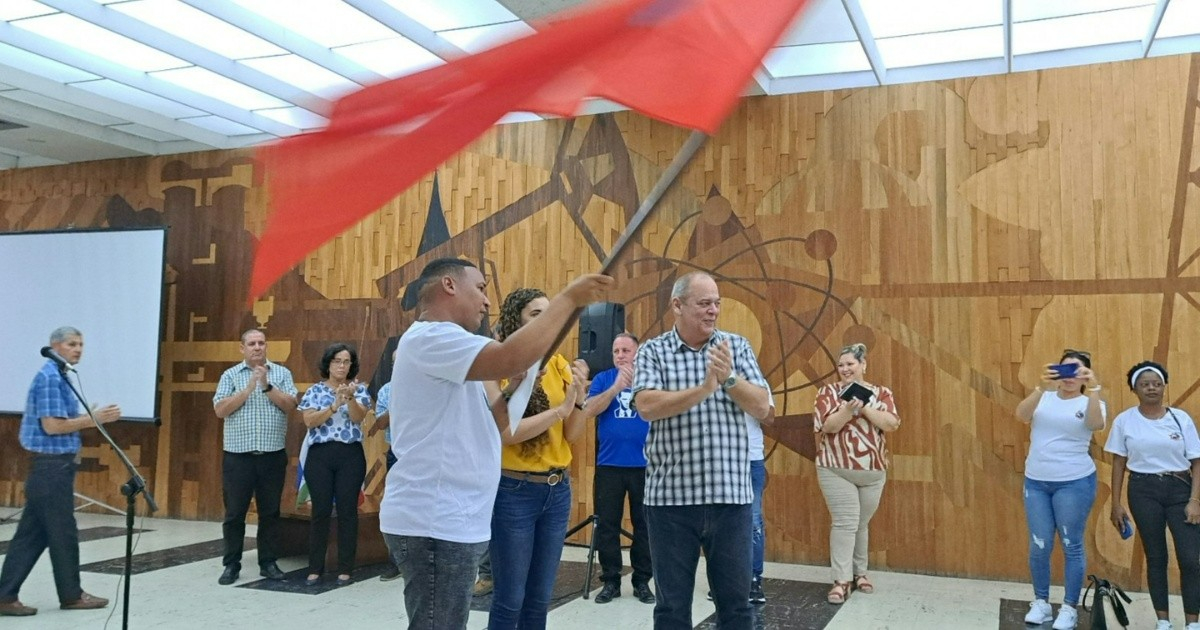
As millions of Cubans endure power outages lasting up to 20 hours a day, the Cuban government launched a youth expedition on Thursday, aimed at educating communities and businesses across all provinces about the so-called energy transition.
The flagging ceremony, held on April 9, gathered young individuals from the electrical, geological, mining, and petroleum sectors, alongside Meyvis Estévez Echevarría, the First Secretary of the Union of Young Communists (UJC), and Vicente de la O Levy, the Minister of Energy and Mines.
The initiative, dubbed "With Our Own Light," is officially intended to spread awareness about renewable energy sources, energy conservation, and the rational use of natural resources. It is scheduled to continue until April 23.
The Ministry of Energy and Mines encapsulated the expedition's essence in a post on X: "Today, a youth expedition from our sectors denounces the harm caused by the blockade on our people, just before heading out across Cuba to engage with communities and organizations about the actions we undertake to advance amidst challenges."
This statement reflects the government's narrative: blaming the U.S. embargo for a crisis deeply rooted in decades of underinvestment and mismanagement of Cuba's electrical system.
The expedition is being launched at a particularly inopportune moment for the regime's credibility regarding energy issues.
So far in 2026, Cuba has experienced three total national electrical collapses, the longest lasting 29 hours and 29 minutes on March 16. On April 6, the shutdown of the Antonio Guiteras thermoelectric plant due to a boiler failure escalated the deficit to 1,845 MW, with only 1,205 MW available against a demand of 3,020 MW.
In Camagüey, reports indicated "practically 20 hours a day" without electricity during the first week of April; in Matanzas, residents faced cycles of two hours with power for every 36 hours without. Argelio Jesús Abad Vigoa, the Deputy Minister of Energy, described the situation on March 21 as the most complex scenario faced by the National Energy System.
Rather than offering solutions, the government has responded to the crisis with a propaganda campaign. A day before the expedition's flagging, Prime Minister Manuel Marrero Cruz and Miguel Díaz-Canel launched the "Community Youth Network," which includes the activation of "digital wasp nests" to combat "fake news."
The frustration triggered by the blackouts has spilled onto the streets, with protests erupting in Havana, Santiago de Cuba, Guantánamo, and other cities. Meanwhile, only nine out of 168 Cuban municipalities have developed local energy strategies, highlighting the deep institutional neglect in addressing the crisis.
Understanding Cuba's Energy Crisis
What is the purpose of the youth expedition launched by the Cuban government?
The youth expedition aims to educate communities and businesses across Cuba about renewable energy sources, energy conservation, and the rational use of natural resources.
Why is the Cuban government blaming the U.S. embargo for the energy crisis?
The Cuban government attributes the energy crisis to the U.S. embargo, although the crisis is also deeply rooted in decades of underinvestment and poor management of the country's electrical system.
How has the Cuban government responded to the energy crisis?
Instead of providing solutions, the government has launched a propaganda campaign, including the "Community Youth Network" and digital initiatives to counteract negative media coverage.