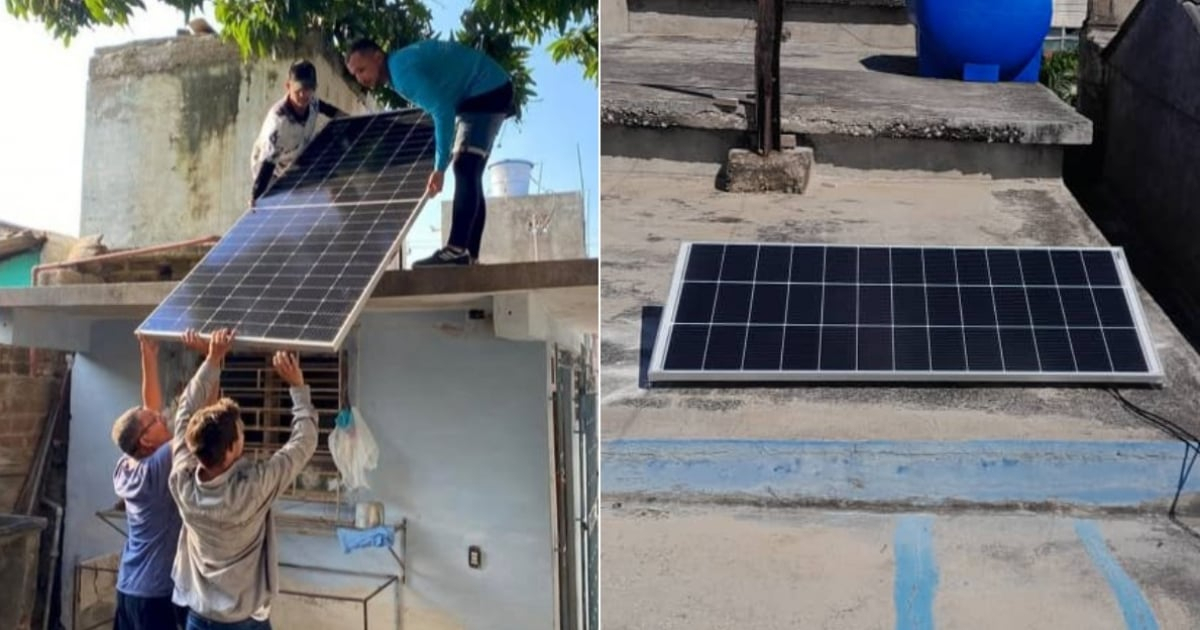
The Cuban government has retracted its requirement for mandatory permits to install solar panels on private homes after a surge of public criticism on social media erupted just hours after the authorities announced the regulation in early April.
Yean Tomasén Frómeta, the Director of Territorial and Urban Planning in Baracoa, had recently declared on the municipal television channel Primada Visión that setting up photovoltaic panels on residences was considered a "minor construction action" needing prior state authorization, as per Decree-Law 322/2014.
The process demanded a photocopy of the property title, potentially a structural technical assessment, and could take up to 15 business days.
In Las Tunas, municipal offices also indicated that a construction permit, costing 68 Cuban pesos, along with a technical project plan, was necessary.
The public response was swift and furious. "It's unbelievable that amid the severe energy crisis, when blackouts are a daily reality, we are asked to legalize the panels we bought with sacrifice," Diannet Hernández wrote on social media.
"Anyone who can put a panel on their house does it out of necessity, not luxury. Now I have to wait 15 days for a bureaucrat to tell me where I can put what's mine?" questioned Ángel Luis Gámez Asencio.
Orlando Vivo expressed it with irony: "Now solar energy will be rationed too."
Faced with public pressure, the National Institute of Territorial and Urban Planning (INOTU), the National Office for the Control and Rational Use of Energy (ONURE), and electric companies convened and reversed the decision within days.
Revised Guidelines for Solar Panel Installation
The revised regulation specifies that permits are only necessary for homes located in historic centers where public aesthetics might be affected, or in multi-family buildings. For all other situations, installation is at the discretion of the homeowner.
Furthermore, ongoing permit applications were canceled, and it was clarified that no fines would be imposed on those who already have panels installed.
Officials had previously argued that the rule was meant to prevent accidents. "Placing a panel is not maintenance; it's a construction action that alters the structure and appearance of the city," explained Tania Vázquez Góngora, the provincial sub-delegate of INOTU in Las Tunas.
"A roof that can't bear the weight, a poorly anchored panel that could be blown away by a cyclone, a lithium battery that explodes due to improper installation... Legalization provides the owner with legal protection and avoids disputes with neighbors or fines for damage to third parties," she added.
Energy Policies in Conflict
This incident highlights a glaring contradiction in the regime's energy policy.
Since February 2026, the government has exempted solar panels, batteries, and inverters from customs duties and offers up to eight years of tax exemption for those investing in renewable energy systems.
However, it simultaneously imposed bureaucratic hurdles for their installation in private residences.
This unfolds at the worst point of Cuba's energy crisis in decades. In March, the National Electroenergetic System suffered two total collapses: on March 16, the country was without power for 29 hours and 29 minutes; on March 22, a failure at the Nuevitas Thermal Power Plant left over 90% of Havana in darkness.
Last Monday, the Antonio Guiteras Thermal Power Plant went offline again due to a malfunction, with generation deficits reaching up to 1,871 megawatts.
In this context, solar panels have become a survival tool for thousands of families, although accessing them is challenging: an 800-watt photovoltaic module promoted by the Electric Union costs over 75,000 Cuban pesos, equivalent to more than 20 months' salary for an average state worker.
Common Questions about Solar Panel Installation in Cuba
Do all homeowners in Cuba need a permit to install solar panels?
No, permits are only required for homes in historic centers or multi-family buildings. Other homeowners can install panels at their discretion.
What was the public reaction to the initial permit requirement?
The public reacted with immediate anger, criticizing the government for imposing such requirements during a severe energy crisis.
How does the cost of a solar panel module compare to a state worker's salary?
An 800-watt photovoltaic module costs over 75,000 Cuban pesos, which is more than the equivalent of 20 months' salary for an average state worker.