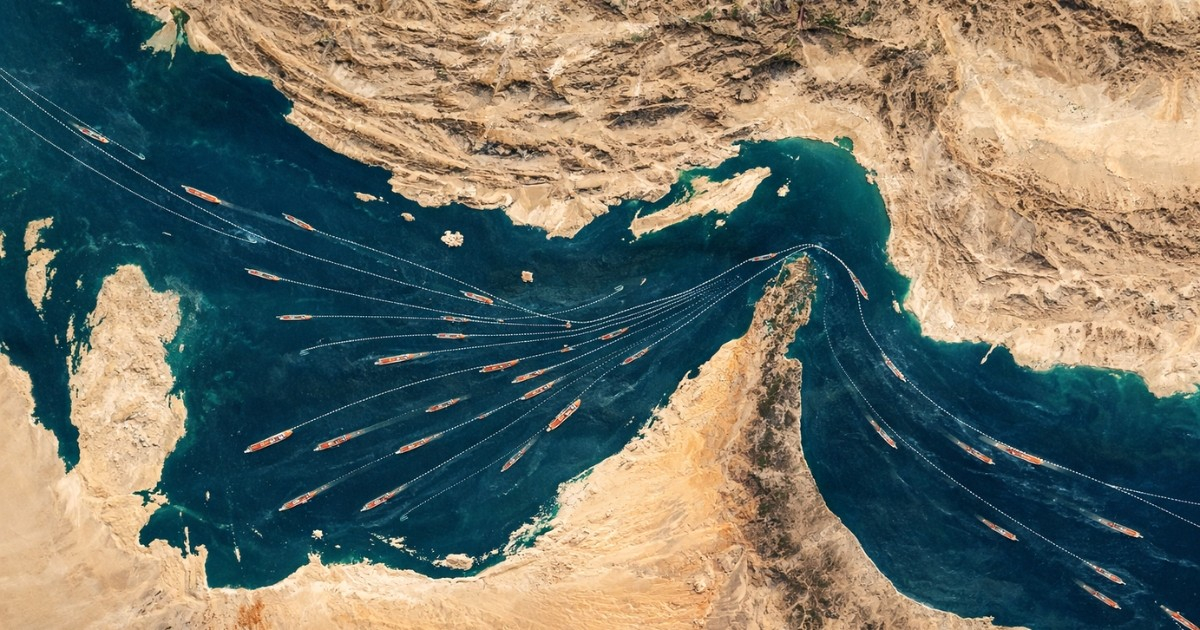
On Wednesday, Iran halted the passage of oil tankers through the Strait of Hormuz just hours after the first vessels began navigating this crucial maritime route. This decision comes as a direct response to the most extensive Israeli airstrike to date against Hezbollah infrastructure in Lebanon, as reported by an Iranian news outlet.
The Fars agency, linked to Iran's Revolutionary Guard, was the first to announce the latest closure: "The transit of tankers through the Strait of Hormuz has been stopped following Israel's attacks on Lebanon."
Israel targeted nearly 100 locations in Beirut, the Bekaa Valley, and southern Lebanon, resulting in at least eight fatalities and 22 injuries in Sidon, as well as four deaths in a car attack in Kila. Israeli authorities also issued evacuation orders for Al-Abassiya in the Tyre district and issued warnings to residents in southern Beirut.
Implications of the Closure
This renewed blockade highlights the fragility of the ceasefire agreement announced on Tuesday by President Donald Trump. Trump had announced on Truth Social a two-week suspension of bombings against Iran, contingent upon the "complete, immediate, and safe" reopening of the Strait of Hormuz.
"Based on discussions with Prime Minister Shehbaz Sharif and Field Marshal Asim Munir of Pakistan, who requested halting the destructive force planned for Iran tonight, I agree to suspend bombings and attacks on Iran for a two-week period," Trump wrote.
The ceasefire, mediated by Pakistan, allowed the first ships to pass through the strait early Wednesday morning: the Daytona Beach at 06:59 UTC and the NJ Earth at 08:44 UTC, while around 800 vessels were stuck in the Persian Gulf awaiting the two-week opportunity.
Exclusion of Lebanon from Ceasefire
However, the Israeli Prime Minister's Office made it clear from the outset that the ceasefire "does not include Lebanon," and Trump confirmed on Wednesday that Israeli attacks on Hezbollah were not part of the agreement.
Pakistan's Prime Minister Shehbaz Sharif, a key mediator, had insisted the ceasefire should be "comprehensive," including Lebanon, but his stance did not prevail. The Norwegian Refugee Council warned that excluding Lebanon from the ceasefire "risks fueling further escalation and undermining stability."
This marks the second closure of the strait since the onset of the conflict. On March 4, Iran first blocked the passage using mines, drones, and missiles, stranding 2,000 ships with 20,000 sailors and collapsing 97% of naval traffic, which sent Brent crude prices soaring from $67 to over $126 per barrel.
Economic Impact and International Response
The Strait of Hormuz is a critical chokepoint, accounting for 20% of the world's oil and liquefied natural gas trade, making any closure a direct threat to global energy markets.
Amid this crisis, Trump proposed the creation of a joint venture with Iran to collect tolls in the strait: "We are considering doing it as a joint venture. It's a way to ensure it. It's something beautiful," the President stated. The proposal was dismissed by international law experts who noted that imposing tolls violates the 1982 United Nations Convention on the Law of the Sea.
Formal negotiations between the United States and Iran are still set for April 10 in Islamabad, with Vice President JD Vance and Iranian representative Mohammad Bagher Ghalibaf as the main interlocutors, and Pakistan, Egypt, and Turkey acting as mediators.
Understanding the Strait of Hormuz Crisis
Why did Iran close the Strait of Hormuz?
Iran closed the Strait of Hormuz in response to extensive Israeli airstrikes on Hezbollah infrastructure in Lebanon.
What impact does the closure of the Strait have on global markets?
The closure significantly affects global energy markets as the strait is a crucial passage for 20% of the world's oil and liquefied natural gas trade.
What was the role of the United States in the ceasefire agreement?
The United States, with President Trump's involvement, announced a two-week suspension of bombings against Iran as part of a ceasefire, contingent on the reopening of the strait.