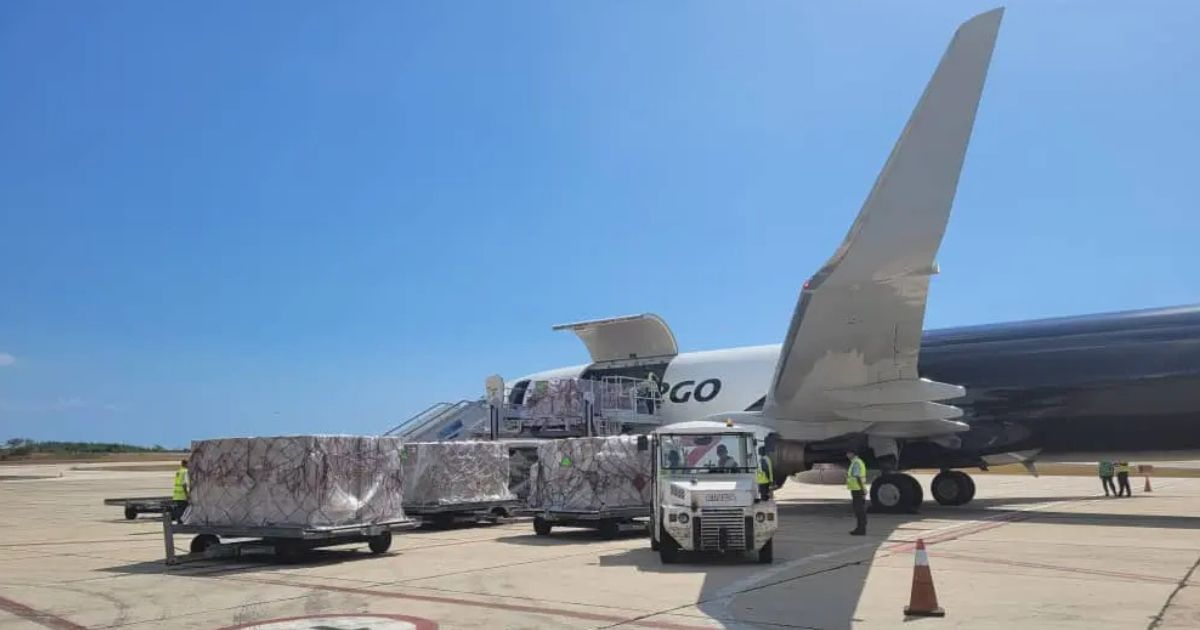
Amidst the ongoing hardships faced by countless Cubans, a fresh wave of humanitarian relief has arrived in the eastern part of the island, aimed at supporting families hardest hit by severe shortages.
A shipment organized by Catholic Relief Services (CRS) was handed over to Cáritas Cuba at Santiago de Cuba's "Antonio Maceo" International Airport. This event marked a collaboration between representatives of the Church and the international organization.
The handover was attended by Carmen María Nodal Martínez, the head of Cáritas Cuba, along with CRS executives, including Jennifer Poidaz, the global vice president of Humanitarian Responses, and Joseph Weber, the project leader.
The contribution consists of 600 kits containing food and hygiene products, which are set to be distributed among affected families in the Holguín-Las Tunas diocese, an area severely impacted by economic challenges.
Cáritas Cuba characterized the donation as "a tangible expression of Christian charity" that "demonstrates Christ's love and service by helping to alleviate the material needs of those suffering the most."
This delivery is the latest in a series of humanitarian efforts initiated after Hurricane Melissa struck eastern Cuba as a Category 3 storm on October 29, 2025, with winds reaching up to 195 km/h.
The relief efforts commenced on January 14 with the first flight to Holguín airport and have included four cargo flights, a ship carrying seven containers that arrived at Santiago de Cuba's port in February, and additional air shipments in March.
Overall, the operation has supported approximately 6,000 families—about 24,000 individuals—in the eastern dioceses of the island.
All assistance is distributed through the Catholic Church and Cáritas Cuba, intentionally bypassing the Cuban government's involvement.
The U.S. Department of State was clear: "This strategy has proven highly effective in ensuring that the failed Cuban regime does not interfere with or redirect aid meant for the needy population."
The Cuban government has criticized this method, accusing Washington of "political manipulation" and demanding that aid be channeled through state-run pathways.
Jeremy Lewin, a senior aid official from the Department of State, stated bluntly, "They have billions of dollars but choose not to use it to purchase food for the average Cuban."
Key Aspects of U.S. Aid to Cuba
How is the aid being delivered to Cuban families?
The aid is being distributed through the Catholic Church and Cáritas Cuba, avoiding government channels to ensure it reaches those in need directly.
What prompted the humanitarian efforts?
The efforts were initiated following Hurricane Melissa, which hit eastern Cuba as a Category 3 storm, causing significant damage and exacerbating existing shortages.
What is the Cuban government's stance on this aid distribution?
The Cuban government has criticized the U.S. approach, accusing it of political manipulation and insisting that aid should go through state-controlled channels.