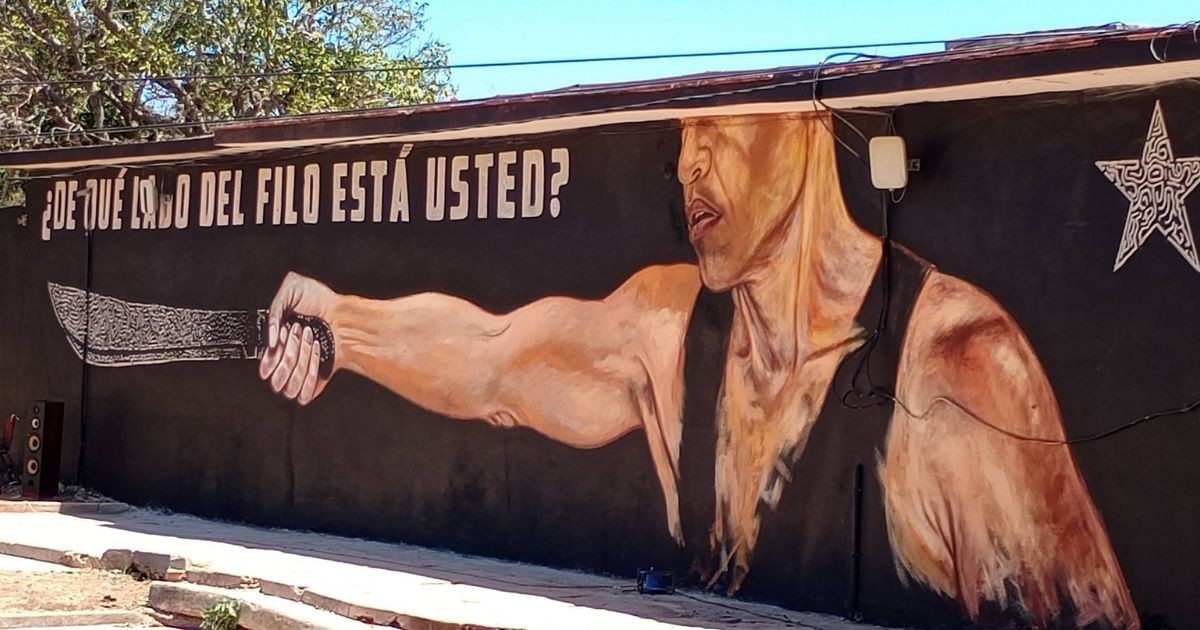
A massive mural was unveiled this Sunday at José Raúl Capablanca Park in the Almendares district of Playa, Havana, posing a direct question to Cubans with no room for neutrality: "Which side of the divide are you on?"
This artwork is a gift from Chilean artist Sebastián "Ratavirus," who traveled to Havana from Valparaíso. The mural was completed in a week of intense collaboration with Cuban artists Yurelsy Villalón George, Pablo Francisco, Félix Aguilar, and Néstor Martínez.
The mural depicts a strong Afro-Cuban male figure, reaching out to the viewer with a machete in hand, set against a black background. The symbolism is intentional, harking back to the mambises, the Creole and Afro-descendant guerrillas who fought for Cuba's independence from Spain between 1868 and 1898, wielding machetes and demanding freedom, not socialism or communism.
This provocative question also taps into a deeply ingrained narrative within the official rhetoric: the demand to take sides. It echoes the familiar Cuban dichotomy of “Patria o muerte,” where there is no room for nuance: you either support the system or are labeled an enemy.
Historical Context and Modern Implications
The mural's imagery could also be seen as an invitation to fight for independence once more. The extended machete serves as a symbolic dividing line, reflecting the fractures within the nation itself. It suggests a Cuba split between those who remain on the island and those who have left but remain connected to its fate.
Journalist Ania Ortega, who covered the unveiling in two Facebook posts, emphasized this historical connection, offering her interpretation: "It's up to us to take care of Cuba as well. And that depends on each one of us."
The Murals' Origins and Broader Significance
The mural's origins carry special significance: it was a personal request from former Uruguayan President José Mujica, who passed away in May 2025. He told the Chilean artist, "If you go to Cuba, leave something behind in my name." Mujica, a historical figure of the Latin American left, had openly criticized the Cuban socialist model in his later years, stating, "it doesn't work" regarding the single-party system.
Ratavirus, known for his murals across Europe and Latin America on social justice themes — such as the Abuelas de Plaza de Mayo in Argentina, the struggles of the Palestinian people, and an Allende in Santiago, Chile — did not hide his stance: "I am on the side of the people, I come from the people," he said, referencing his knowledge of the Mapuche struggles.
He described Cubans as "warm, kind, giving what they have and even what they don't," and promised to return to the island.
Public Reaction and Interpretative Tensions
The mural's phrase immediately sparked debate on social media. Raul Ernesto Gutierrez García linked it to the state propaganda program "Con Filo," one of the most criticized and least-watched shows on Cuban television, created in 2021 as a media response to the July 11 protests— and to chess, because of the park's namesake, world champion José Raúl Capablanca.
Ortega responded firmly: "You didn't get it. You tried to associate it with that program you mentioned, but the artist DOES NOT KNOW or has any idea it exists. The park's name is unrelated to the topic. The chess is all in your head."
This interpretive tension reveals something deeper: in Cuba, the mere word "filo" automatically triggers associations with the regime's propaganda space, underscoring the weight the official media machinery has managed to impose on the collective imagination.
Yet, the mural's machete does not point toward the 1959 revolution. It points to the history of those who fought for freedom long before and asks each Cuban where they stand.
FAQs on Havana's Provocative Mural
What does the mural in Havana symbolize?
The mural symbolizes a call to choose sides, reflecting the historical struggle for Cuban independence and questioning the current socialist regime. It evokes the image of the mambises, who fought for freedom with machetes.
Who is the artist behind the Havana mural?
The mural was created by Chilean artist Sebastián "Ratavirus," known for his works on social justice across Europe and Latin America.
How did social media react to the mural?
The mural sparked a lively debate on social media, with some associating it with state propaganda and others defending its historical context and significance.