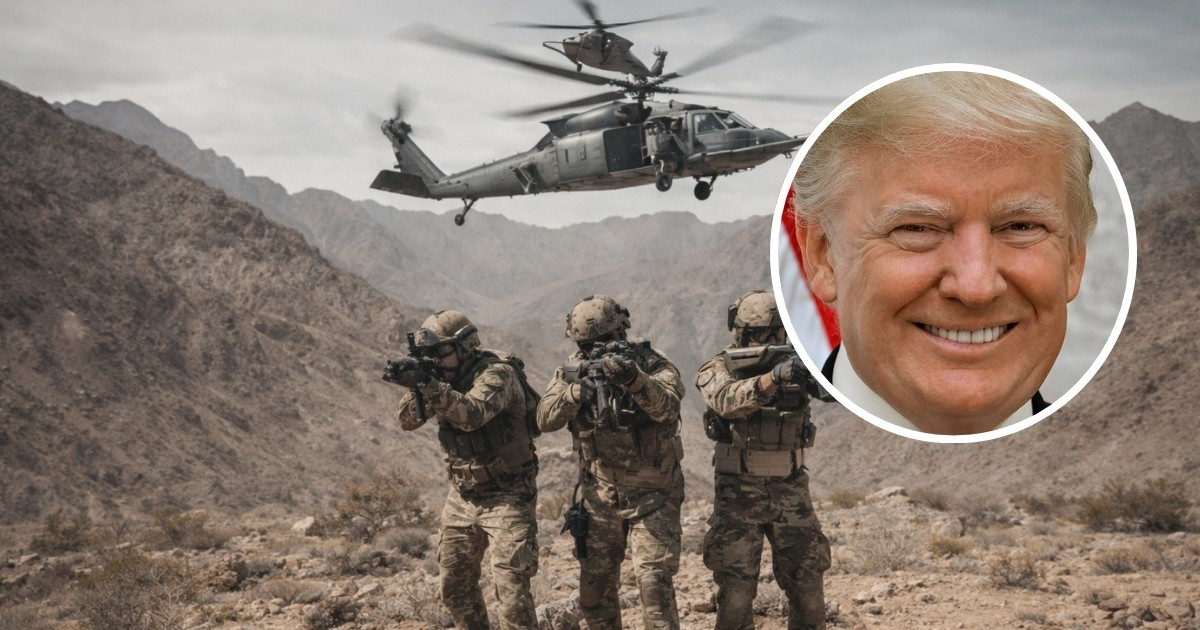
In a dramatic announcement early Sunday morning, President Donald Trump revealed the successful rescue of a U.S. colonel trapped in the mountains of Iran after his fighter jet was shot down. Trump described this operation as one of the boldest military rescues in American history.
"MISSION ACCOMPLISHED! My fellow Americans, in the past hours, the United States Armed Forces executed one of the boldest search and rescue operations in U.S. history," Trump proclaimed at 12:08 AM on Truth Social.
The rescued officer, a weapons systems officer and the second crew member of an F-15E Strike Eagle, had been evading enemy forces for over 36 hours in the rugged terrain of southwestern Iran after being downed by Iran’s Revolutionary Guard last Friday.
"This brave soldier found himself behind enemy lines in the treacherous mountains of Iran, pursued by our adversaries who closed in with each passing hour," Trump explained, emphasizing that the colonel was never alone as military command closely monitored his location around the clock.
According to Trump, the serviceman utilized his survival training to navigate away from the crash site, activate an emergency beacon, and hide in elevated terrain as U.S. forces devised a rescue plan. The operation involved armed engagements with Iranian forces and air support from various military branches.
“Under my directive, the U.S. military deployed dozens of aircraft, equipped with the world's most lethal weaponry, to bring him back. He sustained injuries but is going to be fine," stated the president, withholding further details on the colonel’s condition. Independent sources reported that the officer was flown to Kuwait for medical treatment.
This rescue marks the second within 48 hours. The pilot of the same F-15E was recovered on Friday, hours after the shootdown, though Trump withheld public confirmation to safeguard the subsequent mission. “This marks the first time in military memory that two U.S. pilots have been separately rescued deep within enemy territory,” emphasized the president.
Iran, meanwhile, had mobilized civilians, local tribes, and Revolutionary Guard units in a massive manhunt to capture the colonel alive before the rescuers arrived, offering rewards as reported by Iranian state television. The Tehran regime claimed responsibility for downing the F-15E and released footage of the wreckage, although it was mistakenly identified as an F-35 by their media.
Trump seized the announcement to project an image of military supremacy. “The fact that we executed both operations without a single American fatality or injury is a testament to our overwhelming air dominance and superiority over Iranian skies,” he declared. However, specialized outlets like The War Zone and Military Times confirmed that two helicopters were damaged by Iranian fire during the initial rescue, resulting in several crew injuries, an inconsistency the White House has not addressed.
The dual rescues occurred amid Operation Epic Fury, initiated on February 28 by the United States and Israel against Iran, during a period of heightened tension: the previous day, Trump had announced a massive strike on Tehran and issued a 48-hour ultimatum for Iran to reopen the Strait of Hormuz, which had been closed since March 4.
“WE WILL NEVER LEAVE A U.S. SOLDIER BEHIND!” concluded Trump, adding, “We truly have the greatest, most professional, and most lethal military in world history.”
Key Insights on U.S. Military Operations in Iran
What was the objective of Operation Epic Fury?
Operation Epic Fury was a joint military operation by the United States and Israel aimed at exerting pressure on Iran during a period of heightened tensions, particularly following the closure of the Strait of Hormuz.
How did the U.S. military execute the rescue mission in Iran?
The U.S. military conducted the rescue operation by deploying numerous aircraft outfitted with advanced weaponry, engaging in firefights with Iranian forces, and providing air support from various military branches to safely extract the trapped colonel.
What challenges did the rescued colonel face behind enemy lines?
The colonel faced significant challenges, including evading enemy forces in the mountainous terrain of Iran and utilizing his survival training to remain hidden and communicate with rescuers while awaiting extraction.