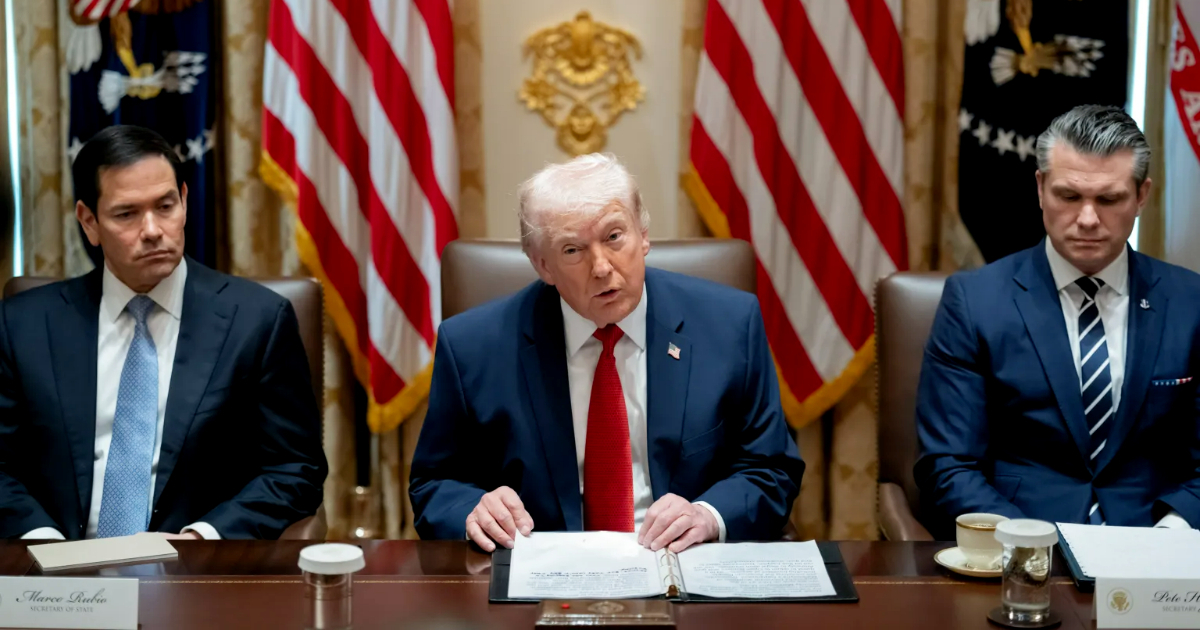
On Saturday, former President Donald Trump issued a stern ultimatum to Iran via Truth Social, demanding the reopening of the Strait of Hormuz within 48 hours or face dire repercussions.
“Remember when I gave Iran ten days to MAKE A DEAL or OPEN THE STRAIT OF HORMUZ. Time is running out—48 hours before all hell breaks loose upon them. Praise the Lord!” Trump declared.
This ultimatum marks the end of a ten-day period that Trump had set on March 26 for Iran to negotiate an agreement or reopen the crucial maritime passage. This was set amid the backdrop of the ongoing conflict between the United States, Israel, and Iran—known as Operation Epic Fury—which began on February 28, 2026.
Iran closed the Strait of Hormuz on March 4, utilizing mines, drones, and missiles, resulting in approximately 2,000 ships and 20,000 sailors being stranded. The strait is considered the world's most strategic maritime chokepoint, with 20% of the global oil and liquefied natural gas passing through it, according to the U.S. Energy Information Administration.
Escalating Tensions and Military Challenges
This is not the first time Trump has used such pressure tactics. On March 21, he threatened to destroy Iranian power plants, starting with Bushehr, if the strait was not reopened in 48 hours, though he later postponed the attacks following what he described as “productive talks.”
By March 30, Trump had renewed his threats, targeting Iranian power plants, oil wells, Kharg Island, and desalination facilities if the passage remained closed beyond April 6.
Conflicting Signals from the White House
The ultimatum comes amidst mixed messages from the White House regarding the objectives of the conflict. In early April, Trump told reporters that the U.S. might withdraw from the war in two to three weeks and stated Iran “does not have to make a deal” for the conflict to end—remarks that contradict his latest ultimatum.
Defense Secretary Pete Hegseth and Joint Chiefs of Staff Chairman General Dan Caine reaffirmed on Tuesday that the war aims to dismantle Iran’s ballistic missile arsenal, eliminate its navy, and prevent nuclear weapon development, without mentioning the strait as a condition for ending the conflict.
Impact on Global Markets and Military Operations
Complications have also arisen from military setbacks. On Friday, a U.S. F-15E was downed over Iranian territory, and an A-10 Thunderbolt II was hit by Iranian fire in the Persian Gulf. The A-10’s pilot ejected over Kuwaiti airspace and was rescued. Two helicopters involved in the F-15 rescue were also damaged by Iranian fire.
When asked by NBC whether these incidents would impact negotiations with Iran, Trump was unequivocal: “No, not at all. No, it’s war. We’re at war.”
Simultaneously, Trump has threatened to pull the U.S. out of NATO following the alliance’s refusal to assist in defending the strait. “I was never swayed by NATO. I always knew they were a paper tiger, and Putin knows that too, by the way,” he told The Telegraph.
The closure of the strait has sent Brent crude oil prices soaring to $105 per barrel and gasoline in the U.S. to $4 per gallon, while Operation Epic Fury has struck over 5,000 Iranian targets, degrading 90% of the regime’s missile capabilities and 95% of its drones.
Understanding the Strait of Hormuz Crisis
Why is the Strait of Hormuz important?
The Strait of Hormuz is the world's most strategic maritime chokepoint, with 20% of global oil and liquefied natural gas passing through it, making it crucial for international energy supply.
What are the potential consequences of closing the Strait of Hormuz?
Closing the strait can lead to significant disruptions in global oil and gas supplies, driving up prices and causing economic instability worldwide.