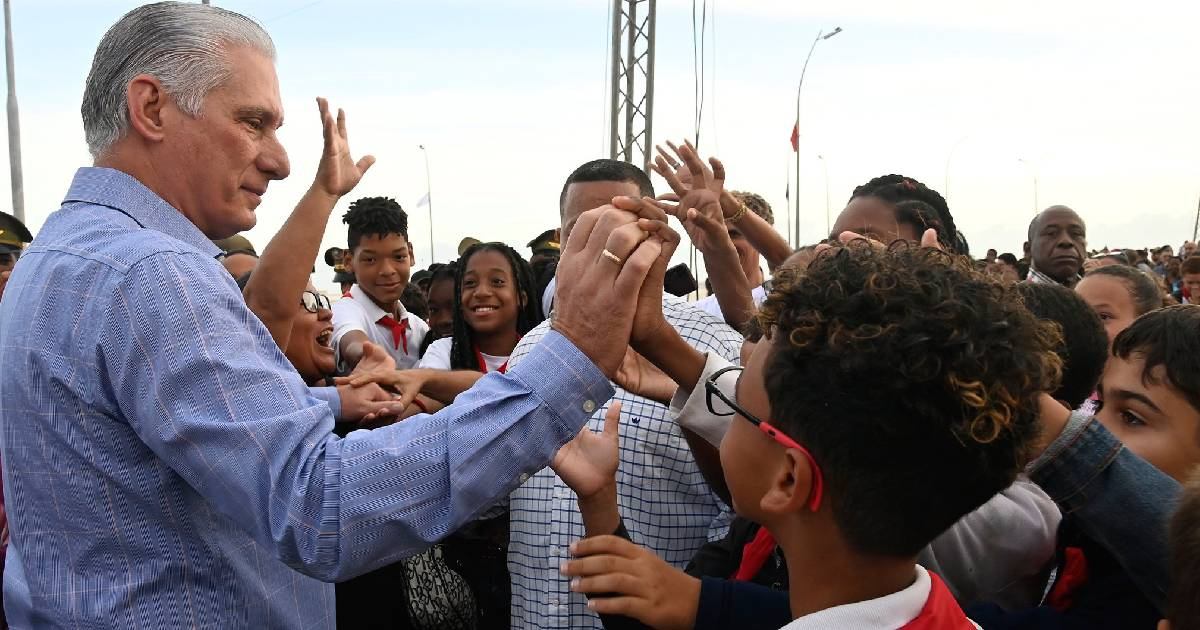
Miguel Díaz-Canel, the Cuban leader, declared on Friday that Cuba will "always stand for human dignity" as he celebrated a youth mobilization event in Havana. This event was organized on the eve of the anniversaries of the Union of Young Communists (UJC) and the José Martí Pioneers Organization (OPJM).
In a social media post, Díaz-Canel recalled his own experiences as a youth leader and praised the new generation of Cubans who "took to the streets and squares" to protest the U.S. embargo and express "their love for life."
He further emphasized that the participants voiced "Cuba's choice," concluding his message with, "We are and will always be on the side of human dignity."
Youth Mobilization Amid a Struggling Economy
The event featured a caravan traversing Havana's Malecón from G Street to La Punta in the Plaza de la Revolución municipality. According to Juventud Rebelde, the state-run newspaper, approximately 100 young people participated, using bicycles, rollerblades, skateboards, and electric tricycles while displaying political slogans and wearing shirts commemorating Fidel Castro's upcoming centennial, scheduled for August 13, 2026.
At the event, Meyvis Estévez Echevarría, the UJC's first secretary, stated that Cuban youth see themselves as "owners of a country we build and defend each day."
Economic Challenges and Energy Crisis
However, this mobilization comes amidst a severe economic and social crisis in Cuba. The Economist Intelligence Unit predicts a 7.2% contraction in Cuba's GDP by 2026, marking a 23% decline since 2019. Power outages lasting between 20 and 25 hours daily plague many areas.
The energy crisis worsened in early 2026 when Venezuelan oil supply was cut off, and on March 16, the national electric system experienced its sixth total blackout in just 18 months.
Migration and Political Discontent
The official narrative of a dynamic youth contrasts starkly with the reality of migration. Since 2021, around two million Cubans, mostly aged 20 to 40, have left the island—ironically, the very demographic the regime claims supports its political agenda.
Reactions to Díaz-Canel's message on social media highlighted this discrepancy. Many users criticized the leader's narrative, pointing out the lack of freedoms and the dire economic situation in Cuba. "Without freedom of thought or choice, there can be no human dignity," one user responded, while others condemned the involvement of minors and students in political events, labeling it as youth indoctrination.
Political Campaigns Surrounding Castro's Centennial
This event is part of a larger political mobilization campaign promoted by the regime in connection with Fidel Castro's 100th birth anniversary and the 64th and 65th anniversaries of the UJC and OPJM, respectively, celebrated this Saturday, April 4.
In preparation for these dates, political activities in schools have been reported, including symbolic tribunals against the United States organized with students, where children chanted slogans under teacher supervision—actions critics view as systematic political indoctrination from an early age.
Understanding Cuba's Current Crisis
What is the current economic situation in Cuba?
Cuba is experiencing a significant economic downturn, with predictions of a 7.2% GDP contraction by 2026, continuing a decline that began in 2019. The country is also facing severe power outages.
How has the energy crisis affected Cuba?
The energy crisis in Cuba has worsened, especially after the cessation of Venezuelan oil supplies, leading to frequent blackouts and a recent total blackout in the national electric system.
What has been the youth's response to the political situation in Cuba?
While the government claims youth support, many young Cubans have chosen to leave the country due to the lack of freedoms and economic hardship, contradicting the regime's narrative.