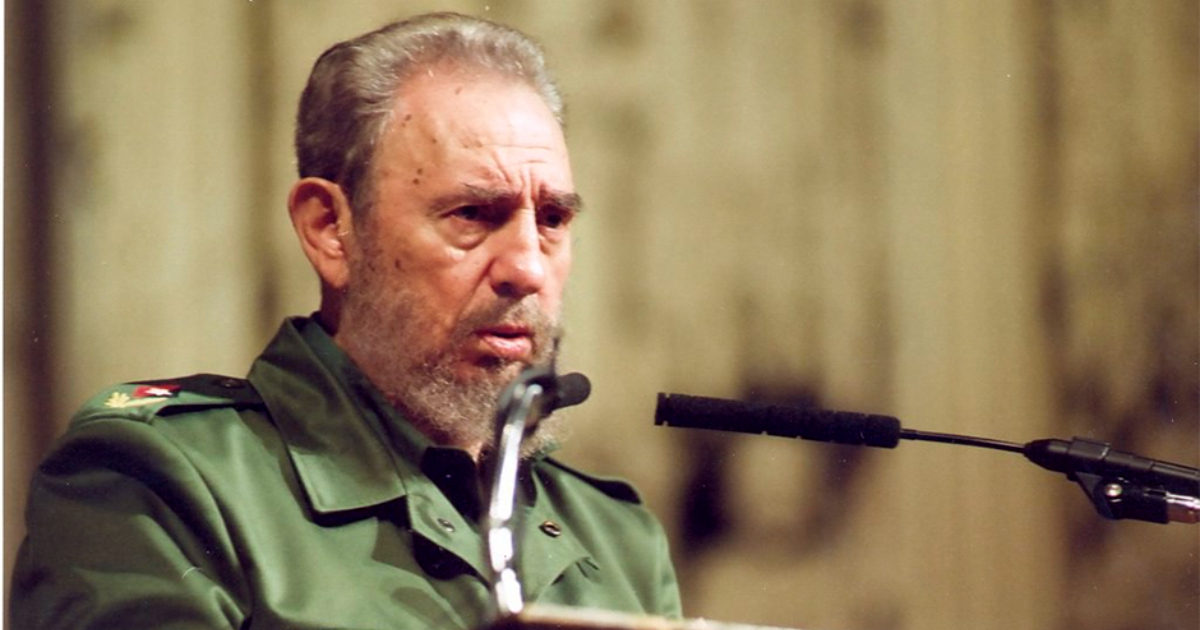
Alina Fernández Revuelta, the biological daughter of Fidel Castro, has broken her long-standing media silence to call for the end of Castroism, asserting that such a change has been overdue for decades. Her statements were made in an exclusive interview with The Epoch Times, released this Tuesday.
"In my view, the need for a regime change has been evident since the late 1980s," Fernández stated. "When Fidel Castro passed away, many believed his regime would end, given its highly personalistic, paternalistic, and narcissistic nature. Yet, it persisted."
Fernández's testimony carries a symbolic weight that no regime propagandist can ignore: if the daughter of the revolution's founder had to flee with a fake passport and endure the stigma of having "traitors in the family," then no Cuban was truly safe under the system Castro established.
The Early Realization of Deception
Growing up within the revolutionary elite, Fernández started recognizing the system's contradictions around the age of nine or ten. Her first lesson in disillusionment came with what was termed "voluntary work."
"I discovered that in Cuba, 'voluntary' actually meant mandatory," she explained. "I quickly realized that I was being lied to."
At the same age, she learned that Castro was her biological father. Her stepfather, cardiologist Orlando Fernández Ferrer, left Cuba with her sister in the early 1960s, forcing her to label her family as traitors in all her school and official documents.
"So, even as a child, I had to mark my school papers and every official document with the notion that my family were traitors," she recalled.
From Disillusionment to Dissent
By the late 1980s, Fernández became a public dissident, driven by fear for her teenage daughter's safety during the Special Period, which she described as "years of utter misery" marked by a lack of electricity, food, and transportation.
In 1993, she escaped using a Spanish tourist's passport, leaving her daughter behind, as she had no other choice. She arrived in Atlanta on December 21 of that year after securing political asylum at the U.S. embassy in Madrid. Shortly after, Reverend Jesse Jackson's visit to Cuba facilitated Castro's consent for her daughter's departure, which Fernández described as "divine intervention."
Currently, Fernández has no contact with any family members, including her 94-year-old uncle, Raúl Castro.
"One of Cuba's greatest tragedies is how this madness tore families apart in the most dramatic way. If you didn't think the same, you became the enemy. It's terrible. It's been this way from the start," she stated.
The Current Crisis in Cuba
Her remarks come amidst a rapid collapse in Cuba. The arrest of Nicolás Maduro by U.S. forces on January 3 led to the cessation of Venezuelan oil shipments to Cuba, sparking one of the island's worst energy crises in decades: power outages lasting up to 30 hours a day, along with severe shortages of food and medicine, have triggered widespread protests in Havana, Santiago de Cuba, and other cities.
This disaster is not the result of external sanctions but rather the foreseeable outcome of 67 years of mismanagement, extreme centralization of power, and reliance on foreign subsidies that the regime itself never sought to overcome.
However, Fernández cautions that significant internal change is unlikely in the short term: banging pots and pans will not be enough to topple a deeply entrenched system.
On March 29, President Donald Trump was more forthright: "It is a failing country, and they will be next. It won't be long before it fails, and we will be there to help."
Fernández is now involved as an executive producer in the documentary "Revolution's Daughter," set to premiere on April 10 in Miami, marking her return to public discourse after years of silence: "I felt like I had already said everything I needed to say."
Alina Fernández's Perspective on Cuba's Future
What prompted Alina Fernández to speak out against the Castro regime?
Alina Fernández decided to break her silence and call for the end of the regime due to her long-standing belief that change was needed since the late 1980s, coupled with the current crisis in Cuba.
How did Alina Fernández leave Cuba?
In 1993, Alina Fernández fled Cuba using a Spanish tourist's passport and was granted political asylum in the United States after seeking refuge at the American embassy in Madrid.
What is the significance of the documentary "Revolution's Daughter"?
"Revolution's Daughter" is a documentary that features Alina Fernández as an executive producer, and it serves as a platform for her to voice her experiences and perspectives after years of silence.