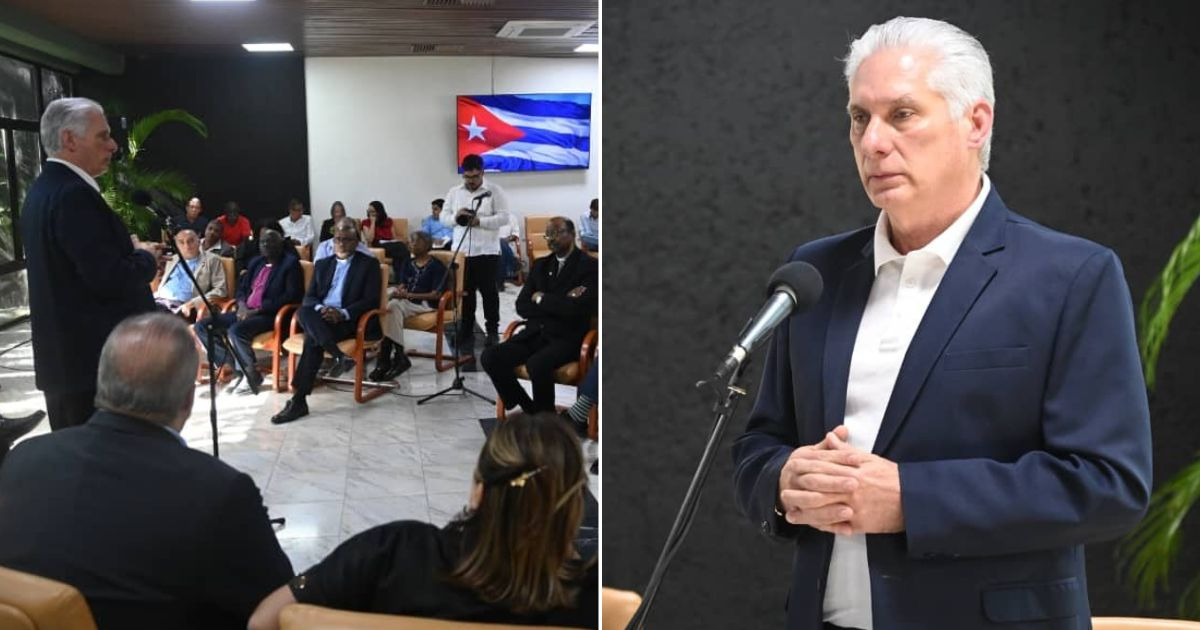
On Monday, Cuban President Miguel Díaz-Canel made an appeal to a group of international religious leaders, urging them to share the Cuban government's version of the ongoing crisis with their congregations. His request aims to transform these leaders into advocates for his administration, reaching an audience of 600 million Christians across approximately 120 countries.
The meeting took place at Havana's Palace of Conventions, where Díaz-Canel hosted high-ranking ecumenical representatives invited by the Council of Churches of Cuba (CIC) and the Presbyterian Reformed Church, as part of Easter celebrations.
"We ask you to showcase this reality; to narrate this reality, and to the leaders of our churches, to continue developing the community initiatives that have always supported us," the president stated, according to the official press.
In response, the visitors expressed that Cuba poses no threat to the United States, echoing the Cuban regime's narrative amidst growing tensions with Washington, as reported by the state-run agency Prensa Latina.
This visit occurs within a context of heightened religious diplomatic activity on the island.
Religious Diplomacy Amid Political Tensions
Just days earlier, U.S. Ambassador Mike Hammer had engaged with the Evangelical Churches Alliance in Cuba, signaling that faith communities have become a battleground for political influence between the regime and its opponents.
The crisis that the Cuban government is asking these leaders to explain to the world is portrayed as unprecedented, characterized—according to the official narrative—by the impact of the U.S. embargo on the national economy.
However, they conveniently omit their own responsibility in plunging Cuban civil society into one of its worst crises in history.
Economic Downturn and Energy Collapse
Cuba's economy has contracted by 23% since 2019, leading to widespread shortages of food, medicine, and fuel, impacting the entire population.
The situation is further exacerbated by an energy collapse, worsened by the halt of Venezuelan oil shipments since December 2025. This has deprived the country of one of its main supply sources and intensified the daily blackouts endured by Cubans.
Understanding Cuba's Economic and Political Crisis
What is the main reason behind Cuba's current crisis?
The Cuban government attributes the crisis primarily to the U.S. embargo, but critics argue that the regime's own policies have significantly contributed to the country's economic downfall.
How has the energy situation in Cuba worsened?
Cuba's energy crisis has intensified due to the cessation of Venezuelan oil shipments, which were a major source of supply, resulting in frequent blackouts and worsening living conditions.
What role do religious leaders play in Cuba's diplomatic landscape?
Religious leaders are increasingly being courted by both the Cuban regime and its adversaries as influential voices that can sway public opinion and international perspectives on the island's situation.