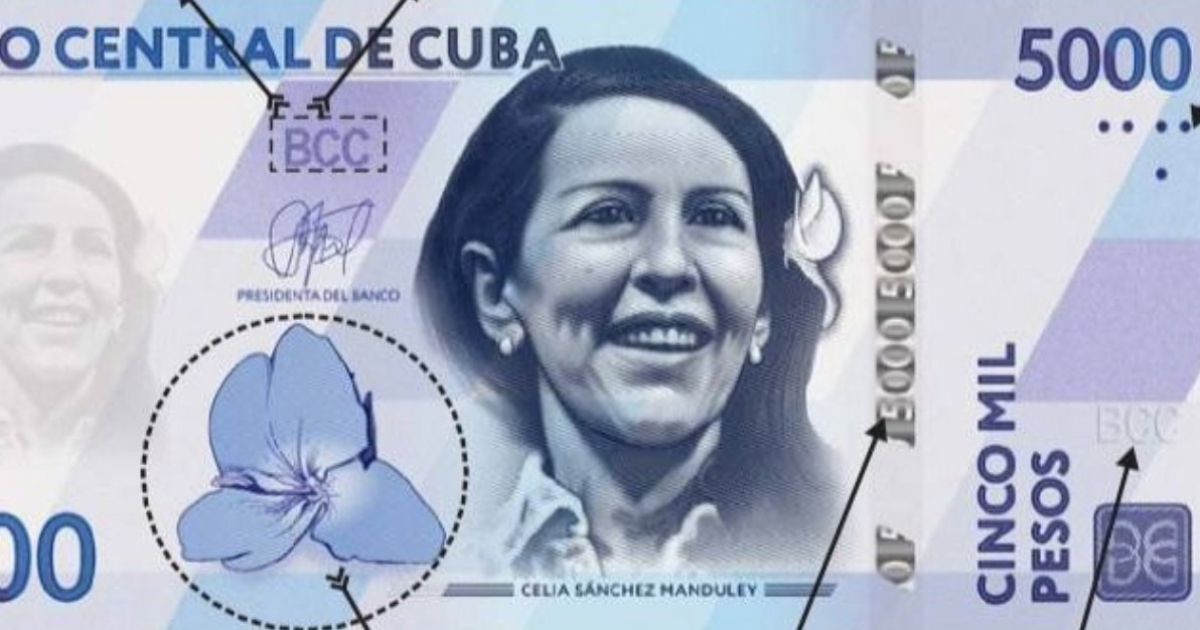
The Central Bank of Cuba has unveiled new high-denomination banknotes—2,000 and 5,000 Cuban pesos—in an overt acknowledgment of the peso's diminishing purchasing power following years of relentless inflation.
Starting this Wednesday, the initial batch of 5,000 peso notes will begin circulating in Havana and will gradually be introduced across the country. The 2,000 peso notes will also be rolled out progressively, although the bank has not specified an exact date, promising to announce it "in due course."
The bank justified this move as a way to "ease cash transactions, meet the real economic needs demanding large cash amounts, reduce the costs associated with cash logistics, and enhance transaction efficiency amid the current inflationary period."
Historical Change in Cuban Currency Design
This issuance marks a historic shift in Cuban currency design, featuring images of female patriots for the first time, printed with high-relief techniques. The 2,000 CUP note showcases Mariana Grajales Cuello, known as the "Mother of the Homeland," while the 5,000 CUP note features Celia Sánchez Manduley. The 2,000 CUP note is predominantly violet and pink, and the 5,000 CUP note is blue. Each note includes a watermark of the respective patriot and an electrotype indicating the denomination.
The bank notes are printed on special security paper that adheres to international standards, measuring 150 by 70 millimeters. A vertical security thread with a movement effect, displaying the BCC initials and the note's denomination on the front, is integrated into the right side of the paper. The denomination is also printed in letters at the bottom center.
Design and Security Features
Additionally, the notes incorporate the national flower of Cuba, the butterfly, which exhibits a rainbow motion effect when viewed from different angles. The reverse of the 2,000 CUP note includes the monument to Mariana Grajales at Santa Ifigenia Cemetery, while the 5,000 CUP note features the Celia Sánchez Memorial in Lenin Park. Visually impaired individuals can identify these notes by feeling the upper right corner.
This decision has been met with criticism and mockery on social media, seen as a superficial measure that fails to tackle the underlying causes of the nation's economic woes.
Economic Context and Challenges
The 1,000 peso note, previously the highest denomination, currently holds a value of less than two dollars on the informal market, where the peso trades at 510 CUP per dollar—a 47.8% depreciation from the 345 CUP per dollar rate in March 2025. This month, the euro hit a record high of 575 CUP on the informal market, and the Central Bank had already adjusted its official rate to 455 pesos per dollar in February without halting the decline.
According to the National Office of Statistics and Information, official inflation concluded in 2025 at 14.07%, but independent economists estimate actual inflation for basic goods is around 70% year-over-year. Cuba's GDP fell by 5% in 2025, marking the third consecutive year of contraction with a cumulative decline exceeding 15% since 2020.
It's worth noting that in 2023, the government had explicitly denied any plans to issue high-denomination bills. The current situation is exacerbated by many Cuban businesses rejecting lower denomination notes, highlighting the severe distortion in the island's monetary system.
Frequently Asked Questions about Cuba's New Banknotes
Why has Cuba introduced 2,000 and 5,000 peso banknotes?
The Central Bank of Cuba introduced these new denominations to facilitate cash transactions and address the economy's need for large cash volumes amid ongoing inflation.
What are the security features of the new Cuban banknotes?
The new banknotes include a vertical security thread with movement effects, a watermark of the featured patriot, and a rainbow motion effect on the national flower image when viewed at different angles.
Who are the historical figures featured on the new banknotes?
The 2,000 peso note features Mariana Grajales Cuello, and the 5,000 peso note features Celia Sánchez Manduley, both significant figures in Cuban history.