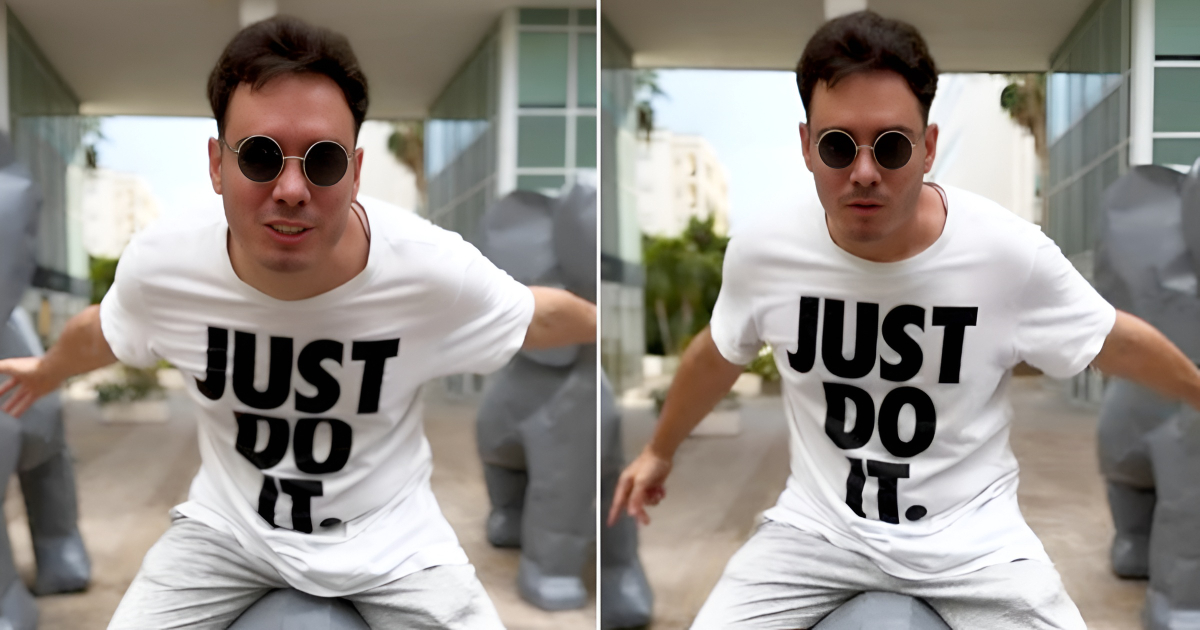
Sandro Castro is not a random occurrence. Nor is he an unknown figure who suddenly decided to flaunt his lifestyle on social media. He comes from a distinct lineage, with ties to the current Cuban landscape.
This self-styled "businessman" and fashionable influencer, often dubbed the "king of the night" or "prince of darkness," is the son of Alexis Castro Soto del Valle, a descendant of the late dictator Fidel Castro. Raised within the protected circle of an elite that preached austerity while living in luxury, Sandro Castro has become a notable figure.
He holds no public office or visible political duties. His role is that of an heir unaccountable to the public, gaining notoriety through his antics on Instagram.
The Role of Independent Media in Shaping a Persona
Sandro Castro's prominence isn't solely due to his actions but rather how he's been portrayed. Before making headlines, traces of his social media presence surfaced in May 2019, thanks to independent journalist Mario Vallejo. Although verifying the original post has become challenging, it marked the beginning of media attention.
By September 21, 2019, Diario de Cuba published the first verifiable piece on Sandro Castro, highlighting a video where he filled up his car's tank, thanking God amid a fuel crisis. This showcased his privilege and disconnection, with an audacity both natural and provocative.
Later that year, on November 2, CiberCuba reported on Sandro dressed as Batman for Halloween, a seemingly trivial story that signaled his transition from a mere anomaly linked to the Castro name to a media fixture.
The Turning Point: From Anomaly to Narrative
The defining moment came on February 27, 2021, with the infamous Mercedes-Benz video cementing his public image. Sandro Castro transformed from a sporadic news item into a continual narrative. It wasn't just about his actions; it was about what he symbolized every time he appeared.
Independent Cuban media, led by CiberCuba, amplified each of his gestures into a broader story: parties, videos, statements, and displays. There wasn't a groundbreaking event behind every headline, but a pattern of repetition that wasn't neutral. It selected, amplified, and framed.
Sandro Castro became a recurring symbol of privilege amid crisis, a representation of an elite disconnected from the real Cuba, a constant provocation to the average Cuban.
International Media and the Broader Implications
As international media like El País, The New York Times, and CNN began to cover him, they presented Sandro as an influencer embodying the contradictions of late-stage Castroism. However, his notoriety wasn't born from international coverage; it was the result of years of being crafted into a recognizable figure within Cuba's independent media ecosystem.
This raises inevitable questions: what exactly is Sandro Castro? Is he an outsider mocking the system from within, or a figure tolerated by the regime because he channels frustration without threatening their power?
The truth likely lies somewhere in between. From a media perspective, however, Sandro Castro functions effectively as a symbol of inequality, as content, and as a narrative shortcut to explain complex realities in a single image: a name, a persona, a camera, and a country behind it.
The Consequences of Media Focus
For years, the Cuban independent press has rightly exposed the contradictions embodied by Sandro Castro. But in doing so, they have also solidified his status as a stable, recognizable, and exportable character.
In a country grappling with profound crises—economic, social, political—the prominence of a figure like Sandro Castro reduces the space for other stories that might better explain what's happening in Cuba.
While the nation's reality fragments into stories of blackouts, repression, and exodus, Sandro Castro maintains a constant, almost unavoidable media presence. It's not just about what he shows, but what he displaces: other voices, other conflicts, other urgencies.
This displacement occurs at an especially sensitive time. With growing pressure from the United States on the regime and opaque discussions about a potential transition, the sustained presence of figures with the Castro surname—albeit with a more discreet or "normalized" image—becomes significant.
Sandro Castro, with his mix of frivolity, constant exposure, and ambiguous discourse, fits into this blind spot. He doesn't represent a rupture but doesn't fully embody the classic language of power.
Ultimately, beyond his actions or words, Sandro Castro's repeated presence in the media could be contributing—consciously or not—to something deeper: the symbolic erosion of the Castro name and its potential reintroduction in a scenario of change under "cleaner," less confrontational, more exportable forms.
Thus, the question shifts from being a media reflection to a political concern. It's no longer just about why Sandro Castro is talked about so much, but what purpose it serves.
Understanding Sandro Castro's Influence in Cuban Media
Why has Sandro Castro become a significant figure in Cuban media?
Sandro Castro's significance stems from how independent media in Cuba have portrayed him over the years, amplifying his actions and presence as a symbol of privilege and disconnection from the reality of ordinary Cubans.
What role does international media play in Sandro Castro's narrative?
International media have confirmed Sandro Castro's notoriety by presenting him as an influencer embodying the contradictions of the Cuban regime, thereby cementing his status as a recognizable figure worldwide.
How does Sandro Castro's presence impact the coverage of other Cuban issues?
His media presence often displaces other important stories and voices in Cuba, drawing attention away from the country's deeper issues like economic hardship, political repression, and social crises.