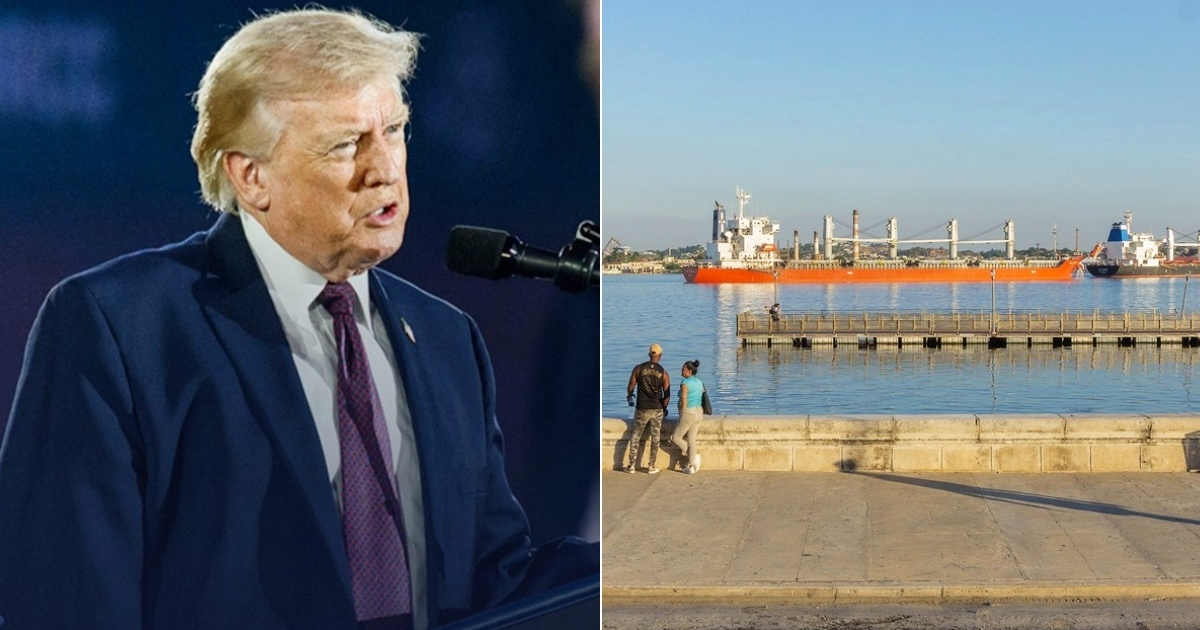
The arrival of a Russian oil tanker in Cuba this past Monday, amidst the energy pressure strategy driven by Donald Trump's administration, has sparked discussions among some observers who see it as a potential easing or contradiction of U.S. sanctions.
However, Eric Martin, a journalist from the U.S. State Department, argues quite the opposite.
In a bold statement on social media platform X, Martin asserted that allowing the Russian oil does not undermine Washington's strategy but rather strengthens it.
"Trump permitting the Russian tanker to dock in Cuba does NOT challenge the U.S. quarantine," he declared.
He further solidified this stance by stating emphatically, "It CONFIRMS it."
According to Martin, the critical element lies in who genuinely controls the energy supply to the island.
Control Over Cuba's Energy Resources
"The only oil reaching Cuba is what the United States authorizes," Martin emphasized.
The journalist expanded on this by linking the event to a broader strategy he had previously outlined in a Bloomberg article.
"As I predicted a month ago: The plan is for the United States to become Cuba's new protective state...," he reiterated.
These comments come after Martin disclosed—citing his own sources—that Washington approved the Russian oil shipment only after a concession from the Cuban regime regarding the U.S. embassy in Havana.
Reportedly, Havana agreed to import fuel for the diplomatic mission, a move—yet unconfirmed officially—that Martin described as "an important action indicating that Havana is, albeit slightly, cooperating."
Strategic Economic Protectorate
Martin's interpretation ties into a wider analysis he published in Bloomberg weeks ago, where he detailed a Trump administration strategy aimed at making Cuba financially dependent on the U.S.
According to sources in that report, the goal isn't direct military intervention but a gradual process based on economic pressure, energy isolation, and negotiations with actors within the Cuban system.
The plan, as these sources suggested, is for the U.S. to "essentially replace the former Soviet Union, which kept Cuba afloat until its collapse in 1991."
Trump hinted at this vision in recent statements, suggesting that "Cuba will fall very soon" and claiming "Cuba is ready, after 50 years."
Conditional Oil Shipment Amid Crisis
The Russian tanker Anatoly Kolodkin, sanctioned by the U.S., EU, and UK, arrived on March 30th with over 700,000 barrels of crude—the first major supply in over three months.
Trump confirmed the decision to allow the operation, stating, "If a country wants to send some oil to Cuba, I have no issue with that."
He justified the action on humanitarian grounds while maintaining his critical stance on the Cuban government: "Cuba is finished. They have a bad regime... very bad and corrupt leadership."
Despite the shipment's immediate impact, experts warn the volume would only sustain about two weeks of consumption amid prolonged blackouts and a structural energy crisis.
Energy Pressure with Controlled Access
Far from signaling a complete policy shift, the event fits into a broader strategy: restricting the Cuban government's access to oil while maintaining the ability to authorize supplies under specific conditions.
Since January, the White House has escalated economic pressure on Havana, including a "quarantine" on oil intended for the state while allowing limited sales to the emerging private sector.
In this context, the selective approval of the Russian shipment strengthens the notion that Washington aims to manage Cuba's energy flow rather than entirely block it.
Although speculation about possible military intervention has circulated in Washington—fueled by statements from figures like Senator Lindsey Graham, who claimed "Iran will fall, and Cuba is next"—insiders assert that this isn't the preferred approach.
According to former officials like Kimberly Breier, the focus is on a gradual transition to avoid chaos.
"The administration wants changes but not chaotic ones that spur massive migration or create more room for adversaries," she explained.
In this framework, the arrival of the Russian tanker isn't seen as a contradiction but as another component in a scheme where Washington seeks to manage—rather than simply cut off—Cuba's access to energy resources.
This dynamic, as Eric Martin warns, might be redefining bilateral relations under a key principle: the oil reaching Cuba is ultimately what the United States decides to permit.
Understanding the U.S. Energy Strategy in Cuba
Why does Eric Martin claim that allowing Russian oil to Cuba aligns with U.S. strategy?
Eric Martin believes that allowing the Russian oil shipment actually strengthens the U.S. strategy by reinforcing control over which energy supplies are permitted to reach Cuba, maintaining pressure on the Cuban government.
What is the broader strategy of the Trump administration towards Cuba?
The Trump administration's strategy is to make Cuba financially dependent on the U.S. through economic pressure and energy isolation, without direct military intervention, aiming for a gradual transition.
How does the U.S. manage energy supply to Cuba?
The U.S. manages Cuba's energy supply by imposing a "quarantine" on oil for the state while allowing limited supplies under specific conditions, thereby controlling the energy flow rather than completely blocking it.